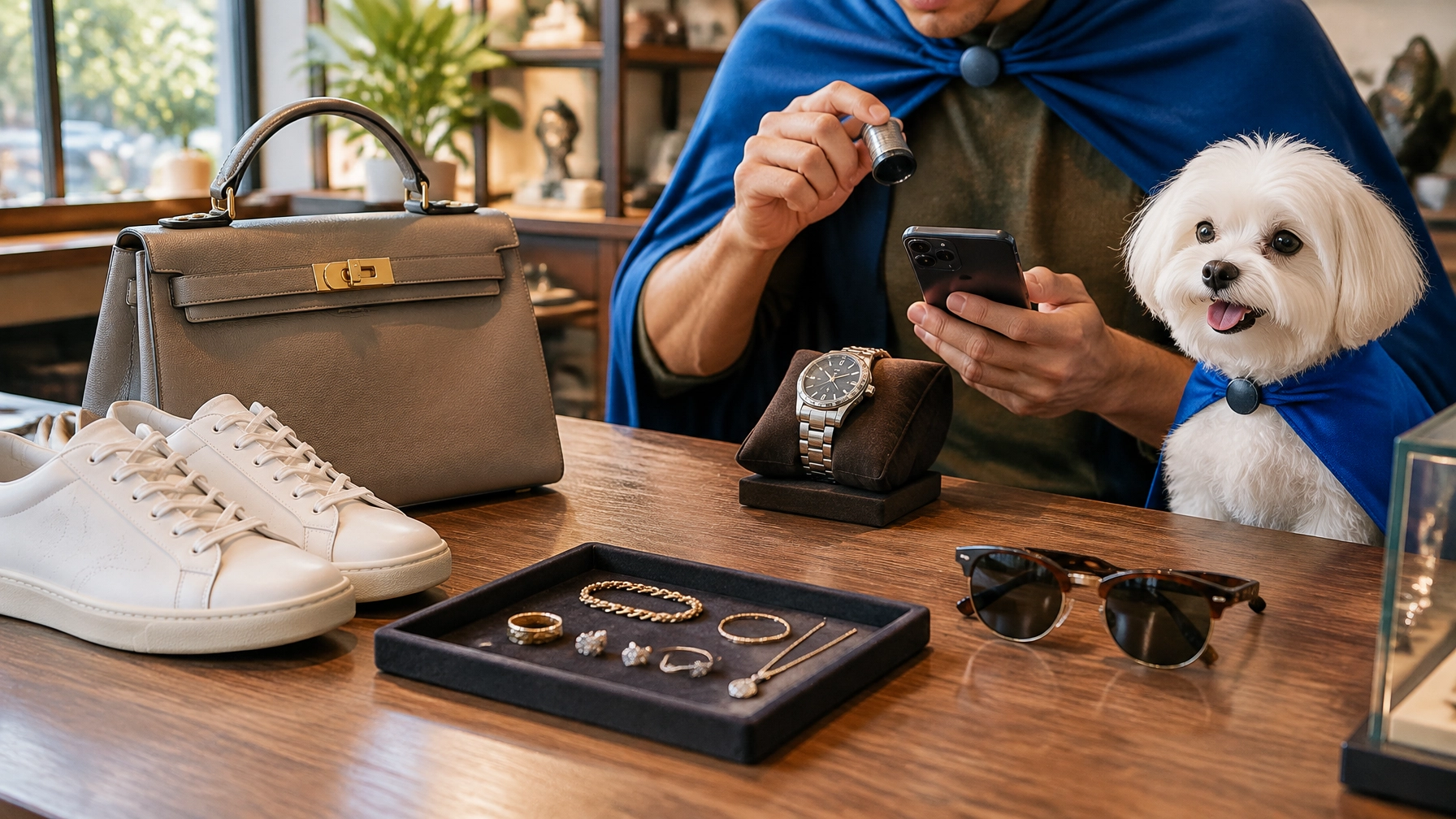
A busy intake day can put five very different authentication challenges on the counter. One seller has a designer-style bag. Another brings a watch that “just needs a new battery.” Sneakers arrive in a familiar-looking box. Jewelry and sunglasses follow before the afternoon rush.
This is a fictional walkthrough, not a report about a real shop or seller. The point is practical: each category calls for a different screening routine, and no single detail proves an item is authentic.

Five categories, five different screening routines. Every item here is fictional and unbranded.
9:05 a.m. The handbag with a convincing story
The seller says the bag was a gift and includes a dust bag and card. Those details may be useful context. They are not proof. Packaging and documents can be copied, and genuine packaging can be paired with a different item.
Start with the bag itself:
- Compare its overall shape and dimensions with a reliable reference for the specific model and era.
- Check logo placement, letter spacing, interior labels, and stitching for consistency.
- Examine corners, lining, seams, zippers, feet, clasps, and other hardware.
- Photograph serial, date, or model markings, then check whether they make sense for the item. A code alone is not a verdict.
- Ask about purchase history and record the seller’s explanation without treating a confident story as authentication.
A mismatch is a reason to pause and investigate, not to make a snap judgment. Some genuine items show wear or repairs. Some counterfeits copy details well.

10:40 a.m. The watch that “only needs a battery”
The watch looks polished, but the seller cannot identify the model. A familiar silhouette or engraved serial number can create false confidence. Compare details as a group:
- Dial printing, spacing, hands, date window, bezel, and crown
- Caseback, reference and serial markings
- Bracelet links, clasp, finish, and overall fit
- Weight and dimensions against a dependable model reference
Look for inconsistencies between the watch’s parts and its claimed model or production period. If the case needs to be opened or the movement checked, do not improvise. Refer the watch to a qualified watchmaker or appropriate specialist. Record what you observed and keep the item on hold if the evidence is inconclusive.
12:15 p.m., Sneakers with the right-looking box
The shoes and box appear to match. That is a useful thing to verify, but it is not enough: packaging can be switched, and labels can be copied.
Compare the shoe and packaging together:
- Check the SKU or style code on the box and shoe labels for consistency.
- Compare the silhouette, panel shapes, materials, colorway, stitching, and branding with a reliable reference.
- Inspect the outsole pattern, insole, glue and finish, and size or factory labels.
- Note spelling mistakes, irregular markings, or details that differ from the claimed model.
A code lookup, box label, or tidy finish cannot independently settle the question. If the model or colorway is unfamiliar, take clear photos and escalate rather than relying on memory.
1:30 p.m., Jewelry with a tiny hallmark
A small stamp can look reassuring under a loupe. But marks can be copied, and a hallmark by itself does not establish metal content, maker, or authenticity.
Inspect the piece as a whole:
- Look at hallmark and maker-mark placement, clarity, and consistency.
- Check the setting, prongs, clasp, solder points, and symmetry.
- Note plating wear, unusual construction, and whether the piece’s weight and materials fit its description.
- Use suitable testing equipment only if staff are trained to do so. For valuable or unfamiliar pieces, involve a qualified jeweler or appraiser.
Do not let a stamp substitute for a proper examination. Keep the seller’s description, photos, and any testing notes together with the intake record.

3:10 p.m., Sunglasses that pass a quick glance
The frames look familiar, but a quick look at the logo is not a reliable screen. Compare the model number and markings on the arms with a trusted reference. Then check:
- Frame symmetry, hinge construction, finish, and material quality
- Logo style and placement, plus the clarity and consistency of model markings
- Lens markings and overall lens quality
- Whether the included case and accessories fit the claimed model
Blurry or inconsistent markings, poor construction, or a mismatch with the reference should trigger a closer review. They do not prove a fake on their own. When in doubt, document the item and get qualified help before accepting it as authentic.
4:00 p.m., Reset the counter and review the evidence
By late afternoon, the useful question is not, “Did I spot the one giveaway?” It is, “Do the item, its details, its history, and its reference checks all make sense together?”
Use a consistent intake routine:
- Record the transaction and seller information as required by your local rules.
- Ask for provenance and note the explanation. Treat receipts, boxes, cards, and online lookups as supporting information, not final proof.
- Photograph identifying details: overall views, labels, serial or model markings, hardware, stitching, soles, lenses, and packaging.
- Compare with reliable references for the specific model. Do not rely on memory alone.
- Pause and escalate when the item is high-value, unfamiliar, inconsistent, or still uncertain.
- Keep the item out of sale or lending inventory until the review is complete. Follow applicable laws and store policy.
The goal is a fair, repeatable decision, not an accusation. Border seizure figures can help explain why careful screening matters, but they are not a measure of how many counterfeit items appear at pawn shops. For context, U.S. Customs and Border Protection reported more than 78 million counterfeit goods seized in FY2025, with estimated genuine retail value above $7.3 billion. Its figures describe border seizures, not the prevalence of fakes in any individual store. See the CBP FY2025 IPR seizure fact sheet.
When a second opinion is the right call
A good intake check can identify reasons to stop. It cannot turn every uncertain item into a confident yes or no. That is where a structured review can help.
Authenticate Pro’s Patented ACE approach is built around Authentication · Community · Experts. AI supports the review, and authentications move to human experts for further evaluation. Authenticate Pro reports: “Based on the last 2,000 authentications, Authenticate Pro boasts a 99% accuracy conclusion.” That is the company’s reported claim, not a guarantee that any individual item is authentic.
For resale businesses, an independent review can help staff make a more informed intake decision and give customers a clearer answer to the question they ask at the counter: “Is this real?”
Make uncertainty part of your process, not your inventory
One rushed decision can cost money and customer trust. A documented screen, a consistent hold process, and expert escalation give your team a better path when details do not line up.
Learn more about Authenticate Pro for resale stores or visit authenticatepro.app. For questions, call 800-395-7172.
Leave a Reply