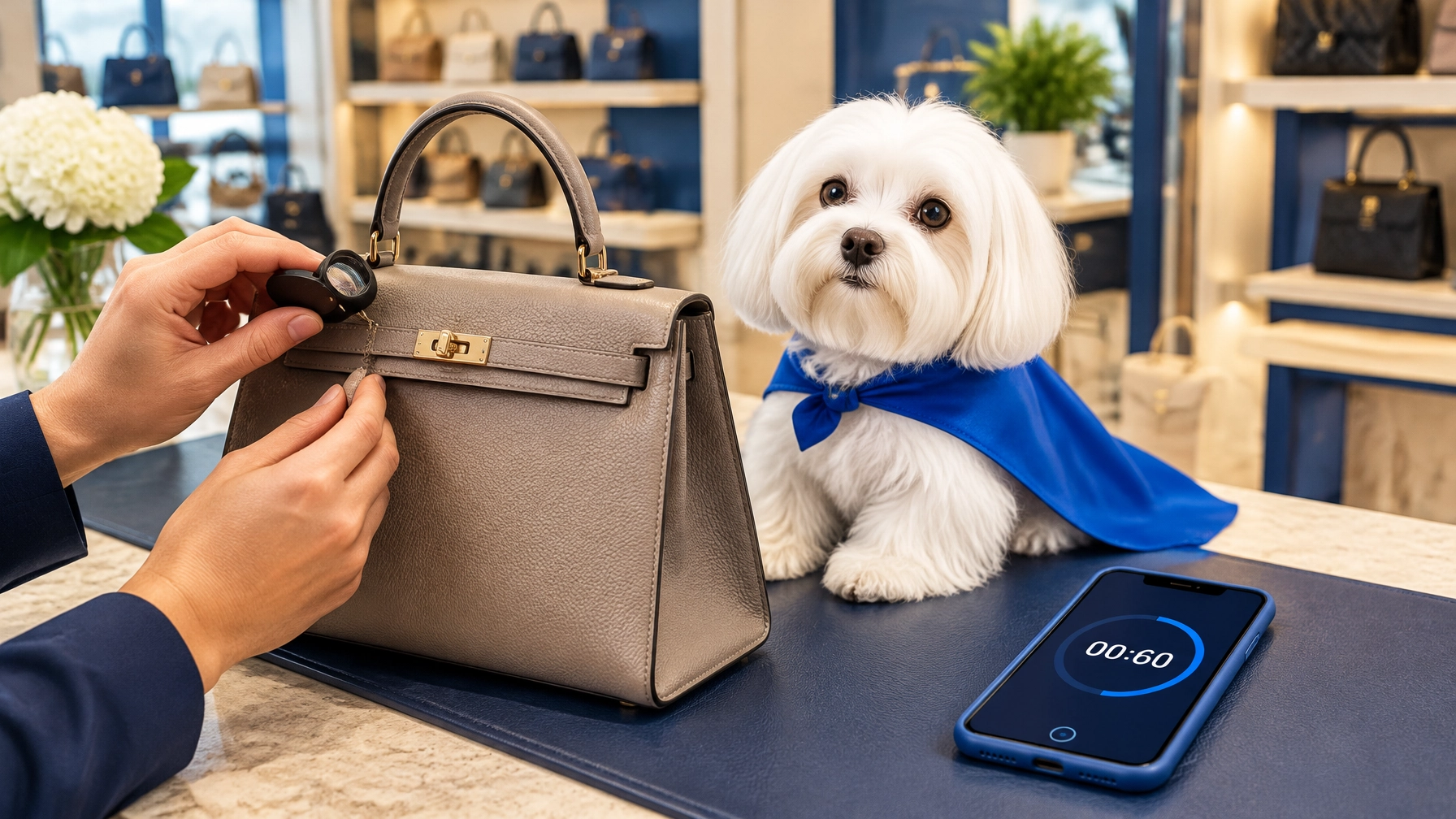
A 60-second intake check won’t prove an item is authentic. It can help your staff catch obvious red flags, gather useful evidence, and make a safer next move before your store buys or consigns a designer item.
The key is consistency. Give every staff member the same quick routine, and make one rule clear: if the item is uncertain, pause and escalate. Don’t guess.
That matters at the front counter, where a rushed purchase can turn into a costly return, a customer dispute, lost inventory dollars, or damage to your store’s reputation.
The 60-second routine: Pause, inspect, decide
Use this as a first-pass screen, not a final authentication. Have staff inspect the item in good light and handle it carefully. Don’t clean, alter, or remove anything during intake.
0–10 seconds: Pause and ask
Get a short, consistent account of the item’s history:
- Where and when did the seller acquire it?
- Is there a receipt, service record, or previous resale record?
- Are any accessories or packaging included?
Note what the seller says. A receipt or dust bag can support the history, but neither proves authenticity on its own. A missing receipt doesn’t prove an item is fake, either.
Watch for details that don’t fit: an unclear story, pressure to complete the deal immediately, or several new luxury items with no plausible explanation. Treat these as reasons to slow down, not grounds to accuse the seller.
10–25 seconds: Check the overall design
Look at the item as a whole. Does its shape, size, panel layout, pocket placement, and hardware appear consistent with the specific model and era the seller describes?
A familiar logo isn’t enough. Counterfeits can copy visible branding. Look for a mismatch between the item’s design details and the claimed model.
25–40 seconds: Inspect construction and materials
Check a few areas quickly:
- Stitching and seam alignment
- Edges, corners, handles, and attachment points
- Material texture, structure, and lining
- Hardware finish, engraving, and operation
Uneven stitching, rough finishing, or hardware that looks wrong may be reasons to escalate. But no single detail confirms a fake. Genuine items vary, and repairs or wear can affect appearance.
40–50 seconds: Review marks and accessories
Check labels, stamps, codes, tags, cards, and included accessories for placement and consistency. Compare them with reliable information for that specific product where available.
Don’t authenticate from a serial number, date code, QR code, card, receipt, or package alone. A plausible-looking identifier is only one piece of evidence, not proof that it belongs to the item.
50–60 seconds: Choose the next step
Make one of three decisions:
- ✅ Routine intake: Nothing raises a concern, and the item fits your staff member’s level of experience. Follow your store’s normal review and documentation process.
- ⏸️ Hold for review: Something doesn’t match, the history is unclear, or the staff member lacks experience with that brand or category.
- ❌ Do not proceed: A serious concern remains after review. Follow your store’s written policy for declining or managing the item.
When in doubt, hold, not buy, consign, or list until it has been reviewed.

Give staff a clear escalation rule
A quick screen is useful because it tells your team when to stop. It isn’t a substitute for professional authentication, especially for high-value items, unfamiliar models, or anything with conflicting details.
Train staff to escalate when:
- Any important detail doesn’t match the claimed model.
- The item is outside their brand or category experience.
- The seller’s account and the item’s condition raise questions.
- One employee’s assessment differs from another’s.
- The item’s value makes a mistake especially costly.
Use a simple staff phrase: “I can’t confirm this at intake, so we need to pause for a specialist review before making a decision.” It’s respectful, clear, and doesn’t accuse the seller.
For a second opinion, Authenticate Pro’s process can move an item to human experts. The company reports about 99% accuracy based on its last 2,000 authentications; that’s a reported overall result, not a guarantee for an individual item. For details about the service and available options, see Authenticate Pro’s membership information and pricing.
ACE means “Authentication · Community · Experts”. In practice, that means your team can flag concerns and send uncertain items for expert review rather than being expected to make a high-stakes call from a quick glance.
Train the team in one short session
You don’t need a day-long seminar to establish a better intake habit. Set aside 20 minutes and run the same exercise with your whole front-counter team.
- Set the boundary: 3 minutes. Explain that the 60-second routine is a screening tool, not a final authentication. Emphasize that “I’m not sure” is a valid outcome.
- Demonstrate: 5 minutes. Walk through the five timed steps on a sample item. Show staff how to record what they observe without treating one detail as proof.
- Practice: 8 minutes. Have each person run the routine on an item or a set of clear intake photos. Ask them to identify a concern, say what they would document, and choose whether to proceed or escalate.
- Rehearse the handoff: 4 minutes. Practice the staff phrase, explain who handles the next review, and confirm where to hold the item and its intake notes.
Finish by posting the checklist near the intake area. Review a few real, resolved cases at team meetings so everyone can learn from outcomes. Keep the lesson practical: don’t memorize a shortcut that supposedly catches every fake; learn to notice inconsistencies and follow the escalation process.

Document the decision, and protect customer trust
For each designer item, record the seller’s account, the staff member’s observations, any concerns, and the decision or escalation. Take clear intake photos when appropriate, including the overall item and details relevant to your review. Keep records according to your store’s procedures and applicable requirements.
This is more than good housekeeping. Knowingly trafficking in counterfeit goods can carry serious legal consequences under 18 U.S.C. § 2320. Legal exposure depends on the facts and applicable law; this article is not legal advice. A consistent process also helps your team respond calmly if a seller or buyer later questions a decision.
And it can strengthen the customer experience. Clothes Mentor Reno described the value of its authentication service as providing “great peace of mind to our staff and customers.” That confidence starts with a team that knows when to pause and ask for help.
Make “not sure” a safe answer
A counterfeit can cost more than the purchase price. It can lead to refund disputes, lost staff time, unhappy customers, and reduced confidence in your store. One minute can help your team spot warning signs, but professional review is the right next step when the evidence is uncertain.
Want to build an authentication step into your store’s intake process? Contact Authenticate Pro or call 800-395-7172 to discuss options for your business.
Leave a Reply