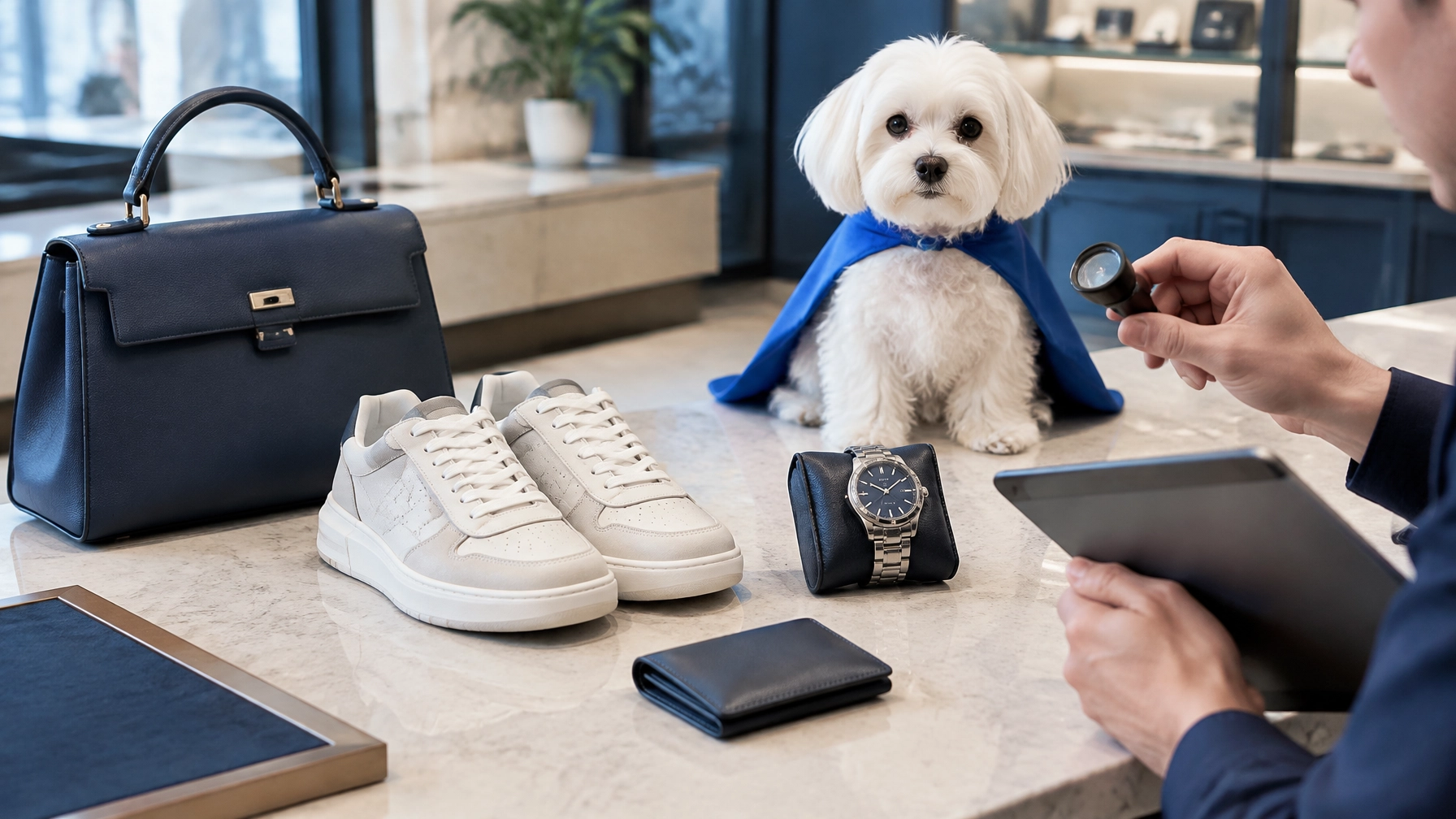
A customer is waiting. You have seconds to decide whether to make an offer, and one wrong call can cost your shop money, inventory space, and customer trust.

Designer handbags, sneakers, watches, and luxury-branded small leather goods are common counterfeiting targets. A quick visual check can catch obvious problems, but no single stitch, serial number, receipt, or box proves an item is genuine. Treat intake as a screening process, document what you see, and escalate uncertainty before you commit.
Start with a fast intake screen
Before examining the item, ask a few practical questions:
- Who owns it, and where did it come from?
- Can the seller provide required identification and transaction information?
- Does the seller’s account make sense for this item?
- Is the price or urgency unusual?
- Are there several identical, supposedly new items?
Inconsistent explanations, refusal to provide required information, or an unusually low price are reasons to slow down. They are risk signals, not proof that an item is counterfeit. Follow your local pawn requirements and shop policy.
Next, photograph the item before making an offer. Capture the exterior, interior, labels, hardware, soles or movement details as relevant, and any serial or reference markings. Record the seller’s account and the item’s condition. A second reviewer can only help if they can see what you saw.

1. Designer handbags
Handbags can look convincing at a glance. Slow down and check how the parts fit together.
At the counter, inspect:
- Logo and lettering: Compare shape, spacing, alignment, and embossing against reliable information for that model.
- Stitching: Look for skipped, uneven, loose, or visibly inconsistent stitches.
- Materials and construction: Check the feel and finish of the exterior, lining, edges, seams, and handles.
- Hardware and zippers: Note the finish, weight, movement, engraving, and how the hardware is attached.
- Codes and labels: Check whether markings are placed where expected and make sense for the model and production period.
Crooked stitching, misspellings, fuzzy engravings, and poor materials can raise concern. But a clean finish is not proof of authenticity. Nor should you reject an item solely because a code is absent: formats and features vary by brand, model, and age.
Brand guidance supports caution. CHANEL warns shoppers about low prices and errors in details such as stitching, spelling, and logos. Givenchy advises buying through official channels and checking product details. These are useful reminders, not a complete authentication manual.
2. Sneakers
Sneakers are easy to inspect in pairs. Use that to your advantage: compare left and right before judging either shoe on its own.
Check:
- Tongue labels and product codes: Look at the style, size, and production information. Compare it with the box label, if present.
- Pair consistency: Check that both shoes match in color, material, construction, and markings.
- Shape and details: Inspect logo placement, stitching, sole pattern, and finishing.
- Box and accessories: Look for mismatched labels, poor print quality, or packaging that seems inconsistent with the shoes.
A tag or UPC that conflicts with the shoe is a reason to pause. So are visibly uneven stitching, peeling labels, or materials that feel unusually flimsy. But boxes can be swapped, and packaging alone cannot settle the question.
3. Watches
A watch may carry more value, and more risk, than a quick counter glance can support. Check the visible details, but do not open a watch unless a qualified person is handling it.
Screen the exterior:
- Compare the dial lettering, alignment, and spacing.
- Inspect case, bracelet, clasp, crown, and engravings for rough or inconsistent finishing.
- Check whether the reference and serial information appear consistent with the model.
- Note unusual looseness, poor fit, or a date display that looks misaligned.
A watch that feels unexpectedly light or has fuzzy dial printing deserves a closer look. These are clues, not a verdict. Internal movement checks require expertise; opening a watch can damage it or affect water resistance.
4. Small leather goods and accessories
Wallets, cardholders, belts, sunglasses, and branded accessories may seem like lower-risk purchases. They still need a careful screen, especially when markings or branded hardware are part of their value.
Check logo placement, lettering, stitching, edge finishing, lining, hardware, and overall construction. Compare the item with reliable brand information for the specific style, not just a different product from the same brand.
Pay attention to combinations of inconsistencies. A questionable logo plus poor stitching and mismatched materials deserves more scrutiny than one minor imperfection alone. Receipts, dust bags, boxes, and authenticity cards can support an item’s history, but they can also be separated from it or copied. Treat accessories as context, not proof.
A fast “accept, hold, or decline” decision
Use a simple shop-floor rule:
- Accept for further evaluation: Your screen raises no concerns, required seller information is in order, and the item meets your shop’s risk and value limits.
- Hold and escalate: The item is high-value, a detail conflicts, the seller’s story is unclear, or staff are unsure. Do not make an offer or list it until the concern is resolved.
- Decline: Required information is missing, significant inconsistencies remain, or the item cannot be responsibly authenticated.
The goal is not to authenticate every luxury item in seconds. It is to know when not to guess.
Put a documentation habit in place
When something needs a closer review:
- Keep the item identifiable and separate from verified inventory.
- Save intake photos, notes, seller details, and any review results according to your shop policy and local requirements.
- Record exactly what triggered the hold. “Logo spacing differs from reference” is more useful than “looks fake.”
- Do not resell or alter a suspected counterfeit. Ask the appropriate professional, brand, legal adviser, or local authority about next steps.
For more context, U.S. Customs and Border Protection recommends checking seller information and being wary of prices that seem too good to be true. Its guidance is not a pawn-counter authentication standard, but it reinforces the value of careful screening.

When a visual screen isn’t enough
How many times a week does a customer ask, “Is this real?” A consistent escalation process helps staff answer carefully instead of relying on confidence alone.
Authenticate Pro, Inc. authenticates luxury items. When authentication is escalated to human experts, the process aims for approximately 99% accuracy. That review can give your team a more informed basis for a decision when a high-value item or uncertain detail needs extra attention.
Learn more about Authenticate Pro, review membership information, or see pricing.
The counter rule to remember
Inspect the item. Check the story. Document the details. Escalate what you cannot verify.
A fast screen can catch obvious red flags. A careful process protects your offer, your inventory, and the trust customers place in your shop.
Leave a Reply