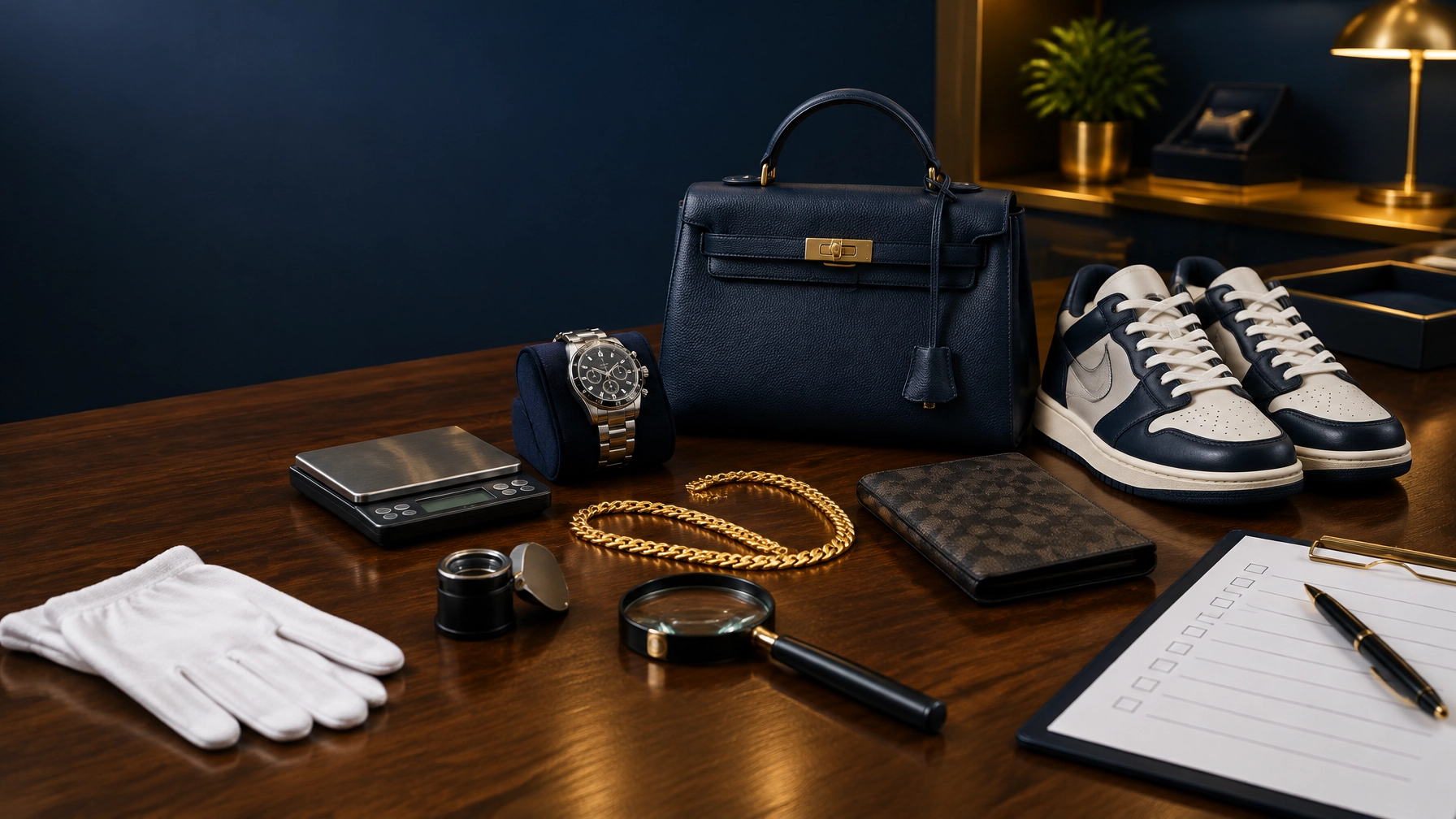
How many times a week does a customer ask, “Is this real?”
For pawn shops, the risk is not limited to one category. Counterfeit luxury items move through every part of the resale market. Some are obvious. Others are superfakes built to pass a quick visual inspection.
A bad intake can mean:
- Lost loan or purchase money
- Chargebacks and returns
- Damaged customer trust
- Reputational harm
- Inventory that cannot legally or profitably be resold
The answer is a consistent pawn shop authentication process. Start with a staff checklist. Escalate high-risk items. Never rely on price, packaging, or one serial number alone.
Important: These checks are screening tools, not proof of authenticity. Brand details vary by model, year, and production run. When the stakes are high, use professional authentication.
The five categories most likely to raise counterfeit concerns
- Designer handbags
- Luxury watches
- Limited-edition sneakers
- Gold and fine jewelry
- Branded small leather goods
Before examining the item, inspect the transaction itself.
Start with the story and the price
Ask:
- Is the price far below market value?
- Is the seller applying unusual pressure?
- Does the seller’s ownership story make sense?
- Are receipts, cards, or original accessories available?
- Do the documents match the item?
A low price does not prove a counterfeit. A good story does not prove authenticity. These are risk indicators that tell your team how carefully to proceed.

1. Designer handbags: inspect construction, not just the logo
Louis Vuitton, Gucci, and Chanel handbags are frequent targets because demand is high and many models retain resale value.
A quick logo check is not enough. Counterfeiters can reproduce a logo while missing the construction details.
Handbag counterfeit detection checklist
Check the materials
- Does the canvas or leather feel substantial?
- Is the finish consistent across panels?
- Does the lining match the expected model?
- Is there a strong chemical or plastic odor?
Check the stitching
- Are stitches even and tightly spaced?
- Are there loose threads or skipped stitches?
- Do seams align across pockets, handles, and panels?
- Does the stitch quality remain consistent in high-stress areas?
Check the pattern and logo
- Are monograms aligned across seams?
- Are logos cut off in places where they should not be?
- Is the interior stamp centered and correctly formed?
- Are the font, spacing, and letter shapes consistent with the brand?
Check hardware
- Does the hardware feel solid rather than hollow or lightweight?
- Are engravings crisp and correctly spaced?
- Is the finish even?
- Is there peeling, flaking, or rough metalwork?
Brand-specific points for staff
Louis Vuitton
Older items may have date codes. Newer items may use embedded identification technology instead. A code or chip is only one data point. Counterfeit bags can include copied codes or inserted tags.
Pay close attention to:
- Monogram alignment
- Handle construction
- Thread color
- Stitch consistency
- Hardware weight and engraving
- Interior lining and stamp placement
Louis Vuitton provides information about its anti-counterfeiting efforts through its official brand protection page.
Chanel
Inspect quilting alignment, chain construction, interior stamping, hardware, and serial or identification details for the specific model and production period.
Gucci
Check the interior label, font, spacing, leather quality, stitching, hardware, and model-specific details. Do not assume a matching dust bag or box is genuine. Packaging can be counterfeit too.
Staff rule: If the bag passes a visual screen but has meaningful resale value, escalate it before purchase or loan approval.
2. Luxury watches: the movement matters
Rolex and Omega watches are among the highest-risk items a pawn shop can accept. High-quality replicas can look convincing from the outside.
The most important question is not, “Does the dial look right?”
It is:
Does the watch contain the correct movement and construction for that exact reference?

Luxury watch authentication checklist
Dial and hands
- Is the printing crisp and correctly spaced?
- Are hour markers aligned?
- Is the lume applied evenly?
- Does the date window, magnification, or complication match the model?
Case and bracelet
- Are polished and brushed surfaces sharply defined?
- Does the bracelet feel solid?
- Are links tight and properly finished?
- Is the watch unusually light?
- Are edges rounded where they should be precise?
Serial and reference details
- Are the numbers in the correct location?
- Do the format and engraving quality match the claimed production period?
- Do the numbers match the papers and warranty card?
- Are there signs of polishing, tampering, or re-engraving?
Movement
For valuable watches, arrange an inspection by a qualified watchmaker or authentication professional. The movement should match the expected caliber and architecture. Rough finishing, incorrect bridge shapes, poor engraving, or an obviously wrong rotor are serious red flags.
Rolex warning signs
- A display caseback on a model normally made with a solid caseback
- A quartz tick on a model expected to be mechanical
- Poorly formed crown engraving
- Fuzzy dial printing
- A date magnifier that does not match the model
- Loud or abnormal rotor movement
Omega warning signs
- Movement details that do not match the claimed caliber
- Incorrect or poorly finished rotor engraving
- Serial placement that does not fit the reference
- A display-back movement with poor finishing
- Complications that do not operate correctly
Never open a watch yourself unless your shop has the proper tools and trained personnel. A damaged caseback or gasket can create a separate liability issue.
3. Sneakers: verify the SKU before the silhouette
Jordans and Yeezys are common in resale channels. Counterfeit sneakers often look close enough at a glance, especially when they are new and boxed.
Start with the box and size tag.
Sneaker counterfeit checklist
- Confirm the box label matches the inside size tag.
- Check every character in the style code or SKU.
- Confirm the code corresponds to the correct model and colorway.
- Inspect the box printing, fonts, and label layout.
- Look for excessive glue or loose threads.
- Compare the left and right shoe for symmetry.
- Watch for strong chemical odors.
- Check whether the materials feel cheap, overly plastic, or unusually thin.
Jordan-specific checks
Pay close attention to:
- Jumpman proportions
- Wings logo embossing
- Tongue label font and spacing
- Toe box shape
- Swoosh placement and angle
- Overall side profile
A poor shape can be more revealing than a logo. Compare the pair with known authentic reference images for the exact release.
Yeezy-specific checks
Inspect:
- Primeknit pattern
- Pull-tab position
- Heel stitching
- Boost texture
- Outsole wave pattern
- Insole branding and orientation
A perfectly clean, repeated foam pattern or incorrect outsole geometry can indicate a counterfeit.
Do not pay a premium based on the box alone. Boxes, receipts, and tags can all be reproduced.
4. Gold and jewelry: test the metal
Gold counterfeits do not always involve fake branding. Sometimes the item is misrepresented as solid gold when it is plated or gold-filled.

Gold authentication checklist
Inspect markings
- Is there a clear karat mark such as 10K, 14K, 18K, or 24K?
- Does the marking look clean and professionally applied?
- Are the karat mark and fineness mark consistent?
- Do terms such as GP, GF, or HGE indicate plating or gold-filled construction?
Check weight and feel
Gold is dense. An item that feels unusually light for its size deserves additional testing. A magnet can be a useful first screen, but it is not a complete authentication method.
Inspect wear points
Look closely at:
- Clasps
- Ring interiors
- Chain links
- Edges
- High-contact surfaces
Peeling, bubbling, green discoloration, or another metal showing through may indicate plating or base metal.
For high-value pieces, use professional testing such as acid testing or XRF analysis when available. Record the test and result in your intake notes.
5. Branded small leather goods: small items still carry real risk
Wallets, cardholders, belts, pouches, and cases are easy to overlook. They are also easy to ship, conceal, and resell.
Small leather goods checklist
- Compare logo font, spacing, and placement.
- Inspect the date code, serial, or identification details when the model should have them.
- Check edge paint for cracking or uneven application.
- Look for straight, consistent stitching.
- Test the feel of the leather. It should not feel thin, plastic-like, or excessively stiff.
- Inspect zippers, snaps, and logo hardware.
- Treat packaging and authenticity cards as supporting evidence only.
A branded wallet with a correct-looking box can still be counterfeit. Examine the item itself.
What to do when the item is inconclusive
Do not force a yes-or-no decision from a weak visual inspection.
Use a three-step policy:
1. Quarantine the item
Separate it from accepted inventory. Mark it as pending authentication.
2. Document the evidence
Capture clear photos of:
- Full item
- Interior and exterior
- Logos and stamps
- Serial, date, or style details
- Hardware
- Stitching
- Packaging
- Areas of concern
3. Escalate to professional authentication
Authenticate Pro’s workflow moves uncertain authentications to human experts, helping achieve approximately 99% accuracy. That escalation is especially important for superfakes, high-value watches, luxury handbags, and items with conflicting details.
For business use, review Authenticate Pro’s pricing and membership options. A documented professional authentication decision can help your team protect capital and give customers more confidence.
A simple pawn shop intake rule
Use this rule with every luxury item:
- ✅ Consistent details, credible price, documented inspection: proceed according to policy.
- ⚠️ One or two concerns: hold and investigate.
- ❌ Multiple red flags or inconclusive professional result: decline the transaction.
Counterfeit detection is not about finding one magic tell. It is about comparing the item, the story, the documentation, and the construction as a whole.
The best pawn shop authentication process is repeatable. Train staff to use the same checklist every time. Escalate before money changes hands. That is how you reduce counterfeit losses while protecting the trust that brings customers back.
Frequently asked questions
What is the most commonly faked item at a pawn shop?
Designer handbags, luxury watches, sneakers, gold jewelry, and branded small leather goods all carry meaningful counterfeit risk. Handbags and sneakers are especially common in resale channels, while watches and jewelry can create larger financial losses per item.
Can a serial number prove a luxury item is authentic?
No. Counterfeiters can copy valid serial numbers, date codes, and warranty cards. A serial number should be checked alongside construction, materials, hardware, movement, and model-specific details.
Should pawn shops authenticate every luxury item?
Your shop should establish a risk-based policy. High-value, high-demand, limited-edition, or suspicious items should receive professional authentication before purchase or loan approval.
Are professional authentication services worth the cost?
For items where a counterfeit could cost hundreds or thousands of dollars, professional authentication is a practical risk-control expense. Human expert escalation is particularly valuable when visual checks are inconclusive.
Leave a Reply