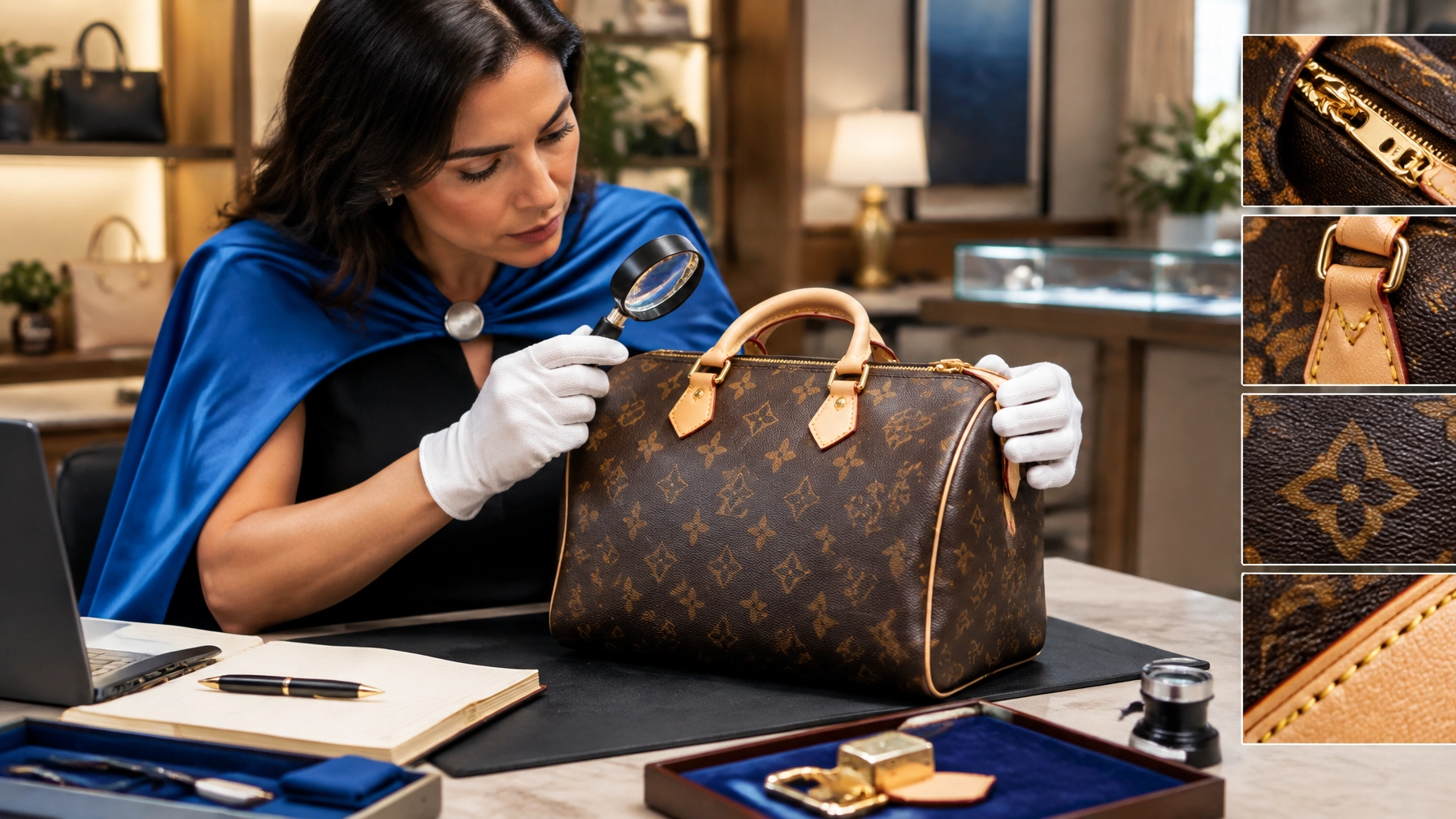
A Louis Vuitton bag can represent a strong resale opportunity, or a costly counterfeit problem.
The difference often comes down to what happens during intake.
How many times a week does a customer ask, “Is this real?” Your team needs a consistent answer. Not a guess. Not a decision based only on a date code. A repeatable screening process that tells you when to proceed and when to escalate.
Use this counter-side walkthrough for Louis Vuitton and other designer bags.
Important: These checks are screening indicators. No single detail proves authenticity. Counterfeiters can copy date codes, heat stamps, hardware, and packaging. High-value or questionable items should move to professional authentication before purchase, lending, or resale.
Start with the bag’s age
Before inspecting individual details, establish what the bag is supposed to be.
Ask:
- Does the style look vintage, contemporary, or recently produced?
- Does the material and hardware match the claimed era?
- Should the bag have a visible date code?
- Does the customer’s story match the item’s apparent age?
Date codes versus microchips
Louis Vuitton bags produced before the brand’s transition to embedded identification generally have a visible date code. These codes usually contain letters and numbers and may be stamped directly into the lining or placed on a leather tab.
Bags made from around March 2021 onward generally use embedded NFC/RFID microchips instead of visible date codes. Therefore:
- Older bag with no visible code: A reason for further review.
- Newer bag with no visible code: Not automatically suspicious.
- Visible code on a newer bag: Check the model and production context before drawing a conclusion.
- NFC response: Supporting information only. It is not proof of authenticity.
For many pre-2021 Louis Vuitton bags, the modern date-code format uses:
- Two letters indicating the factory or country.
- Four numbers indicating the production period.
- For many bags made from 2007 through early 2021, the first and third digits represent the production week, while the second and fourth digits represent the year.
For example, a code such as SD2154 may indicate a French or U.S.-linked factory code and a production period in 2014. The exact code must be evaluated against the model, era, country stamp, and construction.
A plausible-looking code is not enough. Counterfeiters copy real code formats.
For additional date-code background, see Rebag’s Louis Vuitton date-code guide.
Inspect the heat stamp
The interior heat stamp is one of the first details to examine.
Look for:
- Clean, crisp lettering.
- Even spacing.
- A centered impression.
- Consistent depth.
- Correct brand wording and country-of-manufacture information.
- A font that matches known examples from the same era and model.
The “O” in “LOUIS VUITTON” is commonly described as round and clean rather than noticeably oval. The letter spacing should look deliberate, not crowded or uneven.
Watch for:
- Blurry or muddy edges.
- Heavy, oversized lettering.
- Uneven alignment.
- Incorrect spacing.
- A stamp that looks printed when the model should have a heat stamp.
- A country marking that conflicts with the date-code factory letters.
A “Made in France” stamp does not automatically make a bag authentic. Louis Vuitton has also produced authentic pieces in locations including Italy, Spain, the United States, Switzerland, and Germany. The country must make sense with the bag’s other details.
Check the date code against the country stamp
This is where many intake inspections stop too early.
Finding a date code is not the finish line. Compare it with:
- The claimed production era.
- The format used during that era.
- The “Made in” marking.
- The bag’s style and construction.
- The location and quality of the stamp.
A code associated with one manufacturing location paired with a conflicting country stamp is a significant warning sign.
Still, treat a mismatch as a reason to escalate, not as a substitute for expert review. Vintage production history can include unusual formats, licensed production, repairs, and model-specific exceptions.
Examine the monogram alignment
Louis Vuitton’s monogram canvas is designed with a high level of pattern control.
Check the front, back, side panels, and seams.
Look for:
- Consistent spacing between the LV logos and floral motifs.
- Symmetrical panel placement.
- Pattern alignment at seams.
- Crisp printing.
- A consistent color relationship between the canvas and trim.
- No random cuts through important motifs.
Some authentic models are made from a continuous piece of canvas. As a result, the pattern may appear inverted on one side. Do not reject a bag simply because one side looks upside down. Confirm the expected construction for that specific model.
Red flags include:
- Randomly cut monogram elements.
- Poor seam alignment.
- Uneven or distorted logos.
- A pattern that looks too shiny, plastic-like, dull, or blurry for the claimed age.
- Different canvas quality across panels.
Pattern alignment is a powerful screening step because it evaluates how the bag was constructed, not just whether a logo was copied.

Evaluate stitching and leather work
Turn the bag inside out. Inspect the areas counterfeiters often rush:
- Handle bases.
- Leather tabs.
- Zipper ends.
- Pocket openings.
- Stress points.
- Strap attachments.
- Corners and piping.
Authentic construction should show:
- Even stitch spacing.
- Consistent stitch length.
- Straight lines.
- Secure thread ends.
- No loose or frayed threads.
- Consistent thread color for the model and material.
On classic monogram bags with vachetta leather, the leather often begins pale and develops a warm honey-colored patina over time. However, patina depends on use, storage, handling, moisture, and age.
Do not use patina alone as a pass-or-fail test.
Instead, ask whether the leather condition makes sense with:
- The bag’s claimed age.
- The amount of wear.
- The condition of the canvas.
- The hardware.
- The interior lining.
A supposedly new bag with heavily aged leather deserves questions. A vintage bag with perfectly pale, untouched vachetta may also need review. Context matters.
Feel the hardware
Hardware is often where a weak counterfeit becomes obvious.
Handle:
- Zipper pulls.
- D-rings.
- Buckles.
- Clasps.
- Rivets.
- Feet.
- Decorative plates.
- Strap hardware.
Authentic hardware should generally feel solid and substantial for the model. It should not feel hollow, excessively light, sharp, or poorly finished.
Check:
- Weight and balance.
- Smooth edges.
- Consistent plating or finish.
- Clean engraving.
- Correct logo placement.
- Smooth zipper movement.
- Matching color across hardware components.
Red flags include:
- Shallow or rough engraving.
- Uneven lettering.
- Flaking or patchy plating.
- Hardware colors that do not match.
- Cheap-feeling metal.
- Hardware shapes that do not match the model.
- Screws or fasteners inconsistent with known examples.
Do not rely on one zipper pull. Inspect multiple hardware pieces. Counterfeiters may reproduce one visible logo while missing details elsewhere.
Inspect the lining and interior
The lining should match the model, material, and production era.
Depending on the bag, Louis Vuitton interiors may use canvas, microfiber, leather, or other model-specific materials.
Check for:
- Correct lining type.
- Clean attachment to the bag.
- Even seams.
- Proper pocket construction.
- Correct interior color.
- No bubbling, peeling, or extremely thin material.
- No sloppy printing or misplaced logos.
A bag can have a convincing exterior and a poor interior. Always open every pocket and inspect the areas that are easy to overlook.
Use a simple counter-side workflow
A consistent process helps your team avoid emotional decisions and customer pressure.
Step 1: Photograph the item
Take clear photos of:
- Front and back.
- Base and corners.
- Interior.
- Heat stamp.
- Date code or chip-related area.
- Hardware.
- Stitching.
- Monogram seams.
- Accessories and packaging.
Good photos support internal review and make professional escalation faster.
Step 2: Run the quick screen
Spend several minutes checking:
- Overall construction.
- Monogram alignment.
- Heat stamp.
- Date code or expected chip era.
- Stitching.
- Lining.
- Hardware.
- Leather condition.
Step 3: Record facts, not impressions
Write:
- “Heat stamp is blurry.”
- “Country marking conflicts with factory code.”
- “Hardware feels unusually light.”
- “Stitching is uneven at handle base.”
Avoid writing only, “Looks fake” or “Feels real.” Specific observations are more useful for managers, experts, and future training.
Step 4: Set a decision point
Use a clear internal policy:
- ✅ Several markers align: Continue review and price conservatively until confirmed.
- ⚠️ One questionable marker: Escalate before accepting.
- ❌ Multiple major red flags: Do not purchase or lend without professional authentication.
When to escalate to Authenticate Pro
A pawn shop does not need to solve every authentication question at the counter.
That is especially true for:
- High-value Louis Vuitton bags.
- Vintage pieces.
- Rare or limited-edition models.
- Bags with unusual date-code formats.
- Bags with conflicting country information.
- Items where the customer disputes your assessment.
- Any item your staff cannot confidently document.
Authenticate Pro’s workflow is designed for resale businesses. Authentications move to human experts for approximately 99% accuracy, giving your team an escalation path when visual screening is not enough.
The company offers different service levels, including:
- Quick Check: Listed turnaround of approximately 20 minutes to 12 hours.
- Express Authentication: Listed turnaround of approximately 15 to 60 minutes.
- Level 2 Authentication: Listed turnaround of approximately 12 to 48 hours.
See the current Authenticate Pro pricing and service options.
The company also provides authentication support for resale stores through its reseller membership program. Its customer examples include resale businesses such as Clothes Mentor and Plato’s Closet.

Professional authentication protects more than one transaction. It helps protect:
- Inventory dollars.
- Customer trust.
- Your store’s reputation.
- Resale margins.
- Staff confidence.
- Future returns and disputes.
The bottom line
A Louis Vuitton bag should never be accepted because one detail “checks out.”
Use the full intake sequence:
- Establish the likely era.
- Check the date code or expected chip system.
- Compare the code with the country stamp.
- Inspect the heat stamp.
- Review monogram alignment.
- Examine stitching and leather.
- Test hardware quality and engraving.
- Inspect the lining.
- Document every concern.
- Escalate before making a high-value decision.
The goal is not to guess faster.
The goal is to make better decisions, create a repeatable process, and know exactly when a professional human expert should take over.
For more information, visit Authenticate Pro or call 800-395-7172.
Leave a Reply