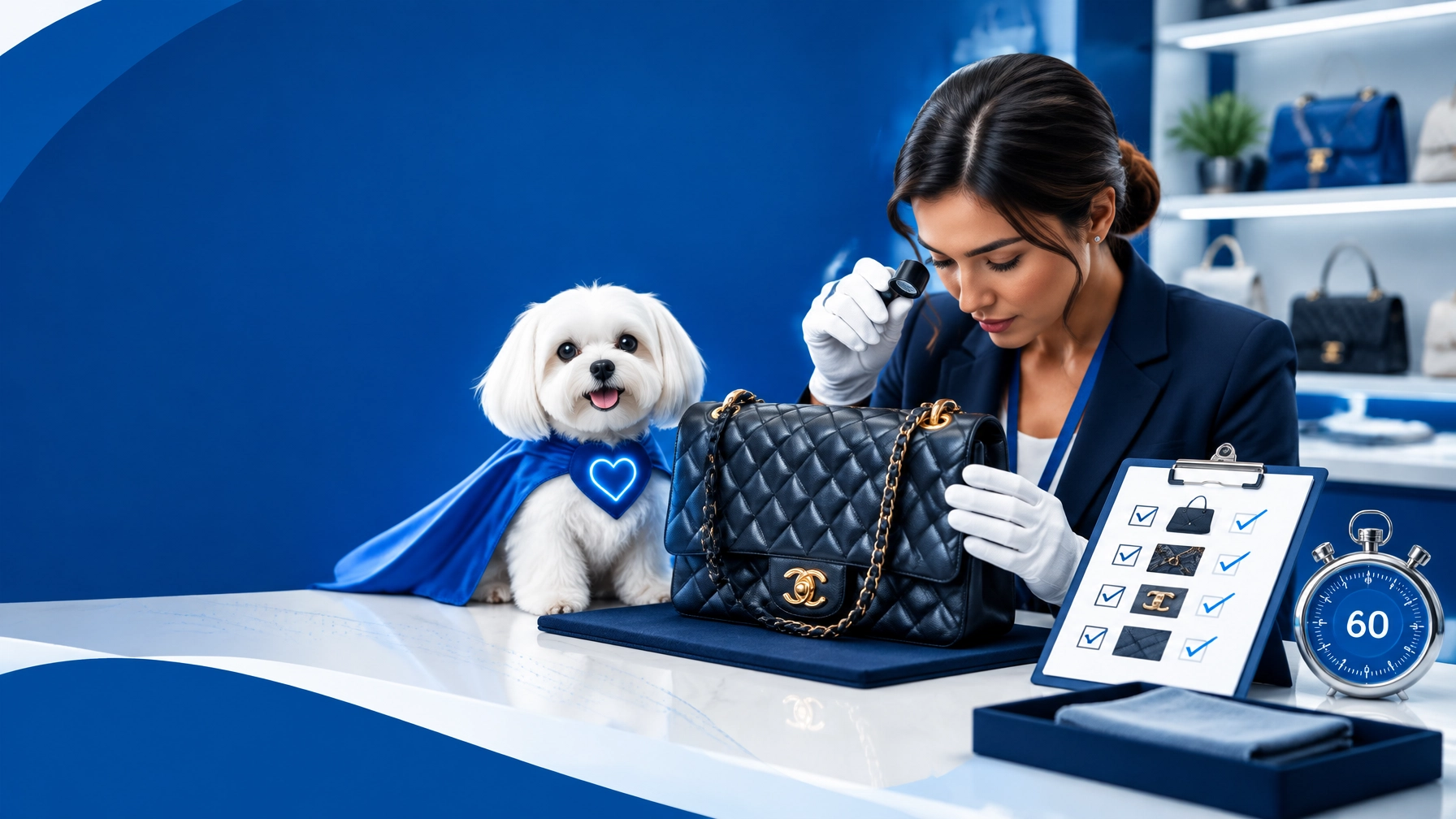
How many times a week does a customer ask, “Is this real?”
Your staff does not need to become a brand historian overnight. They do need a consistent first-pass process.
The goal of a 60-second check is not to issue a final authenticity conclusion. It is to identify obvious red flags, separate low-risk items from questionable ones, and escalate anything uncertain to trained human experts.
Authenticate Pro’s workflow follows Authentication · Community · Experts. Staff perform the initial intake check. Flagged items move to human experts for deeper review and approximately 99% accuracy, based on Authenticate Pro’s reported authentication results.
This process works for resale stores, pawnshops, thrift shops, online sellers, and TikTok sellers.
The 60-second rule: triage, do not guess
Teach your staff to place every item into one of three categories:
- ✅ Proceed: No obvious red flags during the first pass.
- ⚠️ Escalate: Something does not match, or the employee lacks confidence.
- ❌ Stop: Multiple serious red flags suggest the item should not be accepted or listed without expert review.
A staff member should never say, “This is definitely authentic,” based only on a one-minute inspection.
A fast check is a filter. It is not a replacement for expert authentication.

The floor-ready 60-second checklist
Seconds 0–10: Start with the overall impression
Place the item under good lighting. Look at the shape, structure, logo placement, pattern alignment, and overall finish.
Ask:
- Does the item look proportionate?
- Is the logo centered and correctly formed?
- Do the patterns line up at seams?
- Does the construction look consistent with the brand and model?
- Are there obvious spelling, font, or placement errors?
Counterfeit items often reveal themselves through several small inconsistencies instead of one dramatic flaw.
Do not let a familiar logo create false confidence. Logos are among the easiest details for counterfeiters to copy.
Seconds 10–20: Check stitching and construction
Look at the areas counterfeiters often rush:
- Handles
- Corners
- Interior seams
- Pockets
- Quilting
- Strap attachments
- Logo patches
Authentic luxury construction is usually consistent. Stitch length, spacing, thread tension, and color should look intentional.
Red flags include:
- Uneven or wandering stitches
- Loose threads
- Skipped stitches
- Crooked seams
- Thread color that does not match the item
- Poorly aligned quilting or monograms
- Stitching that appears too thick, thin, or rushed
A single loose thread does not automatically prove an item is fake. Items can be repaired, damaged, or heavily used. The question is whether the construction quality matches the brand, model, age, and condition.
Seconds 20–30: Feel the hardware
Handle the zipper, clasp, logo plate, feet, chain, lock, or other metal components.
Check for:
- Weight and solidity
- Smooth movement
- Clean edges
- Correct engraving
- Consistent plating or finish
- Proper screw construction
- Accurate font and spacing
Hardware that feels unusually light, hollow, sharp, tinny, or flimsy deserves attention.
Look closely at engravings. Misspellings, incorrect fonts, uneven spacing, shallow marks, and rough edges are common warning signs.
Do not rely on weight alone. Some authentic items use lighter materials, and hardware can change across production years. Use hardware as one part of the pattern.
Seconds 30–40: Inspect serial numbers, date codes, tags, or chips
Locate the item’s brand-specific identifying details.
Depending on the brand and production era, this may include:
- Serial numbers
- Date codes
- Interior tags
- Authentication stickers
- QR codes
- NFC chips
- Model stamps
- Country-of-origin markings
Check whether the identifier:
- Appears in the expected location
- Uses the correct format for that brand and era
- Matches the item’s model and construction
- Is printed, stamped, or applied with the expected quality
- Matches any included card or paperwork
Important: A serial number is not proof of authenticity. Counterfeiters copy real numbers. Some authentic items may also lack older identifiers because of age, repairs, or changes in brand production.
Treat a missing, incorrect, poorly applied, or mismatched code as a reason to escalate.
Seconds 40–48: Feel and smell the material
Handle the leather, canvas, textile, rubber, or synthetic material.
Look for:
- Expected texture
- Appropriate flexibility
- Consistent grain
- Quality lining
- Natural construction
- Excessive plastic coating
- Strong chemical or solvent odor
A harsh chemical smell can be a warning sign. However, smell is not a standalone test. Storage conditions, cleaners, smoke, perfume, and age can change an item’s odor.
The same applies to material feel. Some authentic products use coated canvas, treated leather, fabric, or synthetic materials. Train staff on the specific brands and models your store handles most often.
Seconds 48–55: Review packaging and accessories
Check the dust bag, box, cards, straps, locks, keys, tags, and other accessories.
Look for:
- Poor printing
- Incorrect branding
- Cheap or incorrect dust-bag material
- Packaging from the wrong era
- Accessories that do not match the item
- Authenticity cards that do not match internal identifiers
Packaging can support an authentication decision. It should not make the decision.
A counterfeit item can come with convincing packaging. An authentic pre-owned item may have no packaging at all.
Seconds 55–60: Compare the price and story
Ask where the item came from and why it is priced as it is.
A price far below the normal resale range is a red flag, especially for a current or highly desirable model.
The seller may say:
- “It came from a friend.”
- “I got it at a storage sale.”
- “I lost the receipt.”
- “I am moving and need quick cash.”
- “I know it is real because it came with the dust bag.”
These statements may be true. They are not authentication evidence.
Provenance helps establish context. It does not replace inspection.
What staff should never rely on
Train your team to mark these as supporting information only:
❌ Receipts
Receipts can be real, altered, duplicated, or connected to a different item. A receipt proves that a transaction may have occurred. It does not prove that the item being presented is the item on the receipt.
❌ Dust bags and boxes
Counterfeiters can purchase or reproduce packaging. Authentic items can also be sold without packaging.
❌ Authenticity cards
Cards can be copied. Some brands have changed card formats over time. A card must match the item and its production details.
❌ A seller’s confidence
A confident seller may still be mistaken. A nervous seller may still own an authentic item.
❌ “It came from a friend”
That is provenance, not proof.
❌ A single red flag
One detail rarely tells the entire story. Look for combinations. When in doubt, escalate.
How to train the drill in one afternoon
Use a simple practice format:
- Select 10 to 20 authentic and questionable items or detailed image sets.
- Give each employee exactly 60 seconds.
- Require a decision: Proceed, Escalate, or Stop.
- Require one sentence explaining the decision.
- Review the item as a group.
- Compare staff observations with the expert conclusion.
- Record recurring mistakes for the next training session.
Start with the brands your store handles most often. Build short brand guides with photos of:
- Stitching
- Hardware
- Logos
- Tags and codes
- Interior construction
- Common counterfeit patterns
Run a 10-minute refresher every week. Counterfeit methods change. Staff confidence should come from repeated practice, not from guessing faster.
What to say when an item fails the first check
The customer conversation should stay calm and professional.
Do not accuse the customer of selling a fake. Do not make a public declaration before the review is complete.
Use language such as:
“We are not able to complete intake based on the first inspection. We have a few details that require additional review by an authentication expert.”
Or:
“Because this is a high-value item, our policy is to escalate anything uncertain before we accept or list it.”
If the item has multiple serious red flags, say:
“We are going to pause this item rather than make a decision without sufficient verification. Protecting both you and our customers is important to us.”
This protects the customer relationship and your store’s reputation.
How to document every questionable item
Create a simple intake record before the item leaves the counter.
Document:
- Date and time
- Employee name
- Seller or transaction reference
- Brand and item type
- Model name, if known
- Stated condition
- Stated source or provenance
- Purchase or expected listing price
- Red flags observed
- Photos of the exterior and interior
- Close-ups of stitching and hardware
- Serial number, date code, tag, or chip
- Packaging and accessories
- Decision: Proceed, Escalate, or Stop
- Expert report or case number, if submitted
Photograph the item before any alterations are made. For stores using an Authenticate Pro Ziptie, record the associated number and keep it connected to the item’s report according to your store’s procedure.

The escalation step is the safety net
Your staff’s 60-second check creates speed and consistency. Human experts provide the deeper review.
Authenticate Pro’s workflow is:
Authentication · Community · Experts
The process combines initial information, community input, technology, and human expertise. Items that require additional review are escalated to human experts rather than forced into a rushed yes-or-no decision.
For resale operators, that matters. One counterfeit can lead to:
- Lost inventory value
- Refunds and chargebacks
- Marketplace penalties
- Customer complaints
- Reputational damage
- Lost repeat business
A trained employee does not need to catch every sophisticated counterfeit alone. The employee needs to recognize when the item should not move forward without expert review.
Build your store’s repeatable standard
Post the 60-second checklist at the intake station. Train every employee to use the same order. Review questionable items without blame. Track which red flags appear most often.
Then connect the floor check to a professional escalation process.
You can learn more about Authenticate Pro’s services for resale stores on the Membership page, review available options on the Pricing page, or contact Authenticate Pro through the company website.


The objective is simple:
- Check quickly.
- Document clearly.
- Escalate uncertainty.
- Do not let packaging or a convincing story override the evidence.
That is how a 60-second staff drill becomes a stronger protection system for your store and your customers.
Leave a Reply