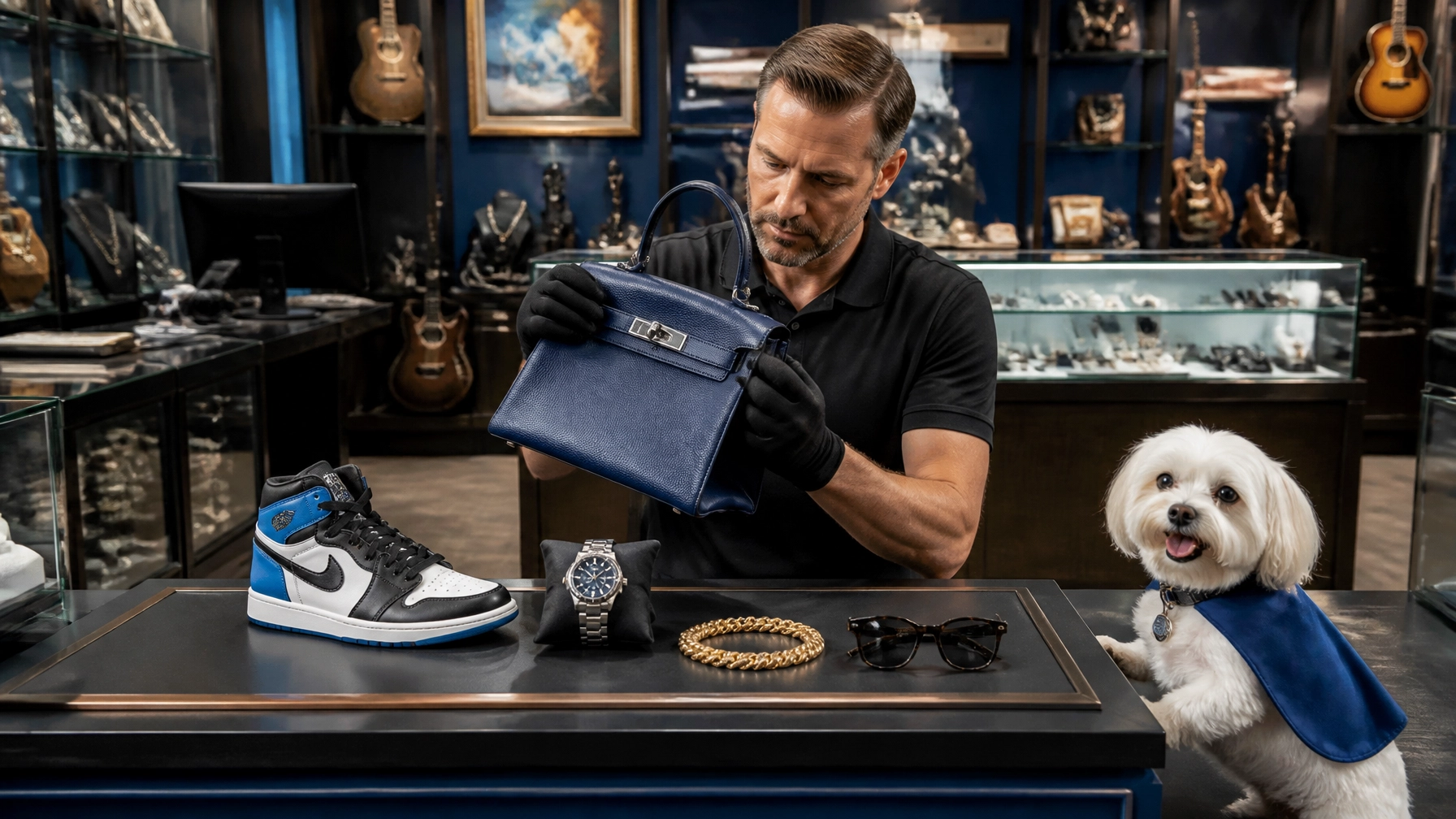
How many times a week does a customer ask, “Is this real?”
For pawn shops, the question is more than casual conversation. A wrong answer can mean:
- Lost money on the purchase
- A forced refund
- Chargebacks and disputes
- Damaged customer trust
- Reputation loss
- Possible legal problems
Counterfeiters target items with strong resale demand. That includes luxury handbags, watches, sneakers, jewelry, sunglasses, and small leather goods.
The good news? Your intake process can catch many fakes before money changes hands.
This guide covers the most common categories and the practical checks your staff can perform at the counter.
Important: No single red flag proves an item is counterfeit. Modern “superfakes” can pass a quick visual inspection. Use these checks as screening tools. Escalate high-value or questionable items for professional authentication.
Why Counterfeits End Up in Pawn Shops
Counterfeit merchandise reaches pawn shops for several reasons.
Owners may not know the item is fake
Many sellers bought the item online, through social media, at an estate sale, or from another reseller. They may genuinely believe it is authentic.
Fakes are designed to look convincing
Counterfeiters now copy:
- Packaging
- Serial numbers
- Date codes
- Warranty cards
- Receipts
- Dust bags
- Authentication cards
- Hardware and stitching
A receipt is not proof. Neither is a box.
Sellers may create urgency
Be cautious when the seller says:
- “I need cash today.”
- “I got it as a gift.”
- “I lost the paperwork.”
- “I don’t know anything about it.”
- “Someone else offered me more.”
- “It is definitely real. I checked online.”
Pressure is not proof of authenticity.
Mixed lots create additional risk
Wholesale returns, storage units, online purchases, and bulk estate merchandise can contain one counterfeit item mixed with otherwise genuine goods.
A Simple Rule for Intake Staff
Before evaluating the item, evaluate the transaction.
Ask:
- Does the price make sense?
- Is the seller’s story consistent?
- Is there a receipt, service record, or other provenance?
- Does the item match known authentic examples?
- Does the risk justify the potential profit?
If the answer to any of these questions is unclear, pause the transaction.


1. Luxury Handbags and Small Leather Goods
Handbags are among the most frequently counterfeited luxury products. High-risk names include:
- Louis Vuitton
- Chanel
- Gucci
- Prada
- Dior
- Hermès
- Goyard
- Saint Laurent
- Fendi
- Celine
Small leather goods are also common targets. Wallets, cardholders, belts, and pouches can carry significant resale value and are easy to move.
Red flags to check
Pattern alignment
Monograms and repeating patterns should line up across seams, pockets, flaps, and side panels. Crooked or randomly cut patterns deserve attention.
Stitching
Look for:
- Uneven stitch length
- Loose threads
- Skipped stitches
- Crooked seam lines
- Excessive glue
- Different thread colors
Stitching alone is not conclusive. It is one part of the larger inspection.
Material and construction
Compare the feel with a known authentic item. Watch for leather or coated canvas that feels:
- Too thin
- Plasticky
- Excessively stiff
- Too light
- Strongly chemical-smelling
Smell is only a clue. Authentic items can also have odors from storage, cleaning products, or age.
Hardware
Inspect zippers, clasps, feet, chains, and buckles. Check for:
- Lightweight metal
- Rough edges
- Peeling finish
- Incorrect color
- Shallow engraving
- Mismatched hardware
Logo and interior details
Check the font, spacing, stamp depth, label shape, and placement. Compare them with reliable references from the brand or a known authentic example.
Serial numbers and date codes
A code that looks correct does not make the item authentic. Counterfeiters copy real formats. Verify:
- Correct format
- Correct location
- Correct font
- Correct date logic
- Consistency with the item’s production period
Best practice
Photograph the entire bag. Then photograph the logo, hardware, interior stamp, code, lining, corners, and any damage.
Do not rely on one “magic” detail.
2. Luxury Watches
Watches can create some of the largest losses for pawn shops. Rolex is a major target, followed by brands such as:
- Patek Philippe
- Omega
- Cartier
- Audemars Piguet
- Breitling
- Hublot
- TAG Heuer
Popular models are especially risky. A highly desirable watch offered far below the normal market price requires a full inspection.
Red flags to check
Weight and feel
Use a digital scale when appropriate. A fake may feel too light, rattly, or poorly balanced. Compare the weight with trusted specifications or a known authentic example.
Case and bracelet finishing
Inspect brushed and polished surfaces. Look for:
- Sharp or uneven edges
- Rough bracelet links
- Poorly finished clasp components
- Loose tolerances
- Uneven polishing
Dial printing
Use a loupe. Check the logo, lettering, minute markers, date window, and alignment. Blurry printing or inconsistent spacing is a warning sign.
Reference and serial numbers
Confirm that the numbers:
- Are present where expected
- Use the correct style
- Match the model
- Are not obviously altered
- Make sense for the claimed production period
A serial number search is not enough. Fakes can use genuine numbers copied from authentic watches.
Movement
If your staff is not trained to open watches, do not open them at the counter. Refer the piece to a qualified watchmaker or professional authenticator.
A generic movement inside a watch that should contain a specific caliber is a serious concern.
Papers and boxes
Boxes and papers can be counterfeit or paired with a different watch. Treat accessories as supporting evidence, not proof.

3. Sneakers and Luxury Footwear
Counterfeit sneakers move quickly because demand is high and many models have recognizable resale prices.
Common targets include:
- Nike
- Air Jordan
- Yeezy
- Adidas
- Converse
- Vans
- Luxury designer footwear
- Limited collaborations
Red flags to check
Box and label
Compare the box label with the shoe. Check:
- Style code or SKU
- Size
- Colorway
- Barcode
- Font and spacing
- Label placement
The code should match the shoe, box, and claimed model.
Shape and materials
Look at the toe box, heel structure, panel shape, logo placement, and overall symmetry. Counterfeit pairs often have subtle differences in shape.
Glue and stitching
Watch for:
- Excess glue
- Uneven stitching
- Loose threads
- Poorly attached soles
- Strong chemical odors
- Inconsistent panel spacing
Insole and interior label
Compare the insole branding, size tag, manufacturing details, and footbed construction with a reliable authentic reference.
Accessories
Extra laces, tissue paper, hangtags, and receipts can also be copied. They may support the seller’s story, but they do not prove authenticity.
For expensive or limited-release sneakers, do not make a payout decision from the box alone.
4. Jewelry and Precious-Metal Pieces
Jewelry counterfeits can involve both brand fraud and metal-content fraud.
Commonly targeted names include:
- Cartier
- Tiffany & Co.
- Van Cleef & Arpels
- Bulgari
- Chanel
- Dior
A piece may also be genuine-looking but contain plated base metal instead of the claimed gold or platinum.
Red flags to check
Hallmarks
Use a loupe to inspect metal marks and brand stamps. Check:
- Correct fineness mark
- Correct font
- Correct location
- Clean engraving
- Consistent depth
Missing, crude, or incorrectly placed hallmarks deserve further testing.
Metal content
Use appropriate metal testing equipment. Acid testing can damage some items and should only be performed by trained staff. XRF testing may be more appropriate for valuable pieces.
A magnet is not a complete test. Some authentic precious-metal items contain magnetic components, while some fakes may not react to a magnet.
Clasps, screws, and settings
Luxury jewelry often has precise construction. Check whether:
- Screws turn smoothly
- Clasps close securely
- Links move correctly
- Settings hold stones evenly
- Edges are cleanly finished
Stones
Inspect cut, symmetry, setting quality, and overall condition. For significant diamonds or gemstones, refer the item to a qualified jeweler or gemologist.

5. Designer Sunglasses and Eyewear
Sunglasses are easy to transport, easy to copy, and widely counterfeited. Ray-Ban and Chanel are common examples, but nearly every recognizable designer label is vulnerable.
Red flags to check
Model number
Check the number on the frame and compare it with the claimed model. Look for incorrect spacing, font, or placement.
Logo quality
Inspect logos on the temples, lenses, and bridge. They should be clean, properly aligned, and consistent with known authentic examples.
Hinges and screws
Open and close the frames. Watch for:
- Loose hinges
- Squeaking
- Rough movement
- Cheap screws
- Uneven frame alignment
Lens quality
Look for distortion, haze, poor clarity, or uneven tint. Do not assume that a dark lens provides UV protection. Use appropriate equipment if UV protection is part of your evaluation.
Cases and cleaning cloths can also be copied. Inspect the eyewear itself.
What to Do When an Item Fails Your First Check
Do not accuse the seller immediately. Use a consistent process.
1. Pause the purchase
Do not issue a loan or buy the item until the inspection is complete.
2. Separate the item
Keep questionable merchandise away from approved inventory. This prevents accidental resale or mixing.
3. Document the item
Take clear photos of:
- Front and back
- Logos
- Serial or reference numbers
- Labels
- Hardware
- Stitching
- Packaging
- Damage
- Seller-provided documentation
Record the seller’s statements and the item’s condition.
4. Escalate when the risk is high
Escalate any item that is:
- High value
- A popular counterfeit model
- Missing expected details
- Inconsistent with the seller’s story
- Difficult to inspect in-house
- Too profitable to reject without confirmation
Use Professional Authentication Before Money Changes Hands
A trained employee can catch obvious problems. The challenge is the convincing counterfeit.
Authenticate Pro helps resale businesses, pawn shops, and other retailers evaluate luxury merchandise. The process uses technology for an initial review, then authentications escalate to human experts for the final conclusion. This workflow is designed to achieve approximately 99% accuracy.
You can submit clear item photos through the Authenticate Pro website. For stores, membership options are available to support recurring authentication needs. You can also review current service options and pricing on the pricing page.
The company serves more than handbags. Its coverage includes hundreds of brands across luxury goods, footwear, jewelry, accessories, and eyewear.
Protect Your Shop One Intake at a Time
Counterfeit detection does not require guessing.
It requires:
- A written checklist
- Consistent staff training
- Clear documentation
- Conservative decisions on high-risk items
- Professional escalation when the item matters
The cost of authentication is usually small compared with the cost of buying, selling, and refunding a counterfeit.
When in doubt, pause the transaction. Take clear photos. Escalate the item. Then make the decision with better information.
Have a luxury item that needs a second opinion? Authenticate it with Authenticate Pro.
Leave a Reply