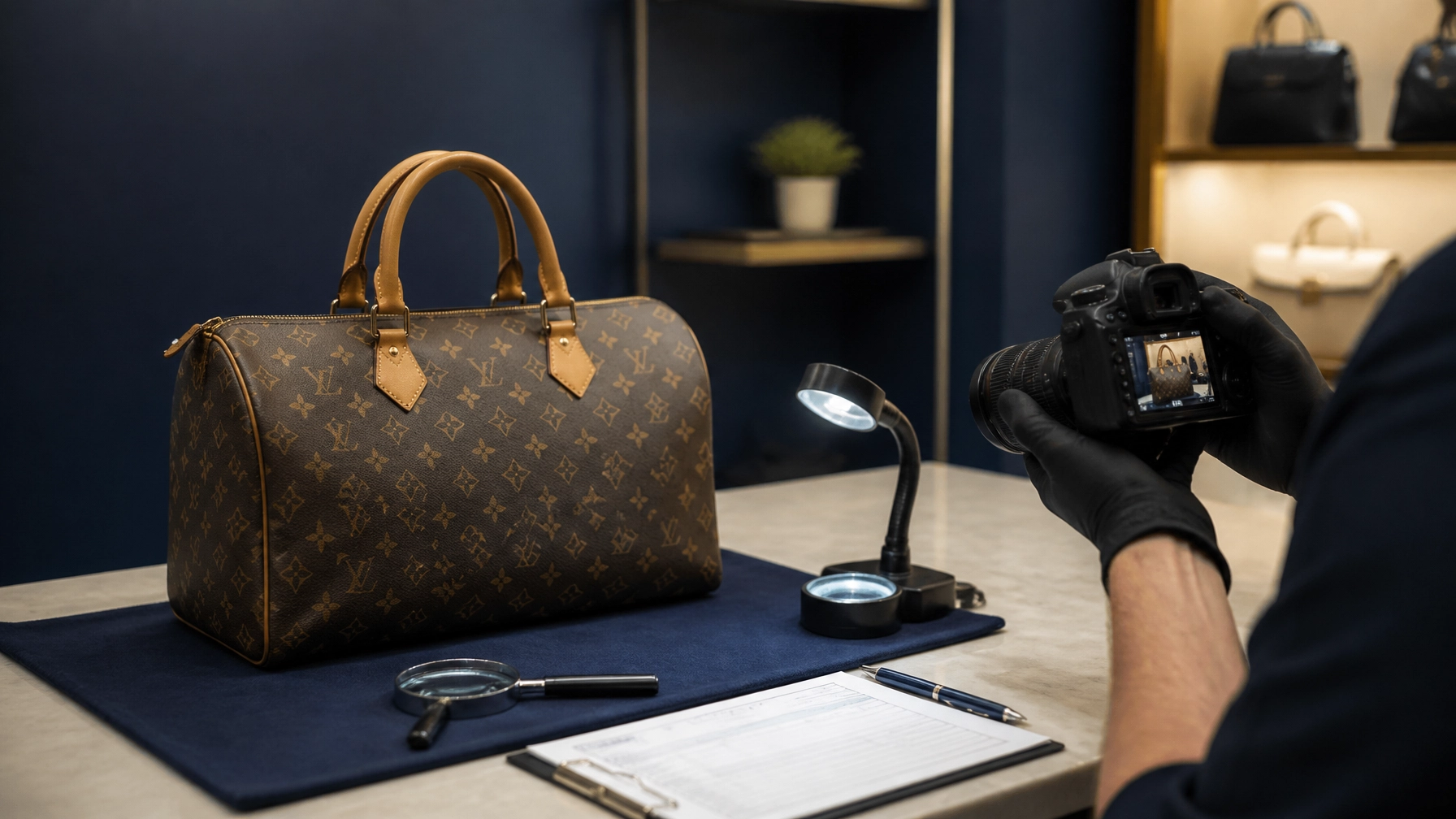
A Louis Vuitton handbag can represent strong resale value: or significant risk.
One counterfeit purchase can lead to:
- Lost loan capital
- Refunds and chargebacks
- Damaged customer trust
- Inventory write-offs
- Reputational harm
- Potential counterfeit liability
That is why pawn shop authentication needs to be consistent, documented, and easy for every staff member to follow.
This guide covers practical intake steps, Louis Vuitton inspection points, counterfeit detection red flags, and when to escalate to professional authentication.
Important: Visual inspection is a screening step. It is not a guarantee of authenticity. Counterfeiters can copy individual details, including date codes, packaging, receipts, and logos.
Start with a repeatable intake process
How many times a week does a customer ask, “Is this real?”
Your answer should not depend on who is working the counter. Create a standard process for every designer handbag that enters the store.
1. Record the item before handling it
Capture:
- Customer name and identification information
- Date of intake
- Brand and claimed model
- Color, size, and material
- Approximate purchase date
- Claimed purchase location
- Customer’s requested loan or purchase price
- Any available receipt, dust bag, box, or packaging
Ask direct questions:
- Where was the bag purchased?
- Was it purchased new or pre-owned?
- How long has the customer owned it?
- Does the customer know the original owner?
- Is there any reason the item is being sold today?
A receipt or dust bag can support the story. It cannot prove authenticity. Counterfeiters regularly reproduce packaging and documentation.
2. Photograph the complete item
Take clear, well-lit photos before making an offer.
At a minimum, photograph:
- Front and back
- Both sides
- Bottom and corners
- Handles and straps
- Interior lining
- Pockets and compartments
- Heat stamp
- Date code, if present
- Hardware and zipper pulls
- Any repairs, stains, or damage
- The item next to the intake reference number
Use the same photo sequence for every handbag. Consistent documentation makes later review faster and creates an evidence trail if the customer questions the decision.


Louis Vuitton authentication: practical inspection points
Louis Vuitton bags vary by model, year, country of manufacture, and material. A Neverfull, Speedy, Alma, and vintage trunk will not share every construction detail.
Use the following points for initial screening, not as a stand-alone authentication method.
Canvas and monogram alignment
Look at the overall print quality.
Potential concerns include:
- Blurry or uneven monogram printing
- Unusual color tone
- Misaligned patterns at seams
- Logos cut off in places where the model’s construction would not require it
- Canvas that feels overly plastic, flimsy, or unusually stiff
- A shape that does not match the claimed model
Some Louis Vuitton styles use one continuous piece of canvas. As a result, one side may show an upside-down pattern by design. Do not reject a bag based on one online “rule” without confirming the model and production era.
The key question is consistency. Does the canvas, pattern placement, shape, and construction make sense together?
Stitching and craftsmanship
Inspect high-stress areas first:
- Handle attachments
- Corner seams
- Strap connections
- Pocket edges
- Zipper panels
- Flaps and closures
Watch for:
- Loose or skipped stitches
- Uneven spacing
- Crooked seams
- Excessive glue
- Frayed thread
- Incorrect thread color
- Stitching that changes quality from one section to another
A single imperfect stitch may reflect wear or repair. Several construction problems across the bag deserve escalation.
Hardware and zippers
Authentic luxury hardware generally feels substantial and operates smoothly. Check:
- Weight
- Finish
- Edge quality
- Engraving sharpness
- Alignment
- Zipper movement
- Snap and clasp function
Be cautious with hardware that feels hollow, unusually light, rough, or excessively shiny. Engravings should be clean and appropriately positioned for the model.
Do not treat a branded zipper pull or metal stamp as proof. Hardware is one of the easiest areas for counterfeiters to imitate.
Leather and patina
Many classic Louis Vuitton bags use natural, untreated leather trim that changes color over time.
Look for:
- Consistent texture
- Natural-looking patina
- Wear patterns that make sense
- Handles that show appropriate handling
- Leather that feels substantial rather than synthetic
A perfectly uniform dark color on an allegedly well-used vintage bag may deserve a closer look. So may leather with an overpowering chemical smell.
However, lighting, storage, cleaning, climate, and repairs can all affect appearance. Patina is supporting evidence: not a verdict.
Interior layout and lining
Compare the interior with a reliable reference for the specific model and era.
Check:
- Lining material
- Lining color
- Pocket count
- Pocket placement
- Interior dimensions
- Date-code location
- Shape and structure
An incorrect interior layout can be a stronger warning sign than minor cosmetic wear. If the seller identifies a model but the lining, pocket configuration, or proportions do not match that model, stop and escalate.
Heat stamps and date codes
The heat stamp should be examined for:
- Letter shape
- Spacing
- Alignment
- Depth
- Country-of-origin wording
- Overall font consistency
Older Louis Vuitton bags may include a date code. Newer production may use an embedded chip instead of a visible code. The transition depends on production timing and model.
Keep these rules in mind:
- A date code is not a unique serial number.
- A correct-looking date code does not prove authenticity.
- Counterfeiters can copy real codes from genuine bags.
- A code should be consistent with the claimed production era.
- The factory location and “Made in” information should not conflict.
- The absence of a visible date code is not automatically proof of a counterfeit, especially on newer items or certain vintage pieces.
Louis Vuitton does not provide a public online date-code authentication database. Do not base a purchase decision on a code checker alone.
Red flags that should stop the transaction
One warning sign may have an innocent explanation. Multiple unrelated warning signs should change the decision.
Use a stop-and-escalate rule when you see:
- ❌ Misaligned canvas across several panels
- ❌ Sloppy stitching in multiple areas
- ❌ Wrong or inconsistent interior construction
- ❌ Lightweight or poorly finished hardware
- ❌ Conflicting date-code and country information
- ❌ A heat stamp with unusual spacing or font
- ❌ Model dimensions that do not match references
- ❌ Strong chemical odor or synthetic-feeling leather
- ❌ A price or story that seems too good to be true
- ❌ Customer resistance to basic photographs or inspection
- ❌ A high-value bag that staff cannot confidently identify
Do not allow pressure from a customer to override your process. “I need the money today” is not an authentication result.
When staff should escalate to professional authentication
Escalate before buying, lending against, or listing the item when:
- The handbag has significant loan or resale value.
- Staff members disagree about the result.
- The model is unfamiliar.
- The item is vintage, limited edition, altered, or repaired.
- The visible details are inconsistent.
- The customer provides incomplete or conflicting information.
- The bag has no clear reference match.
- A counterfeit would create a meaningful financial or reputational loss.
The correct response is not always “fake.” Often, it is:
“Unable to verify at the counter. Hold for professional authentication.”
That distinction protects both your store and your customer.

A practical pawn shop authentication workflow
Use this five-step process:
Step 1: Intake
Record the seller, item details, claimed provenance, and requested value.
Step 2: Triage
Perform a short visual screen for obvious issues involving canvas, stitching, hardware, shape, and interior construction.
Step 3: Document
Take complete, high-resolution images. Do not rely on one close-up of the logo or date code.
Step 4: Escalate
Send the item for professional authentication when the value, uncertainty, or potential loss justifies it.
Authenticate Pro’s workflow combines technology with human review. Authentications move to human brand experts when expert judgment is needed, and the company reports approximately 99% accuracy based on recent authentication results. That escalation is important: AI or visual screening can support the process, but a high-value transaction should not depend on a single automated signal.

Step 5: Document the conclusion
Save:
- Original intake photos
- Staff notes
- Authentication report
- Expert conclusion
- Customer communication
- Final purchase, loan, return, or rejection decision
This record helps your team stay consistent and gives you a defensible process if authenticity is challenged later.
Protect your store from counterfeit liability
Selling or representing a counterfeit as genuine can create serious exposure. The Federal Trade Commission’s counterfeit guidance explains the consumer-protection concerns involved in counterfeit goods. Federal criminal provisions also address trafficking in counterfeit marks under 18 U.S.C. § 2320.
This is not legal advice. Speak with qualified counsel about your state and local requirements.
From a practical standpoint, pawn shops should:
- Create a written authentication policy.
- Train staff on the policy.
- Set a dollar threshold for mandatory expert review.
- Avoid describing an item as “authentic” before verification.
- Keep authentication reports with the inventory record.
- Quarantine suspected counterfeits.
- Do not return or resell questionable inventory without following legal and internal procedures.
- Review insurance requirements and vendor terms.
A consistent process does not eliminate risk. It helps reduce preventable mistakes.
Build a safer luxury intake program
Pawn shop authentication is not about memorizing one Louis Vuitton detail. It is about making better decisions with a repeatable system.
Use visual inspection to identify obvious red flags. Use documentation to create accountability. Use professional authentication when the stakes are high.
Authenticate Pro supports resale businesses with services designed to help stores authenticate luxury items, document results, and give customers more confidence. Review the reseller membership options or current authentication pricing to determine which workflow fits your store.
The goal is simple:
- ✅ Fewer counterfeit purchases
- ✅ Better customer confidence
- ✅ Stronger inventory records
- ✅ More consistent staff decisions
- ✅ Less avoidable counterfeit liability
When Louis Vuitton walks in, slow down, document everything, and escalate when you are not certain.
Leave a Reply