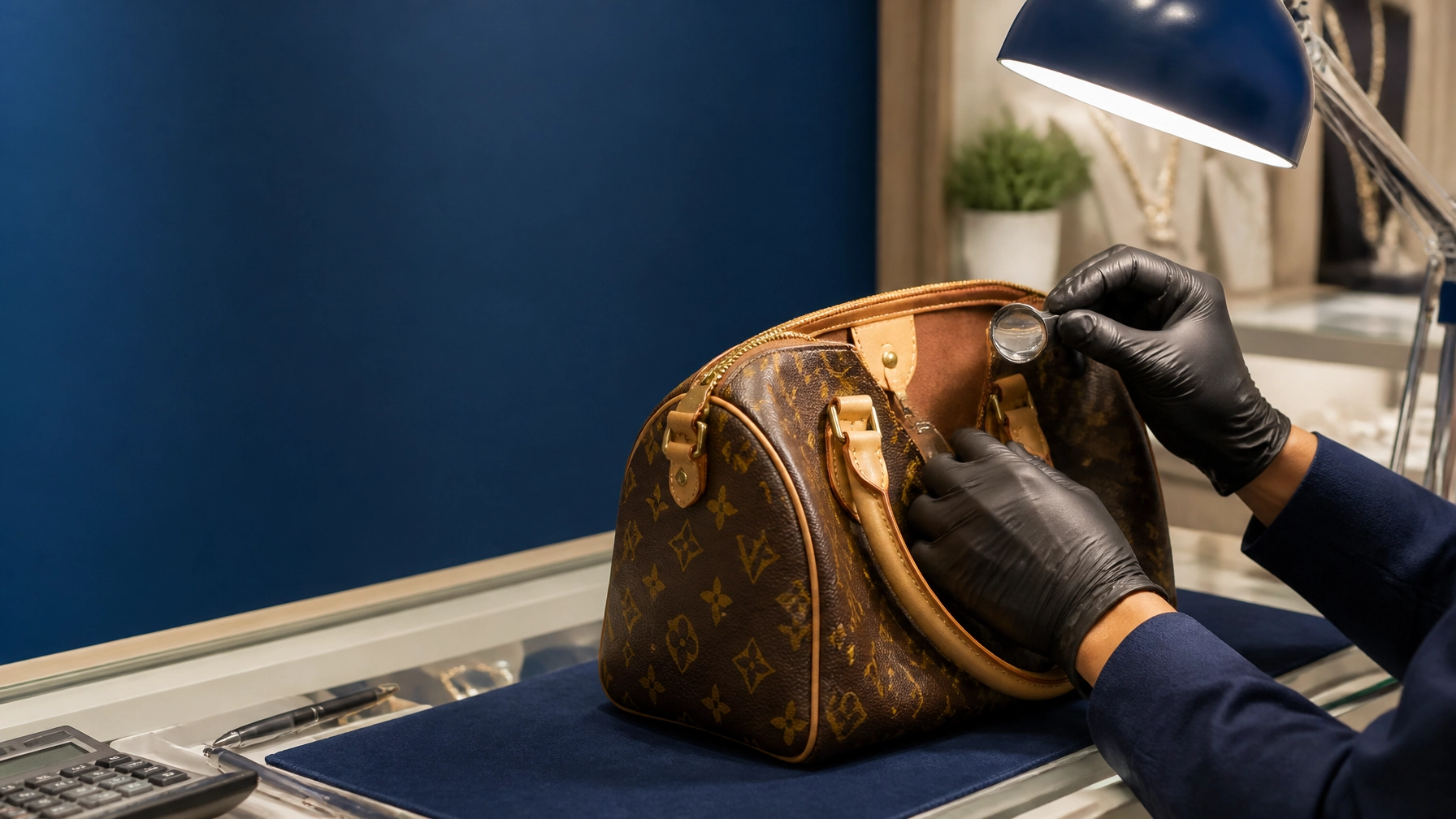
A Louis Vuitton bag can represent significant revenue for a pawn shop. It can also create significant risk.
One convincing counterfeit can lead to:
- Lost money on the purchase
- A customer dispute
- Refund and chargeback problems
- Damage to your store’s reputation
- Legal and compliance concerns
- A counterfeit entering the resale market
How many times a week does a customer ask, “Is this real?”
Your counter staff need a consistent answer. Not a guess. Not a decision based on one date code or a familiar monogram pattern.
This pawn shop authentication checklist gives your team a practical first-pass process for Louis Vuitton bags. Use it to identify risk quickly. Then escalate high-value, unusual, or borderline items to a professional authentication service.
Important: No single detail proves authenticity. Counterfeiters copy date codes, logos, packaging, and even individual construction features. Always evaluate the entire bag.
Start with the bag’s claimed age
Before inspecting details, ask basic intake questions:
- When and where was the bag purchased?
- Does the customer have a receipt, dust bag, or original paperwork?
- Who owned it?
- How long has the customer had it?
- Is there a repair or alteration history?
- What model does the customer believe it is?
- Does the condition match the claimed age?
Provenance is not proof. A receipt can be fabricated. Packaging can be replaced. Still, the answers help you establish whether the story makes sense.
A nearly new bag with no purchase history deserves more scrutiny. So does a vintage bag described as a recent purchase.
1. Check the date code: but do not stop there
For many Louis Vuitton bags made from the early 1980s through approximately early 2021, you may find a stamped production code. Depending on the model and era, it may appear:
- On a small leather tab
- Inside a pocket
- Along an interior seam
- Near a zipper or D-ring
- Stamped directly into the lining
Beginning around 2021, Louis Vuitton moved away from visible date codes on many products and introduced embedded microchips. Therefore, a newer bag may not have a visible code.
A missing date code does not automatically mean “fake.” A visible code does not automatically mean “real.”
Run a quick date-code logic check
If a code is present, inspect it for:
- Correct format for the claimed era
- A plausible week and year
- Factory letters that make sense
- Consistency with the “Made in” stamp
- Crisp, even embossing
For many modern pre-microchip formats, the letters identify the factory while the numbers indicate the production period. The exact format changed over time, so compare the code with a reliable reference such as Fashionphile’s Louis Vuitton date-code guide or Love That Bag’s date-code overview.
Date-code red flags
- The code uses an impossible week
- The date predates the model
- The factory code and “Made in” country conflict
- The stamp is blurry, crooked, or too deeply pressed
- The code appears in the wrong location for the model
- The code is present on a bag claimed to be a post-2021 model
Treat an inconsistent code as a serious warning. Do not let a “correct-looking” code override poor construction elsewhere.

2. Inspect the canvas and coating
Louis Vuitton’s coated canvas should feel substantial, structured, and consistent with the model. It should not feel like thin plastic or flimsy vinyl.
Look closely at the monogram or other patterned canvas:
- Are the print edges crisp?
- Is the spacing consistent?
- Are the colors even?
- Does the pattern align properly across seams?
- Does the coating feel appropriate for the bag’s age?
- Are the corners and edges finished cleanly?
Pattern alignment is important, but do not rely on symmetry alone. Different models have different pattern layouts. Learn the expected layout for common bags your shop handles, or keep model references available at the counter.
Canvas red flags
- Fuzzy or bleeding print
- Uneven color saturation
- Excessively shiny plastic appearance
- Thin, weak-feeling canvas
- Poor alignment at seams
- Coating that feels sticky, rubbery, or unusually stiff
Wear can change the appearance of authentic canvas. Dirt, fading, cracking, and repairs are condition issues: not automatic counterfeit indicators. Focus on whether the materials and construction make sense together.
3. Examine the heat stamp and “Made in” marking
The interior heat stamp is one of the most useful visual checkpoints in Louis Vuitton authentication.
Inspect:
- Letter shape
- Spacing
- Alignment
- Embossing depth
- Stamp location
- Country designation
- Leather quality around the stamp
A genuine stamp should look clean and intentional. The letters should have consistent spacing and depth. The impression should not look grainy, sloppy, or uneven.
Compare the country marking with the production code when an older bag has both. A mismatch is a red flag, but remember that factory information and formats changed over time. When the combination is unusual, escalate rather than making a fast rejection.
Heat-stamp red flags
- Crooked or off-center logo
- Inconsistent letter height
- Incorrect-looking font
- Overly deep or muddy embossing
- Poor-quality leather tab
- Country marking that conflicts with other details
4. Review stitching and construction
Stitching often reveals shortcuts that photographs miss.
Check the major attachment points, handles, tabs, corners, pockets, and seams. Look for:
- Even stitch length
- Consistent spacing
- Clean thread ends
- Tight corners
- Straight seam lines
- Appropriate thread color
- No loose, skipped, or wandering stitches
Many authentic Louis Vuitton bags use a warm mustard or yellow-toned thread on certain leather components. However, color can change with age, dirt, oxidation, and repairs. Use thread color as one clue: not a pass/fail test.
Some models have recognizable stitch patterns or counts at specific attachment points. Your staff should use model-specific references for those checks. A generic internet photo is not enough for every variation.
Stitching red flags
- Loose threads on multiple areas
- Uneven stitch length
- Thread that is too bright, too pale, or clearly synthetic
- Slanted seams
- Roughly cut leather edges
- Handle attachments that appear weak or misaligned

5. Weigh the hardware and test the zippers
Hardware should feel appropriate for the bag. Pick it up. Move it. Listen to it.
Inspect:
- Zippers
- Pulls
- Rivets
- D-rings
- Buckles
- Locks
- Feet and protective hardware
- Engravings
Authentic hardware generally feels solid and well-finished. It should not feel hollow, excessively light, rough, or tinny.
Test the zipper gently. It should move smoothly without catching. A stiff zipper alone does not prove a counterfeit; age, dirt, oxidation, or damage can affect performance. Look at the overall quality instead.
Hardware red flags
- Lightweight or hollow-feeling metal
- Flaking or uneven plating
- Overly bright, inexpensive-looking gold tone
- Blurry or shallow engraving
- Poorly centered logos
- Rough zipper movement
- Hardware that does not match the model or claimed era
6. Check the interior lining
Louis Vuitton used different lining materials across models and production periods. Depending on the bag, you may find textile, microfiber, coated canvas, or another model-specific material.
Confirm that the lining matches:
- The model
- The approximate production era
- The color and material expected for that style
- The quality level of the exterior
Look inside every pocket. Inspect corners, seams, and areas where a counterfeit maker may hide a poor finish.
Interior red flags
- Wrong lining material for the model
- Incorrect color
- Excessively loose lining
- Poorly finished interior seams
- Glue residue
- Strong chemical odor
- A date code located in an implausible area
7. Use smell and hand feel as supporting clues
Experienced counter staff often notice material differences before they can explain them.
Authentic leather and coated canvas typically have a subtle, clean material smell. A strong chemical, rubber, or plastic odor can indicate low-quality imitation materials.
Feel the bag carefully:
- Does the canvas have the right weight?
- Does the leather feel natural rather than rubbery?
- Are the edges smooth and properly finished?
- Does the structure match the model?
- Does the bag feel consistent from panel to panel?
Do not reject a bag based on smell alone. Storage conditions, smoke exposure, perfume, cleaning products, and age can all change odor.
Red flags that should stop the intake process
Pause the transaction and escalate when you see multiple issues, such as:
- ❌ Incorrect date-code logic
- ❌ Conflicting factory and country information
- ❌ Poor heat stamp quality
- ❌ Lightweight or incorrect hardware
- ❌ Wrong lining
- ❌ Sloppy stitching in several locations
- ❌ Chemical or plastic smell combined with poor hand feel
- ❌ A price that is far below a reasonable resale range
- ❌ A customer story that changes during questioning
- ❌ A “new” bag with details inconsistent with its claimed production period
One flaw may be wear. Several unrelated flaws suggest a counterfeit.
When to use professional designer bag authentication
Escalate before lending against, purchasing, listing, or returning a high-value item when:
- The bag is a rare or limited model
- The item has unusual construction
- The date code is missing or confusing
- The bag has been repaired or altered
- You suspect a superfake
- Your team disagrees
- The transaction value is high enough that one mistake would hurt the store
Superfakes are designed to pass casual inspection. They may include plausible codes, convincing packaging, accurate patterns, and decent hardware. The risk is not limited to obvious market-stall copies.
Your internal check should be a screening process, not a guarantee.
A practical pawn shop authentication workflow
Use the same workflow every time:
- Photograph the bag at intake.
- Record the model, condition, claimed age, and customer statements.
- Inspect canvas, stitching, hardware, heat stamp, lining, smell, and hand feel.
- Check date-code or microchip-era logic.
- Mark the item as low, medium, or high risk.
- Escalate high-risk or high-value items before finalizing the transaction.
- Save the authentication report with the item record.
- Keep the report connected to the item if it is sold.
Clear photos improve turnaround. Capture the full bag, front and back, logo or heat stamp, date-code area, lining, hardware, stitching, handles, corners, and any damage.
Use ACE when the decision carries real risk
Authenticate Pro’s process is built around ACE: “Authentication · Community · Experts.”
The workflow combines technology with qualified human review. Authentications move to human experts when expert judgment is needed, helping achieve approximately 99% accuracy based on the company’s reported results.
That matters when your staff is facing a difficult Louis Vuitton bag at the counter.
You can learn more about the Authenticate Pro membership program, review available authentication pricing, or contact the team through Authenticate Pro.
A Clothes Mentor customer testimonial describes the service as a way to give staff and customers “peace of mind” while helping the store build confidence around high-dollar goods.
That is the goal for a pawn shop, too:
- ✅ Buy with better information
- ✅ Reduce counterfeit exposure
- ✅ Protect your reputation
- ✅ Support fair pricing
- ✅ Give customers a more defensible answer

Final counter rule
Do not ask, “Can I find one detail that proves this bag is real?”
Ask:
“Do the bag’s age, materials, construction, markings, and provenance all tell the same story?”
If they do not, stop and escalate. A professional designer bag authentication service can cost far less than one counterfeit Louis Vuitton purchase.
When the risk is high, confidence is worth verifying.
Leave a Reply