
How many times a week does a customer ask, “Is this real?”
For pawn shops and resale stores, that question is not just about customer confidence. It is a risk signal.
A counterfeit handbag, watch, sneaker, or piece of jewelry can create:
- Lost inventory cost
- Refund and chargeback disputes
- Operational disruption
- Reputation damage
- Customer complaints
- Potential legal exposure
“We don’t sell fakes” is a good intention. It is not a counterfeit-control strategy.
A real strategy explains how your store prevents counterfeit merchandise from entering inventory, how uncertain items are handled, and how every decision is documented.
Counterfeit liability does not begin at the register
Many businesses assume liability starts when a counterfeit item is sold.
The risk starts earlier.
It can begin when your team:
- Buys a branded item without sufficient review
- Accepts a trade-in based only on appearance
- Relies on a receipt or box as proof
- Lists an item before authentication is complete
- Allows an employee to make an undocumented judgment
- Keeps a questionable item in active inventory
A seller may claim they did not know an item was fake. That does not automatically eliminate business risk. Civil claims, customer-protection issues, refunds, and reputational damage can still follow.
Under 18 U.S.C. § 2320, knowingly trafficking in goods bearing counterfeit marks can create federal criminal exposure. The U.S. Department of Justice also explains the federal framework surrounding trademark counterfeiting.
This article is not legal advice. State laws and business obligations vary. Work with qualified local counsel on your store’s policies.
The practical point is simple:
You need a repeatable process that shows reasonable care before a high-risk item reaches the sales floor.
“We train our staff” is not enough
Staff training matters. Experience matters. Product knowledge matters.
But no employee can reliably identify every counterfeit across hundreds of brands and product categories.
Counterfeiters improve. Materials change. Production details vary by year, region, and model. Authentic items can also have wear, repairs, replaced hardware, or manufacturing variations.
A team member who is highly skilled with handbags may not have the same expertise with:
- Luxury watches
- Jewelry
- Designer footwear
- Streetwear
- Sunglasses
- Collectibles
- Limited-edition sneakers
That is why professional authentication should not be treated as an emergency service only after a customer raises a concern.
It should be part of your intake and listing workflow.
The operational cost of selling counterfeit goods
The purchase price is only the first loss.
When a counterfeit is discovered, your store may also absorb:
1. Inventory loss
The item must be removed from sale. Any money paid to acquire it may be unrecoverable.
2. Staff time
Your team must investigate the item, contact the customer, process a return, review records, and determine whether other items from the same source are affected.
3. Payment disputes
A buyer may request a refund, initiate a chargeback, or report the transaction to a marketplace or consumer-protection agency.
4. Reputation damage
Customers do not always judge one transaction in isolation. One counterfeit sale can create negative reviews and distrust around your entire luxury inventory.
5. Supplier and sourcing risk
If an item came from a repeat seller, consignment partner, or trade-in source, the issue may require a broader review of prior transactions.
A counterfeit-control process protects more than one item. It protects your inventory system, customer relationships, and buying decisions.
A practical authentication workflow for pawn shops and resale stores
Your workflow does not need to be complicated. It needs to be consistent.
Step 1: Identify high-risk items at intake
Create clear categories that require additional review.
Examples include:
- High-value handbags
- Luxury watches
- Designer jewelry
- Premium sneakers
- Branded accessories
- Items with unusually high resale value
- Items offered at a price that seems too good to be true
Do not let urgency determine the standard. A seller’s pressure to complete a transaction is not a reason to skip verification.
Step 2: Capture complete item information
Before an item is moved into inventory, record:
- Brand and model
- Item type
- Color and material
- Serial number or date code, when applicable
- Condition
- Included accessories
- Seller or consignor information
- Purchase or intake date
- Clear photos from multiple angles
Photograph details such as logos, stitching, hardware, labels, tags, interiors, soles, engravings, and serial-number areas.
Good photos improve the review. They also create a record of the item’s condition at intake.
Step 3: Use internal inspection as a screening step
Your team can perform an initial review for visible concerns:
- Incorrect fonts or spacing
- Uneven stitching
- Poor-quality materials
- Inconsistent branding
- Incorrect hardware finish
- Missing or suspicious markings
- Packaging that does not match the item
- Unusual construction
- Mismatched production details
This is a screening step, not always a final conclusion.
If the item is valuable, unfamiliar, or questionable, move it to professional authentication before buying or listing it.
Step 4: Escalate uncertain items to human experts
Technology can help organize information and provide an initial assessment. It should not replace experienced review for high-risk merchandise.
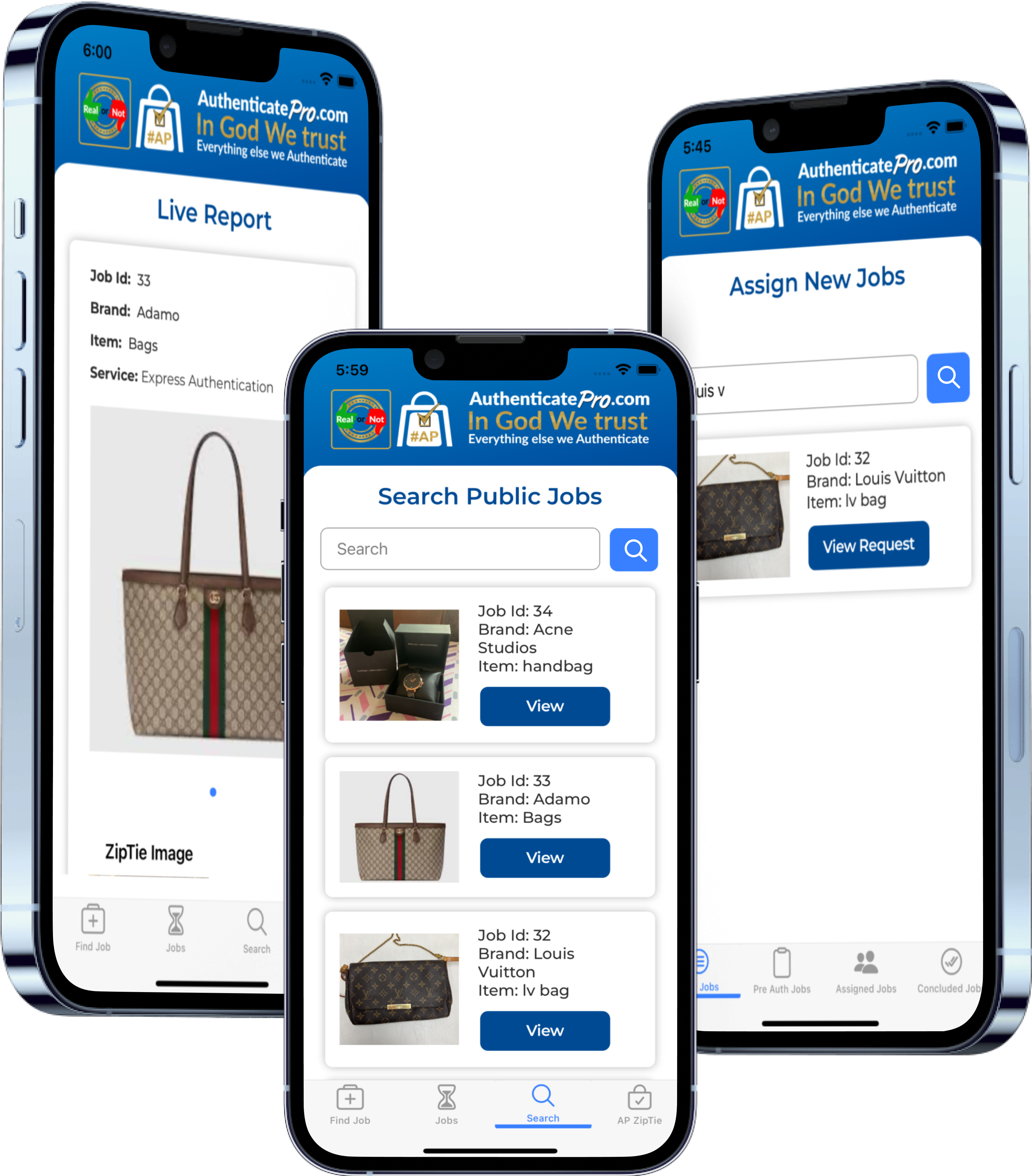
Authenticate Pro’s workflow combines app-based submission, image review, and expert involvement. Authentications move to human experts to achieve approximately 99% accuracy in the conclusion, based on the company’s published information.
That escalation matters.
A human expert can assess context, construction, brand-specific details, and unusual characteristics that a basic checklist may miss. When uncertainty remains, the item should be held: not priced, listed, or sold.

Step 5: Keep the item connected to its report
A professional authentication result is most useful when it stays connected to the specific item.
Authenticate Pro offers AP ZipTie and report lookup options for applicable services. The company explains that the unique Zip number connects an item to its report, while the report provides the authentication result.
For stores, this can support:
- Item-level traceability
- Customer questions
- Listing documentation
- Return-fraud prevention
- Internal review
- A clearer handoff between employees
Review the current service details and terms, including applicable turnaround times, guarantees, and ZipTie conditions.
Step 6: Document the decision
Your record should show:
- Who submitted the item
- What service was used
- When the review occurred
- The result
- Any limitations or conditions
- Whether the item was approved, rejected, or held
- What happened next
Documentation does not make a counterfeit legal. It does show that your business used a defined process rather than ignoring warning signs.
What to do when an item fails authentication
Do not quietly return the item to inventory.
Use a written response protocol:
- Remove the item from active inventory.
- Do not list, sell, donate, or transfer it as authentic.
- Preserve intake records and photos.
- Review other items from the same source.
- Notify the appropriate manager.
- Address the customer issue promptly if the item was sold.
- Consult local counsel or law enforcement when appropriate.
Your store should also define how employees handle terms such as “replica,” “inspired,” “fake,” “knockoff,” and “counterfeit.” These are not interchangeable marketing descriptions. Staff should never use vague wording to make a questionable item easier to sell.
Turn authentication into a customer-trust advantage
Professional authentication is not only defensive.
It can help your store answer the customer’s most important question with evidence.
Clothes Mentor Reno described Authenticate Pro as a value-added service that gives customers confidence when purchasing high-dollar branded goods and helps the store stand apart from competitors.
That is the difference between saying:
“We don’t sell fakes.”
And showing:
“This item was reviewed through a documented professional authentication process.”
Customers notice the difference.
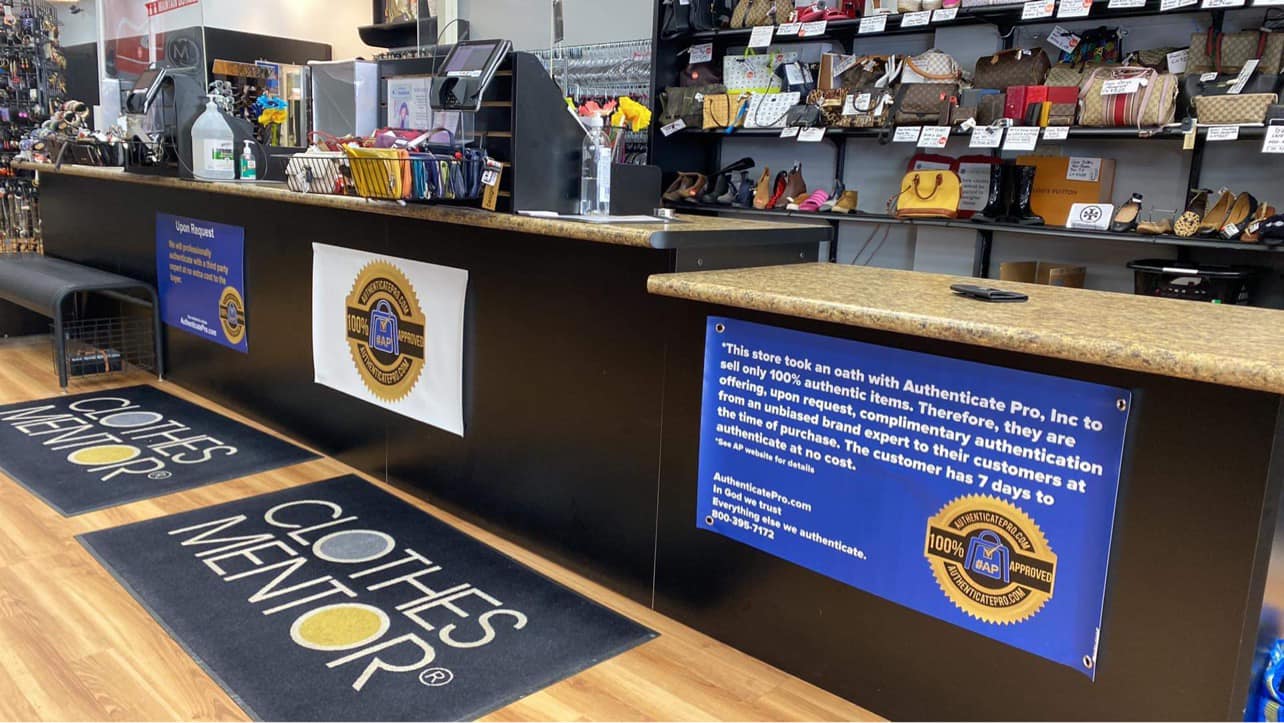
Consider making authentication visible through:
- A clearly posted authenticity policy
- Staff talking points
- Item-level reports where applicable
- A process for customer-requested verification
- Professional authentication for high-risk categories
- Consistent records for every approved item
Authenticate Pro’s reseller membership program is designed for resale businesses that want structured authentication support. Current service options and pricing are available on the Authenticate Pro pricing page.
Build the strategy before the problem
Counterfeit liability is easier to manage before an item is bought, listed, or sold.
Start with five decisions:
- Which categories require professional authentication?
- What information must staff capture at intake?
- Who can approve or reject a high-risk item?
- Where are reports and transaction records stored?
- What happens when a customer challenges authenticity?
The goal is not to make every employee an expert in every brand.
The goal is to build a system that combines:
- Trained staff
- Clear escalation rules
- Professional authentication
- Human expert review
- Item-level documentation
- Prompt customer response
“We don’t sell fakes” is a statement.
A documented authentication workflow is a strategy.
When your store is ready to strengthen its process and authenticate luxury items with greater confidence, contact Authenticate Pro to discuss the right approach for your business.

Leave a Reply