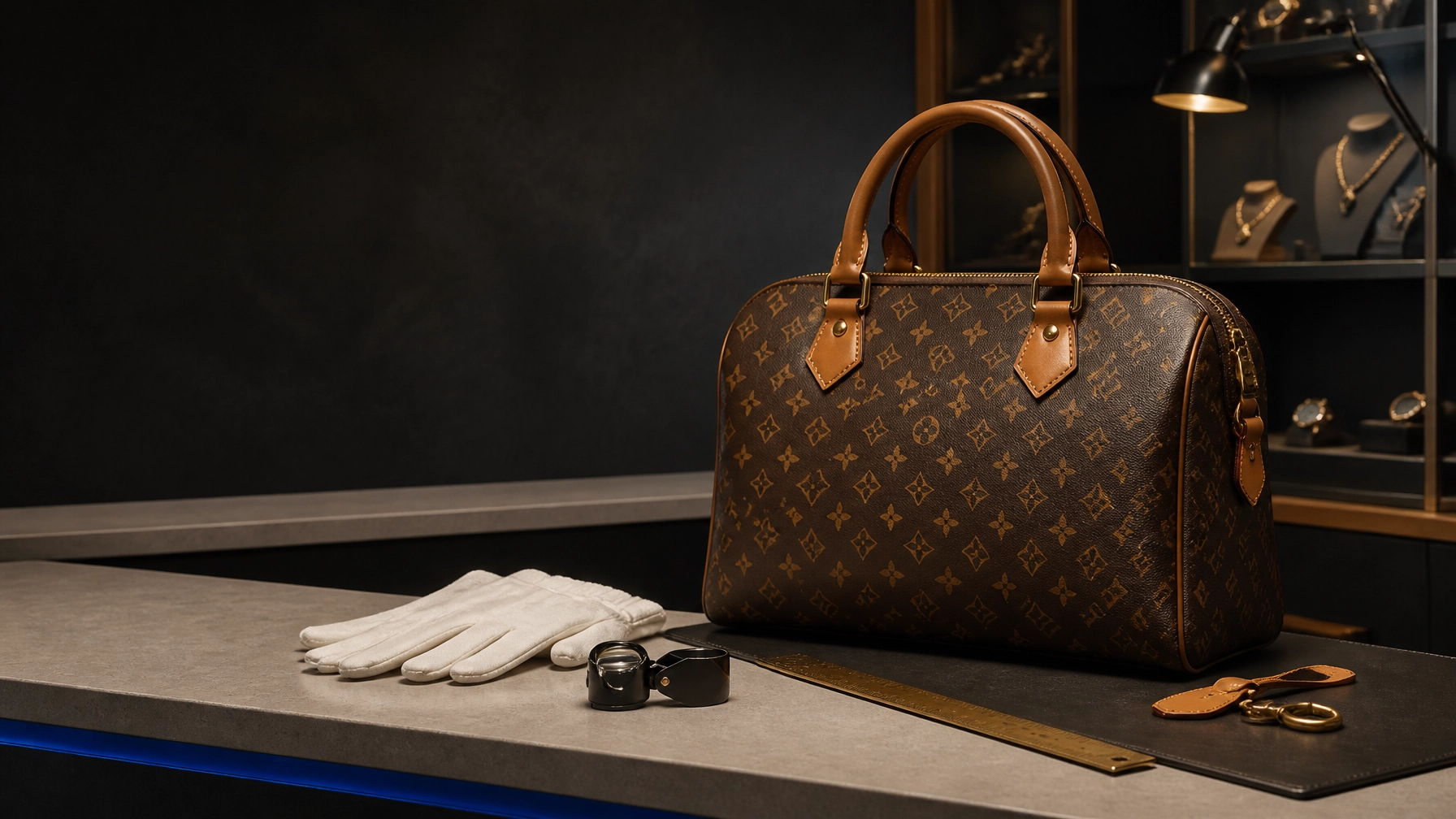
A Louis Vuitton bag can bring strong resale value: or serious risk.
How many times a week does a customer ask, “Is this real?” For pawn shops and resale stores, the answer cannot depend on a quick glance, a date code, or a seller’s receipt.
A reliable pawn shop authentication process uses multiple checkpoints:
- Materials
- Monogram and canvas construction
- Stitching
- Hardware
- Heat stamps and interior details
- Date codes, serial markings, and NFC-era considerations
- Professional escalation when details conflict
This guide will help your team screen Louis Vuitton items during intake. It is not a replacement for a qualified expert. No single detail proves authenticity.

Start With a Consistent Intake Process
The best counterfeit detection system is repeatable.
Use the same inspection order for every Louis Vuitton item:
- Review the item’s overall shape and construction.
- Examine the canvas, leather, or other primary materials.
- Check monogram placement and pattern alignment.
- Inspect stitching and edge finishing.
- Review hardware, zippers, and engravings.
- Locate and evaluate the date code or production marking.
- Compare all findings with the claimed model and production era.
- Escalate when the evidence is mixed or the financial risk is high.
This macro-to-micro approach keeps staff from overrelying on one “famous” detail.
1. Inspect the Materials First
Authentic Louis Vuitton pieces are known for structured construction and carefully finished materials. The correct characteristics vary by model, age, and collection, so compare the item with reliable model-specific references.
Monogram canvas
Classic Louis Vuitton Monogram canvas is generally a coated canvas with a firm, durable hand. It should not feel like thin plastic, paper, or excessively glossy vinyl.
Look for:
- A sturdy but flexible feel
- A consistent surface texture
- A warm brown base color
- Crisp, clean monogram motifs
- Even print density
- No obvious smudging, bleeding, or fuzzy edges
A counterfeit may feel too light, too stiff, overly shiny, or unusually squeaky when handled. These signs are not conclusive by themselves, but they deserve attention.
Leather trim
Check the leather for:
- Consistent color and grain
- Clean edge finishing
- Even glazing
- Secure attachment to the canvas
- Hardware that sits correctly on the leather
Natural patina can develop over time. Vintage leather may show darkening, wear, or surface marks. Artificially aged leather can look uneven, overly orange, or distressed in places that do not make sense based on normal use.
2. Study the Monogram and Canvas Details
Pattern placement is one of the quickest intake checks.
On many symmetrical Louis Vuitton models, the Monogram should appear centered and balanced. The pattern often aligns across seams, pockets, tabs, and panels. Randomly chopped motifs, awkward seam placement, or visibly uneven symmetry can be warning signs.
But use caution. Pattern cutting varies by model. A motif being cut off does not automatically mean the item is fake.
Check the direction of the pattern
Some Louis Vuitton bags use a single piece of canvas wrapped around the body. On certain models, such as some Speedy and Alma constructions, one side may show the Monogram upside down because of this design method.
That means an upside-down pattern is not automatically a counterfeit indicator.
The correct question is:
Does the pattern direction match the known construction of this specific model?
Compare the entire panel
Inspect the canvas around:
- Handles
- Exterior pockets
- Side seams
- Bottom panels
- Interior pockets
- Leather tabs
- Decorative bands
A high-quality counterfeit may get the general color right while missing the pattern scale, spacing, or placement. A real component may also be attached to a counterfeit body. Treat mixed signals seriously.

3. Check Stitching and Construction
Stitching can reveal rushed manufacturing.
On authentic pieces, stitches are generally:
- Straight
- Evenly spaced
- Securely finished
- Consistent around curves and corners
- Free of loose threads and skipped sections
On many Louis Vuitton leather components, stitch spacing is relatively consistent. Some guides reference approximately five to six stitches per inch on certain areas. However, stitch counts vary by model and component. Use counts only as a supporting check.
Look at the thread
Classic Monogram canvas often uses a mustard or golden-beige thread. Be cautious if you see:
- Neon yellow or bright orange thread
- White or cream thread where it does not belong
- Fuzzy, cheap-looking thread
- Inconsistent thread color on matching components
- Loose ends or visible rework
Also inspect how the stitching behaves around corners. Poor construction may cause puckering, waviness, uneven tension, or gathered canvas.
4. Examine Hardware, Zippers, and Engravings
Hardware should match the quality and design of the item.
Inspect:
- Zipper pulls
- Buckles
- Rivets
- D-rings
- Feet
- Locks
- Decorative studs
- Hardware color and finish
Authentic hardware typically feels solid and appropriately weighted. Engravings should be clean, sharp, and correctly spaced for the model and era.
Counterfeit warning signs include:
- Lightweight or hollow-feeling hardware
- Blurry or shallow engravings
- Incorrect lettering or spacing
- Rough edges
- Uneven plating
- Flaking or bubbling finish
- A zipper that feels flimsy or catches repeatedly
Do not reject an older bag simply because the hardware shows wear. Honest wear is expected on pre-owned luxury goods. Focus on whether the wear pattern makes sense and whether the underlying construction remains consistent.
5. Review Heat Stamps and Interior Details
The interior heat stamp should be clear and properly aligned.
Look for:
- Balanced lettering
- Correct spacing
- A level stamp
- Clean impressions
- No double stamping
- No blurry or overly deep lettering
Check the lining and pocket construction against the claimed model. A bag with the wrong lining material, incorrect pocket layout, or mismatched interior color should be treated as high risk.
Receipts, dust bags, and packaging may support a seller’s story. They do not prove authenticity. These items can be replaced or reproduced.
6. Understand Date Codes and Serial Markings
Louis Vuitton date codes are often misunderstood.
For many older items, a date code may identify a manufacturing location and production period. The format and meaning have changed over time. The location inside the bag also varies by model.
Important intake rules:
- A date code does not prove authenticity.
- Counterfeiters can copy legitimate codes.
- Codes can be stamped incorrectly or placed in the wrong location.
- The code must match the item’s construction, model, and claimed era.
- A correct-looking code cannot override suspicious materials or hardware.
What about newer Louis Vuitton items?
Louis Vuitton moved toward embedded NFC technology in newer products, and visible date codes are generally not expected on many bags from the newer production era.
If a seller claims a bag is a recent model but presents a visible date code that does not fit the expected era, escalate it. Do not make a final decision based on a date-code rule alone. Model and production variations matter.
For additional background on date-code limitations and model-specific details, review a specialist guide such as D.J.R. Authentication’s Louis Vuitton counterfeit identification guide.
A Practical Intake Rule: Look for Conflicts
A single unusual detail may have an innocent explanation:
- Vintage wear
- A repaired zipper
- A replaced strap
- A limited-edition variation
- A model-specific construction choice
Several conflicting details are different.
Escalate when you see:
- Correct-looking canvas with poor hardware
- A plausible date code in the wrong location
- Good stitching but an incorrect heat stamp
- A seller claiming a recent item with an inconsistent production marking
- Signs that genuine parts may be attached to a counterfeit body
- A high-value or limited-edition item your team does not routinely handle
When the potential loss includes the loan amount, resale value, return exposure, and reputational damage, professional review is usually the lower-risk decision.
When to Use a Luxury Authentication Service
Your staff’s visual screening process should filter obvious concerns. It should not force employees to make a high-stakes final call outside their expertise.
Use a luxury authentication service before buying, lending against, or listing:
- High-value Louis Vuitton handbags
- Rare or limited-edition pieces
- Vintage items with unusual markings
- Items with conflicting signals
- Newer NFC-era products
- Items from unfamiliar sellers
- Any item where the cost of a mistake is significant
Authenticate Pro uses advanced systems to support the workflow, but authentications move to human experts for the final conclusion. This escalation is central to reliability. Authenticate Pro reports approximately 99% accuracy based on its recent authentication history.

Build an Evidence-Based Workflow
Before submitting an item, photograph it carefully.
Capture:
- Full front, back, sides, and bottom
- Close-ups of corners and edge glazing
- Monogram alignment across seams
- Stitching on handles, tabs, and straps
- Zipper pulls and hardware engravings
- Heat stamps
- Date codes or interior markings
- Lining, pockets, and signs of repair
- Any damage or alteration
Keep the item’s intake notes with the authentication report. This creates a better internal record and gives your team a repeatable process for future inventory.
Authenticate Pro’s resale store membership program is designed for businesses that need ongoing support when they buy and sell luxury goods. Options include Quick Check, Express Authentication, and Level 2 Authentication. Review current service details and pricing before setting your store policy.
The Bottom Line
Louis Vuitton authentication is not a one-detail test.
The strongest intake process combines:
- Material quality
- Pattern alignment
- Stitching consistency
- Hardware construction
- Heat-stamp accuracy
- Era-appropriate date-code analysis
- Professional human review when risk remains
Use this checklist to identify obvious red flags. Then escalate uncertain items before they become expensive inventory problems.
For a practical next step, review Authenticate Pro’s current pricing or visit the Authenticate Pro website to learn how your pawn shop can authenticate luxury items before the transaction is complete.
Leave a Reply