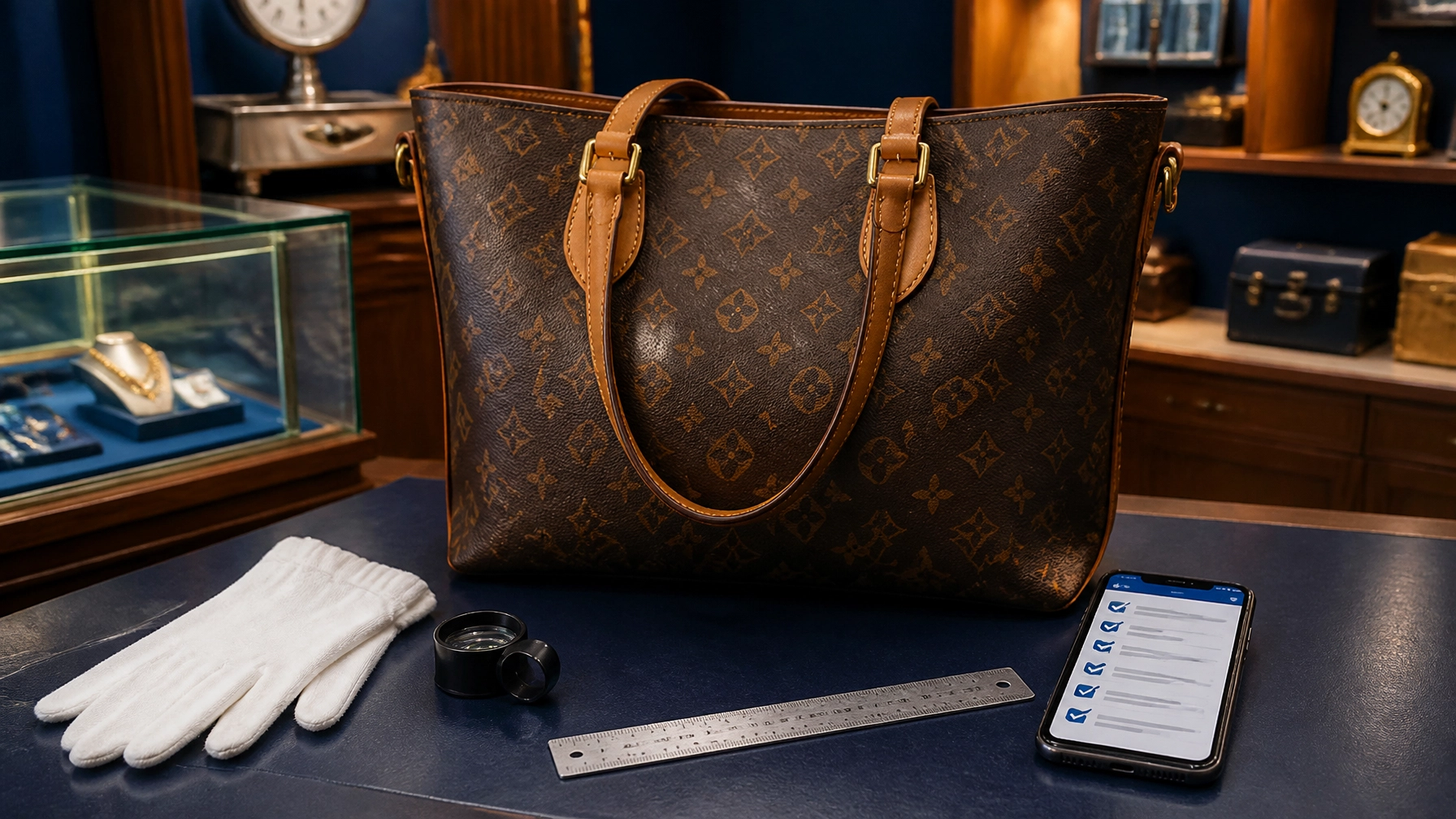
How many times a week does a customer ask, “Is this real?”
For pawn shops, the question is not casual. A counterfeit Louis Vuitton bag can create lost revenue, customer disputes, damaged reputation, and compliance headaches.
The problem is getting harder. Today’s superfakes can copy popular canvas patterns, date codes, stitching, and hardware with surprising accuracy. A quick look is not enough.
Use this guide as a practical first-pass checklist. Then escalate high-value, questionable, or unusual pieces to a professional authentication service before you buy, lend against, or list them.
Important: No single detail proves authenticity. Louis Vuitton construction varies by model, country, and production era. Look for consistency across the entire item.
Start with the overall story
Before inspecting individual details, ask whether the bag’s condition and features make sense together.
Check:
- The model name and approximate production year
- The claimed country of manufacture
- The condition of the canvas, leather, lining, and hardware
- Whether the price matches the condition and market demand
- Whether the seller’s story is specific, consistent, and verifiable
A “new” bag with dark, heavily aged vachetta leather deserves questions. So does an older bag with pristine leather, a modern microchip claim, or a date code that does not fit the model.
Price is also a signal. A low price does not prove a counterfeit. However, an unusually cheap Louis Vuitton item with no purchase history, no explanation, and no authentication report carries more risk.
Louis Vuitton authentication checklist
1. Check the heat stamp and font
Inspect the interior LOUIS VUITTON stamp and any “made in” marking under strong lighting.
On authentic pieces, the stamp is generally:
- Crisp and evenly pressed
- Cleanly spaced
- Consistent in depth
- Carefully positioned
- Made with a recognizable brand-specific font
Look closely at the letter shapes. The O should appear round rather than noticeably oval. The L has a short, neat foot. The letters should not look overly thick, blurry, painted, or uneven.
Red flags include:
- A crooked or off-center stamp
- Uneven lettering depth
- Rough edges around the embossing
- Generic-looking serif lettering
- A heat stamp that appears printed or painted instead of pressed
Do not stop after finding one good-looking stamp. Superfakes may reproduce the logo well while missing other construction details.
2. Examine the date code or microchip expectations
Louis Vuitton identification systems changed over time. The correct inspection depends on the bag’s claimed production era.
Older pieces may have:
- Digits-only codes
- Two letters followed by four digits
- Codes using month-and-year formats
- Later codes using week-and-year formats
Starting around 2021, many Louis Vuitton products moved away from visible date codes and began using embedded RFID or NFC microchips. The exact transition can vary by product and production period.
That creates several important pawn shop checks:
- Does the item’s identification method fit its claimed age?
- Does the code use a plausible format for that era?
- Do the factory letters make sense with the “made in” marking?
- Does the model appear to have been produced during the stated period?
- Is the seller treating a date code as the only proof of authenticity?
A visible date code is not a certificate of authenticity. Counterfeiters can copy legitimate-looking codes. Modern fakes may also contain dummy or nonfunctional chips.
Treat code inconsistencies as a reason to pause and escalate, not as the sole reason to make a final decision.
3. Inspect monogram canvas alignment
Louis Vuitton’s coated canvas pattern is one of the most recognizable features of its classic handbags. It is also one of the easiest areas for counterfeiters to get almost right.
Inspect:
- Pattern symmetry on the front panel
- Alignment at seams and side panels
- Placement of the LV initials and floral motifs
- Whether the print is sharp and evenly colored
- Whether the canvas feels sturdy and lightly textured
On many classic models, the canvas is cut in a way that creates a balanced, continuous appearance. Some models may have upside-down motifs on a back panel because of how the canvas is constructed. That is why you must compare the exact model rather than apply one universal rule.
Red flags include:
- Randomly chopped motifs
- Misaligned flowers at seams
- Blurry or oversaturated printing
- Uneven spacing
- Thin, overly shiny, or plasticky-feeling canvas
For a pawn shop, model-specific comparison matters. A Neverfull, Speedy, Pochette Métis, and vintage shoulder bag will not have identical construction details.

4. Count and inspect the stitching
Stitching is a valuable counterfeit detection point because it reveals how consistently the item was assembled.
Look for:
- Straight stitch lines
- Even spacing
- Tight construction
- Consistent distance from the edge
- Clean corners
- Matching stitch counts on mirrored components
Authentic Louis Vuitton pieces commonly use a warm mustard-yellow thread on vachetta leather. The thread should look controlled and slightly waxed, not neon, loose, or synthetic.
Watch for:
- Skipped stitches
- Loose ends
- Overlapping or crooked stitches
- Different stitch counts on matching handle attachments
- Uneven stitching around tabs, handles, or zipper panels
Superfakes may match the thread color. They often struggle with perfect symmetry, spacing, and stitch counts across multiple areas.
5. Evaluate hardware and engraving
Hardware should feel substantial and consistent with the quality of the bag.
Check:
- Weight
- Finish
- Color consistency
- Zipper movement
- Engraving clarity
- Alignment of logos or lettering
Authentic hardware generally feels solid rather than hollow or tinny. Engravings should be crisp, centered, and evenly finished.
Potential warning signs:
- Lightweight hardware
- Shallow or blurry engravings
- Different gold tones across zippers, rings, and rivets
- Peeling or uneven plating
- A zipper that catches, sticks, or feels poorly finished
Hardware wear is possible on authentic bags. The question is whether the wear looks consistent with the item’s age and overall condition.
6. Check leather, glazing, lining, and odor
Louis Vuitton vachetta leather typically begins pale and develops a honey or caramel patina over time. Patina should make sense for the bag’s age, use, storage, and exposure.
Inspect the leather for:
- Even or explainable patina
- Natural grain
- Supple feel
- Consistent color across comparable panels
Also inspect edge glazing. Authentic glazing should generally be smooth and controlled. Lumpy, bubbled, cracked, or excessively thick edge paint is a concern.
The lining must match the model and era. Louis Vuitton has used different textiles, microfiber, and coated materials across its product lines. A lining that does not match known specifications deserves escalation.
Finally, use odor only as a supporting observation. A strong chemical, glue, or plastic smell is a red flag. It is not conclusive by itself.
Why superfakes require a second layer
A basic visual inspection can catch obvious counterfeits. It is less reliable against a well-made fake that copies one or two recognizable details.
A superfake may have:
- A plausible date code
- Correct-looking monogram placement
- Good stitching color
- Heavy-feeling hardware
- A convincing logo stamp
The weakness may appear only when the details are compared together.
That is why pawn shop authentication should use a layered process:
- Inspect the item in person.
- Photograph every relevant detail.
- Document the seller’s description and claimed history.
- Compare the exact model and production era.
- Escalate the item to human experts when the value or risk justifies it.
- Keep the authentication report with your inventory records.
Do not rely on a single app result, date code, receipt, dust bag, or box. Accessories can be replaced. Receipts can be copied. Codes can be replicated.
A practical workflow for pawn shops

When a Louis Vuitton item walks in, use a repeatable intake process.
Before accepting the item
- Photograph the exterior, interior, corners, handles, hardware, lining, and markings.
- Record the model if known.
- Note visible wear and repairs.
- Ask how and when the seller obtained it.
- Avoid making a high loan or purchase decision based on appearance alone.
Before listing or lending
- Complete your internal inspection.
- Confirm that the claimed date or chip expectations fit the item.
- Review pattern, stitching, stamp, hardware, and materials together.
- Escalate any high-dollar or uncertain item to an independent authentication service.
Keep the chain of evidence
Document:
- Intake date
- Employee who inspected the item
- Photos submitted
- Authentication result
- Report number or reference
- Final inventory decision
This process protects the store and gives customers a clearer answer when they ask, “Is this real?”
How Authenticate Pro helps
Authenticate Pro is built for resale stores, pawn shops, and other businesses that need a practical way to authenticate luxury items before resale.
The workflow combines technology with brand-specific review. You submit clear photos, receive a pre-authentication review from an approved brand expert, and the item can move through additional expert review before a conclusion is reached.
Most importantly, questionable items can be escalated to human experts. Authenticate Pro reports approximately 99% accuracy based on its authentication history. That is a stronger safeguard than relying on a single visual opinion from a busy counter.
The service also offers multiple review levels and turnaround options. According to the Authenticate Pro membership information, Quick Check and Express Authentication options are available, along with higher-level authentication for items requiring additional assurance. Current options and pricing are listed on the Authenticate Pro pricing page.
Authenticate Pro also supports more than 600 brands, including Louis Vuitton, Chanel, Gucci, Prada, Dior, Hermès, Fendi, and others.

The bottom line
Louis Vuitton authentication is not about finding one magic detail.
It is about checking whether the entire item tells one consistent story:
- The model fits the era.
- The date code or chip expectation makes sense.
- The stamp is correctly formed.
- The monogram is properly aligned.
- The stitching is controlled.
- The hardware feels right.
- The leather, lining, and wear are consistent.
- The seller’s story matches the evidence.
When the stakes are high, do not guess.
Use your inspection skills for the first screen. Then send uncertain or valuable pieces to Authenticate Pro for review by human experts and a documented conclusion. Visit Authenticate Pro to learn how your pawn shop can reduce counterfeit risk, protect revenue, and give customers more confidence in every luxury purchase.
Leave a Reply