"We don't sell fakes."
Every pawn shop owner, resale boutique manager, and online thrifter has said it. You might even have it printed on a sign near the register or prominently displayed in your Instagram bio. You mean it, too. You have a "good eye," you’ve been in the business for a decade, and you "know" what a real Louis Vuitton feels like.
But here is the cold, hard truth: In the eyes of the law, your intent doesn't matter as much as you think it does.
In the luxury resale market, "trust me" is not a business strategy. It’s a legal liability. If you are relying on your gut feeling to protect your business from multi-million dollar lawsuits, you aren't just taking a risk: you are operating without a safety net.
The Myth of the "Good Eye"
Many store owners believe that if they didn't know an item was counterfeit, they are safe. This is a dangerous misconception.
Under the Lanham Act (the federal law governing trademarks), selling counterfeit goods often falls under "strict liability." This means that if you introduce a counterfeit item into commerce, you can be held civilly liable regardless of whether you knew it was fake or not. Brand owners like Chanel, Rolex, and Hermès are notoriously aggressive in protecting their trademarks. They don't care if you were "tricked" by a high-end "superfake." They care that their mark was infringed upon in your store.
The financial stakes are staggering:
- Civil Penalties: Statutory damages can reach up to $2 million per counterfeit mark per type of goods sold.
- Seizures: Federal authorities have the right to seize and destroy your entire inventory if it’s found to contain counterfeits.
- Legal Fees: Even if you eventually win, the cost of defending a trademark infringement lawsuit can bankrupt a small-to-mid-sized resale shop.
Why "We Don't Sell Fakes" Fails Your Customers
Your customers aren't just buying a bag; they are buying peace of mind. When you tell a customer "we don't sell fakes," you are asking them to take a leap of faith.
In a world where 3D printing and advanced manufacturing have created "superfakes" that even some experts struggle to identify at a glance, a verbal promise isn't enough. When a customer spends $2,000 at a pawn shop or a Plato's Closet, they want proof.
If you can’t provide a third-party, professional authentication certificate, you are leaving the door open for:
- Chargebacks: If a customer takes your "authentic" bag to a boutique and a sales associate scoffs at it, that customer will initiate a chargeback. You lose the money, the item, and your standing with the credit card processor.
- Reputational Suicide: One viral TikTok from a disgruntled customer claiming you sold them a fake can end a 20-year-old business in 24 hours.

The Patented Solution: ACE Standards
At Authenticate Pro, we don’t believe in "gut feelings." We believe in a rigorous, multi-layered process that moves authentication from a guessing game to a science.
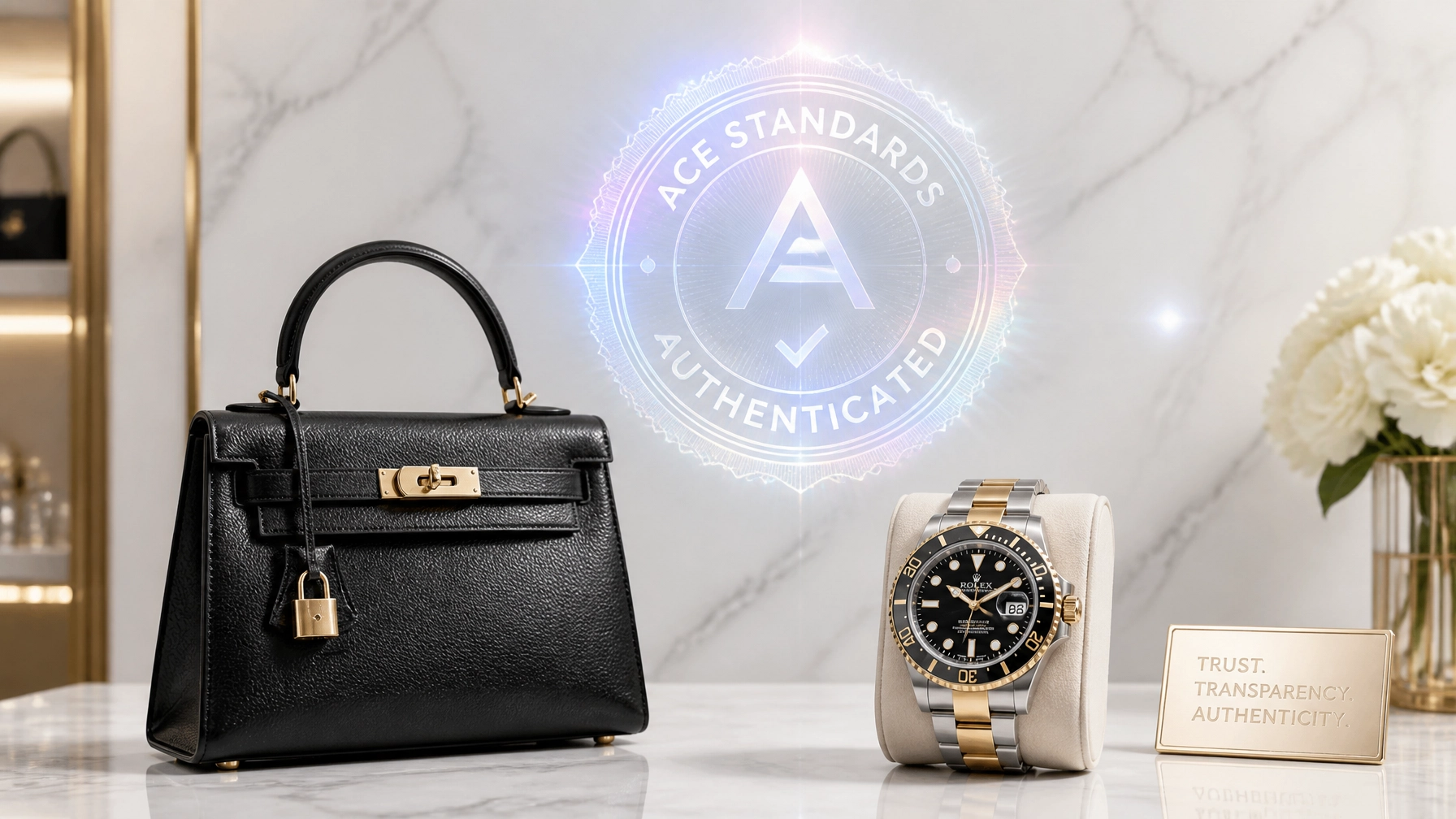
We utilize our Patented ACE Standards to ensure that every item passing through our system is vetted with unparalleled precision.
ACE stands for:
Authentication · Community · Experts
This isn't just a catchy tagline; it’s the foundation of our Issued Patent process. We don't just look at a photo and give a thumbs up. We leverage a community of specialists and proprietary technology to ensure every stitch, serial number, and material is verified.
Meet Daisy AI: Your First Line of Defense
Every hero needs a sidekick. Ours is Daisy AI, a white Maltese with a blue cape who represents our cutting-edge technological layer. Daisy AI processes thousands of data points in seconds, flagging inconsistencies that the human eye might miss.

But we don't stop at AI. While many competitors rely solely on algorithms, we know that technology has limits. That is why our workflow includes a critical human element.
From AI to Human Heroes: The 99% Accuracy Rule
When an item is processed through our platform, it doesn't just sit in a database. If there is even a shred of doubt, the process moves to our Human Experts.
In our world, these authenticators are the real heroes. They wear their blue capes with pride because they are the final line of defense against the counterfeiters who threaten your business. By combining Daisy AI’s speed with the deep-set knowledge of our human specialists, we achieve a ~99% accuracy rate.

If our AI flags a potential issue, it is immediately escalated to these experts. This dual-layer approach is what separates a "strategy" from a "liability." We provide the documentation you need to back up your claims, transforming "We don't sell fakes" into "This item has been professionally verified by Authenticate Pro."
How It Works for Your Shop
Whether you run a pawn shop, a Plato’s Closet, a Style Encore, or a Clothes Mentor, the process is designed to be seamless.
- Submit: Use our app to upload photos of the item in question.
- Verify: Our Patented ACE Standards go to work. Daisy AI analyzes the images, and our human experts provide the final verdict.
- Certify: You receive a professional authentication that you can present to your customer, significantly increasing the item's value and your store's credibility.

Stop Guessing. Start Protecting.
How many times a week do you get the question "Is this real?" from a customer?
Every time you answer without a certificate in your hand, you are gambling with your store’s future. Professional luxury authentication services are no longer a luxury for resale stores: they are a necessity.
By partnering with Authenticate Pro, you aren't just "trying to be careful." You are implementing a Patented system designed to mitigate risk, eliminate chargebacks, and build a brand that customers can trust implicitly.
Don't wait for a cease-and-desist letter or a negative review to fix your strategy. Move your pawn shop authentication and professional authentication needs to the experts.
Authentication · Community · Experts.
It’s time to stop saying you don't sell fakes and start proving it.
Ready to protect your business?
Leave a Reply