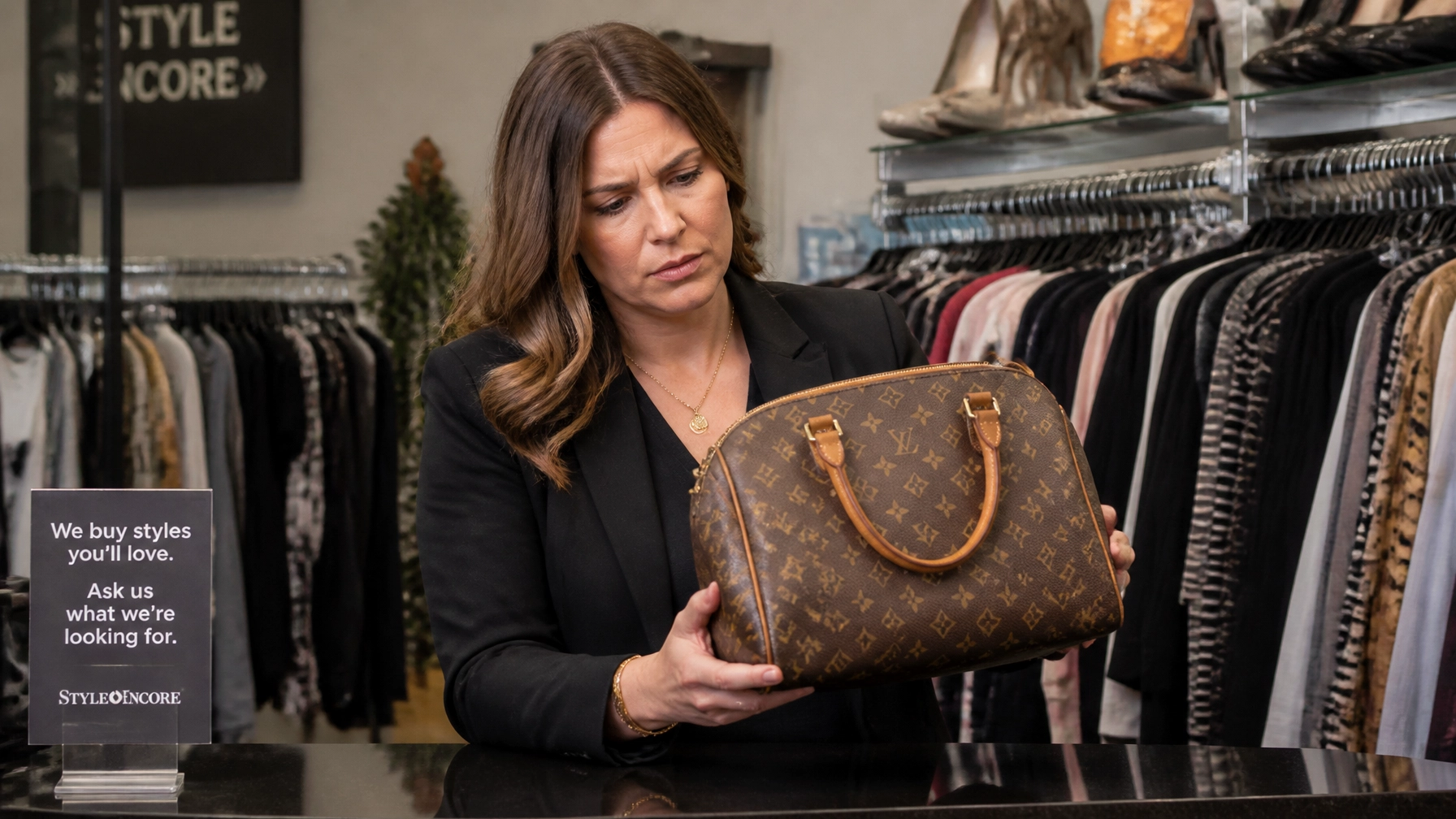
How many times a week does a customer look you in the eye and ask, “Is this real?”
For owners of resale powerhouses like Plato’s Closet, Style Encore, and Clothes Mentor, that question isn’t just about making a sale. It’s about protecting your bottom line. You might think the occasional counterfeit slip-up is just the "cost of doing business," but the reality is much darker.
A single counterfeit item doesn't just lose you the cost of that one buy-in. It creates a profit leak that can drown your monthly margins.
The Brutal Math of a Counterfeit Return
When a counterfeit item walks through your doors and makes it onto your sales floor, the clock starts ticking on a financial disaster. Many store owners calculate the loss as simply the money they paid the seller. They are wrong.
According to industry data, a $50 counterfeit sale can ultimately translate into $500 to $5,000 in total business impact. Here is where that money actually goes:
- The Immediate Refund: You lose the revenue of the sale instantly.
- Chargeback Fees: If you sold the item online or via credit card, the processing banks often hit you with hefty dispute fees.
- Wasted Labor: Your staff spent time buying it, tagging it, photographing it, and putting it out. That’s payroll hours down the drain.
- Reputational Damage: This is the big one. One viral TikTok from a customer saying "I found a fake at [Your Store Name]" can tank your foot traffic for months.
- Inventory Write-offs: Unlike a normal return, you can't put a fake back on the shelf. It’s a total loss.
For a store operating on standard resale margins, it takes dozens of perfect, authentic sales just to recover the lost profit from one counterfeit return.
Why Your Intake Staff is Stressed (And Why It’s Not Their Fault)
Your buyers are fast. They have to be. Between sorting through bags of clothes and managing a line of customers, they have about 60 seconds to decide if a Louis Vuitton Neverfull or a pair of Jordan 1s is the real deal.
Superfakes are getting scary good. We aren't talking about "Louis Vuiton" spelled wrong on a plastic tag anymore. Modern replicas use real leather, correct date codes, and high-quality hardware. Expecting a 19-year-old associate to catch every high-end replica without help isn't just optimistic, it's dangerous for your business.

The ACE Standard: Your Secret Weapon
To stop the leak, you need a system that doesn't sleep. At Authenticate Pro, we utilize our Patented process to provide a level of security that manual inspection simply can’t match. We call it the ACE Standard.
Authentication · Community · Experts
This isn't just a catchy tagline; it’s the foundation of how we protect your store.
- Authentication: We provide a rigorous, multi-point check for every item.
- Community: We tap into a vast network of data to stay ahead of the latest counterfeit trends.
- Experts: When the stakes are high, we don't guess.
Our workflow is designed for the high-speed environment of a busy resale shop. When an item is submitted through our app, it undergoes an initial analysis. However, we know that technology alone isn't enough. That’s why our process includes an essential escalation to human experts. By moving the authentication from a digital scan to a seasoned human professional, we achieve ~99% accuracy.
Meet Your New Best Friend: Daisy AI
We know that "security" can sometimes feel cold and corporate. That’s why we introduced Daisy AI.

Daisy AI is our digital sentinel (and yes, she's a very good girl). Represented as a white Maltese in a blue cape, Daisy symbolizes the protection we offer your brand. While she represents the "smart" side of our technology, she works hand-in-hand with our Issued Patent technology to ensure that nothing gets past your intake counter without a fight.
5 Practical Tips for Your Intake Staff
While you work on integrating a professional authentication membership, here are five immediate tips you can give your staff at Plato’s Closet or Style Encore to catch fakes during the buy-in process:
- Trust the "Hand Feel": Luxury brands use high-quality materials. If a "leather" bag feels like plastic, smells like chemicals, or feels unusually light, it’s a red flag.
- Check the Stitching (Under Light): Authentic luxury items have consistent, slightly angled stitching. If the thread is frayed, uneven, or bright white on a vintage bag, proceed with extreme caution.
- Weight of the Hardware: Real gold-toned hardware is usually solid brass or plated metal. It should have weight. If the zipper feels like a toy, it probably is.
- Look for "The Glitch": Fakers often get the font on the interior "Made In" stamps slightly wrong. Look for letters that are too close together or inconsistent ink depth.
- When in Doubt, Escalate: Tell your staff it is okay to say "I need to run this through our authentication partner before we can complete this buy." It’s better to lose a buy than to lose your reputation.
Stop the Leak Today
You work too hard to let counterfeiters steal your margins. By using a Patented system that combines high-speed tech with the undeniable accuracy of human experts, you turn your store into a fortress.
Whether you are running a single shop or a multi-unit franchise, the pricing for professional authentication is a fraction of the cost of a single bad return.

Don't wait for the next "Is this real?" to turn into a "I want a refund." Implement the ACE Standard: Authentication · Community · Experts: and start selling with 100% confidence.
Ready to protect your profits? Explore our services here.
Leave a Reply