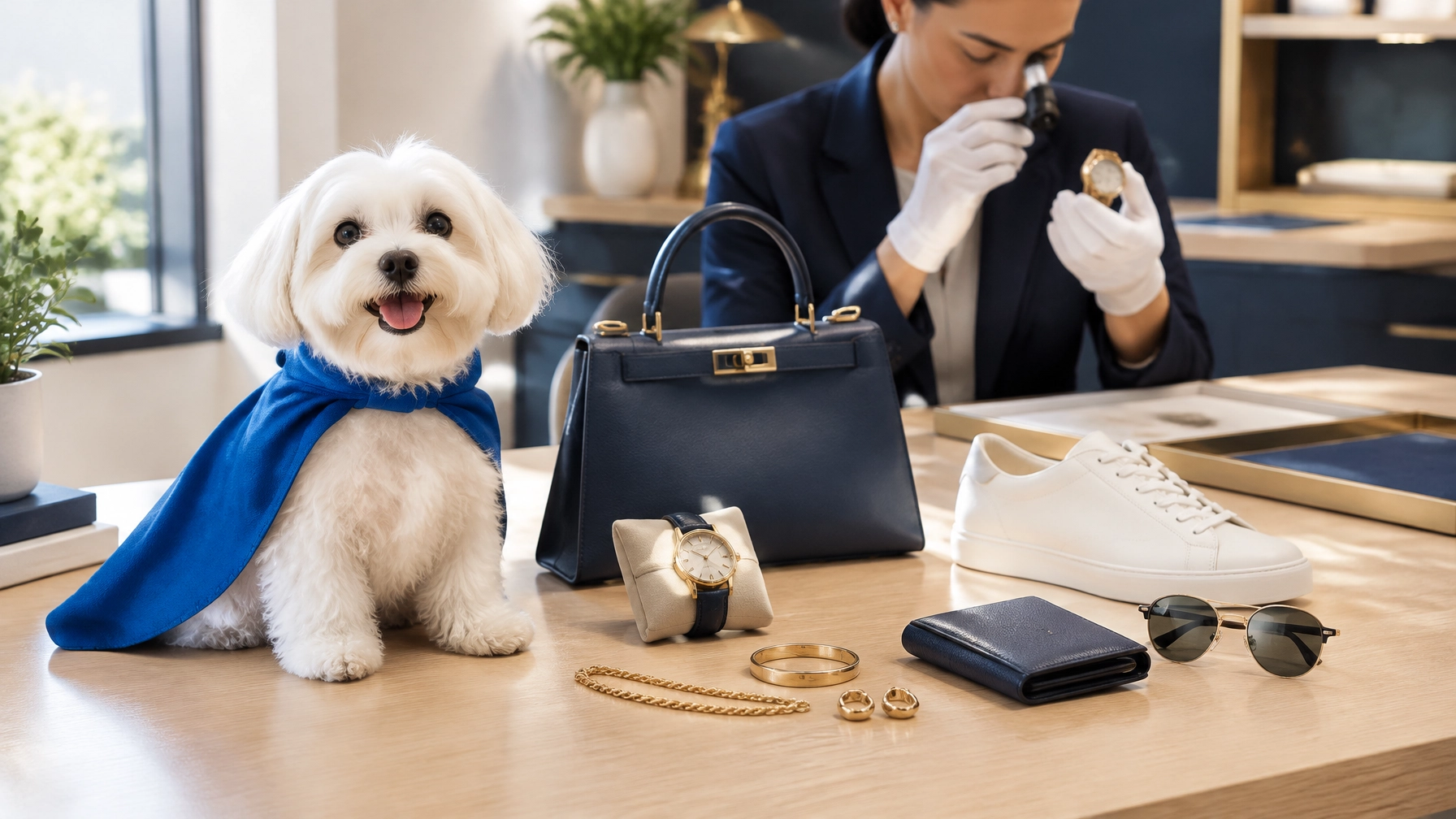
A counterfeit can look convincing across the counter. That matters when your store has to make a buy decision, set a resale price and stand behind the item afterward.
There is no reliable public ranking of the most counterfeited pawn-shop items. But luxury handbags, small leather goods, watches, jewelry, sneakers and designer eyewear are all categories worth checking carefully. U.S. Customs and Border Protection has reported large seizures involving watches, shoes, jewelry, handbags and wallets. Evidence of the range, not a precise measure of what your shop will see.[^1][^2]
Here are practical red flags for each category, and why a quick visual check shouldn’t be the only step for a high-value item.

Use this as a screening guide. No single detail can confirm that an item is genuine or counterfeit.
1. Designer handbags
Handbags combine recognizable designs, strong resale demand and many details that can be copied. Chanel, Louis Vuitton, Gucci, Prada, Dior, Hermès and other luxury names may warrant closer scrutiny.
Look closely at:
- Stitching: Check for consistent spacing, tension and finish. Uneven seams or loose threads can be a warning sign.
- Logo and stamps: Look for misspellings, unusual spacing, inconsistent fonts or imprecise embossing.
- Materials and hardware: Compare the feel, finish, weight and construction with reliable references for that model.
- Interior and identifiers: Check labels, codes and construction together. A code by itself is not proof.
- Model details: Does the lining, pocket layout, hardware and color match the specific model and production period?
Brand guidance also calls out details such as stitching and logo accuracy. Chanel warns that unusually low prices and unauthorized sales channels can be warning signs.[^3][^4]
2. Small leather goods
Wallets, card holders, belts, pouches and key cases are compact, easy to resell and easy to overlook during intake.
Inspect the whole piece, not just its logo. Check edge paint, glazing, stitching, leather or coated-canvas texture, hardware, interior construction and alignment. Confirm that the claimed color and model actually match the item.
A box, dust bag, receipt or authenticity card may help provide context, but it does not prove the item is genuine. Packaging and paperwork can also be copied.
3. Watches
A watch can appear convincing in a quick glance and still have mismatched components or incorrect details. In August 2026, CBP reported seizing a shipment containing 152 counterfeit watches and 32 counterfeit shoes, with a stated genuine-equivalent MSRP above $9.3 million.[^1]
For an initial screening, examine:
- Dial text, markers and hand alignment
- Case finish, crown, engravings and bracelet or clasp fit
- Whether the reference details and claimed complications match the model
- The movement, when it can be properly inspected
A serial number, box or papers are supporting details, not standalone authentication. For a costly or complex watch, use professional review by someone qualified to assess that category.
4. Jewelry
Jewelry checks can involve both brand authenticity and claims about metal or stones. A piece may have a convincing mark but still not be made from the stated materials.
Inspect maker’s marks, hallmarks, engraving, clasp construction, soldering and symmetry. Remember: a stamp can be imitated, too. For metal content, use appropriate professional testing rather than relying on color or a magnet. For significant gemstone value, get a qualified specialist’s assessment.
CBP has also reported a 2026 seizure of counterfeit earrings, necklaces and bracelets with a stated genuine-equivalent value above $3 million.[^2]
5. Sneakers
Limited releases, collaborations and high-demand models deserve extra attention. Compare the pair with dependable product references and check:
- Shape, symmetry and panel placement
- Stitching, logos, outsole and midsole details
- Inside labels, style information and box label
- Whether the colorway and release details match the claimed model
A matching tag or box is not conclusive. Superfakes may reproduce familiar identifiers, and normal wear can make an authentic shoe look unusual. Treat individual tells as reasons to investigate, not a final verdict.
6. Designer sunglasses
Sunglasses and other eyewear are small, portable and sold under many recognizable labels. Check the frame finish, hinge quality, logo or engraving, symmetry, model codes and packaging against reliable product information.
Appearance cannot confirm UV protection. When that matters, have the lenses tested by an optical professional. A case or code alone does not establish authenticity.

Close inspection can reveal inconsistencies, but sophisticated replicas can defeat a quick visual check.
Why one “tell” isn’t enough
Counterfeit detection is a comparison of details, not a search for one magic flaw. A misspelling or poor seam can be a strong warning. But the absence of obvious errors does not make an item authentic.
That is especially important with superfakes: replicas designed to imitate surface details more convincingly. Staff can use visual checks to decide when an item needs further review. They should not have to treat those checks as a substitute for professional authentication.
A practical intake routine
- Record the claim. Note the brand, model, condition, included accessories and seller-provided history.
- Photograph key details. Capture labels, codes, hardware, stitching, soles, clasps and any areas of concern in clear light.
- Compare the exact model. Use trustworthy references. Avoid judging against a vaguely similar product.
- Pause on inconsistencies. An implausible price, rushed sale or conflicting details deserves more scrutiny.
- Escalate high-risk items. If the value or uncertainty is significant, get professional authentication before you commit.
Get expert review without slowing every decision
Pawn-shop authentication needs to fit the pace of intake. With Authenticate Pro, staff submit photos online for review. Authentications escalate to human experts rather than relying on an automated result alone. The company reports approximately 99% accuracy based on its last 2,000 authentications; results depend on the information and images available for review.
Authenticate Pro’s Patented ACE approach stands for Authentication · Community · Experts. Its workflow combines AI support with brand-expert review, community input and an Authenticate Pro conclusion. Clear, well-lit photos of multiple angles and identifying details help the review move forward.
Depending on the service and item, the company lists Quick Check turnaround at 20 minutes to 12 hours and Express Authentication at 15 to 60 minutes; availability and timing can vary. Check the current pricing and service details before placing an order.
For a retail perspective, Clothes Mentor Reno describes using Authenticate Pro as a value-added service to build staff and customer confidence with high-value items.
Build confidence into the transaction
How many times a week does a customer ask, “Is this real?” A consistent screening process helps your team know when to proceed and when to ask for help. That can protect your buying decisions, your resale inventory and the trust customers place in your store.
Explore Authenticate Pro for resale stores, visit AuthenticatePro.app, or call 800-395-7172 to learn more about online professional authentication.
[^1]: U.S. Customs and Border Protection: Louisville CBP intercepts a $9 million shipment of counterfeit watches and shoes
[^2]: U.S. Customs and Border Protection: counterfeit jewelry seizure
[^3]: Givenchy: Anti-Counterfeit guidance
[^4]: CHANEL: Anti-Counterfeit guidance
Leave a Reply