

How many times a week does a customer ask, “Is this real?”
For resale stores, pawn shops, and online thrifters, that question is not a delay. It is a buying signal.
The customer is interested. They are also managing risk.
A professional authentication process gives you a direct way to answer with evidence, not guesswork. It can help you price luxury goods with more confidence, reduce disputes, and stand apart from sellers who rely only on a label or a personal opinion.
The opportunity is simple:
Do not treat authentication as a back-office expense. Treat it as a visible part of your value proposition.
Why proof of authenticity affects price
A designer handbag is not priced only by its material condition or brand name.
The buyer is also paying for confidence.
An unverified luxury item creates questions:
- Is the bag genuine?
- Has it been repaired or altered?
- Can the seller stand behind it?
- What happens if another expert says it is counterfeit?
- Will the buyer be able to resell it later?
Those questions create friction. Friction slows sales and pressures sellers to negotiate.
A professionally authenticated item changes the conversation:
- ✅ The item has been reviewed through a defined process.
- ✅ The buyer can access a report or verification record.
- ✅ The seller can explain how authenticity was evaluated.
- ✅ The item can be marketed as a lower-risk purchase.
- ✅ The store has a stronger basis for its pricing.
Authentication does not guarantee that every item deserves a premium price. Condition, rarity, color, demand, and season still matter.
But authentication helps remove one of the biggest objections: uncertainty.
The trust advantage for resale stores and pawn shops
Customers do not compare every resale business on price alone.
They compare risk.
A buyer may pay more at the store that offers a clear professional authentication process because the alternative is uncertainty from a private seller or an unverified listing.
That is especially important for:
- Luxury handbags
- Designer shoes
- Watches
- Jewelry
- High-value accessories
- Collectible fashion
- Branded items purchased online
This is where a luxury authentication service becomes a marketing tool.
Instead of saying only:
“Designer bag for sale.”
You can say:
“Professionally authenticated designer bag with an available authenticity report.”
That second message gives the buyer a reason to choose your business over a cheaper listing.
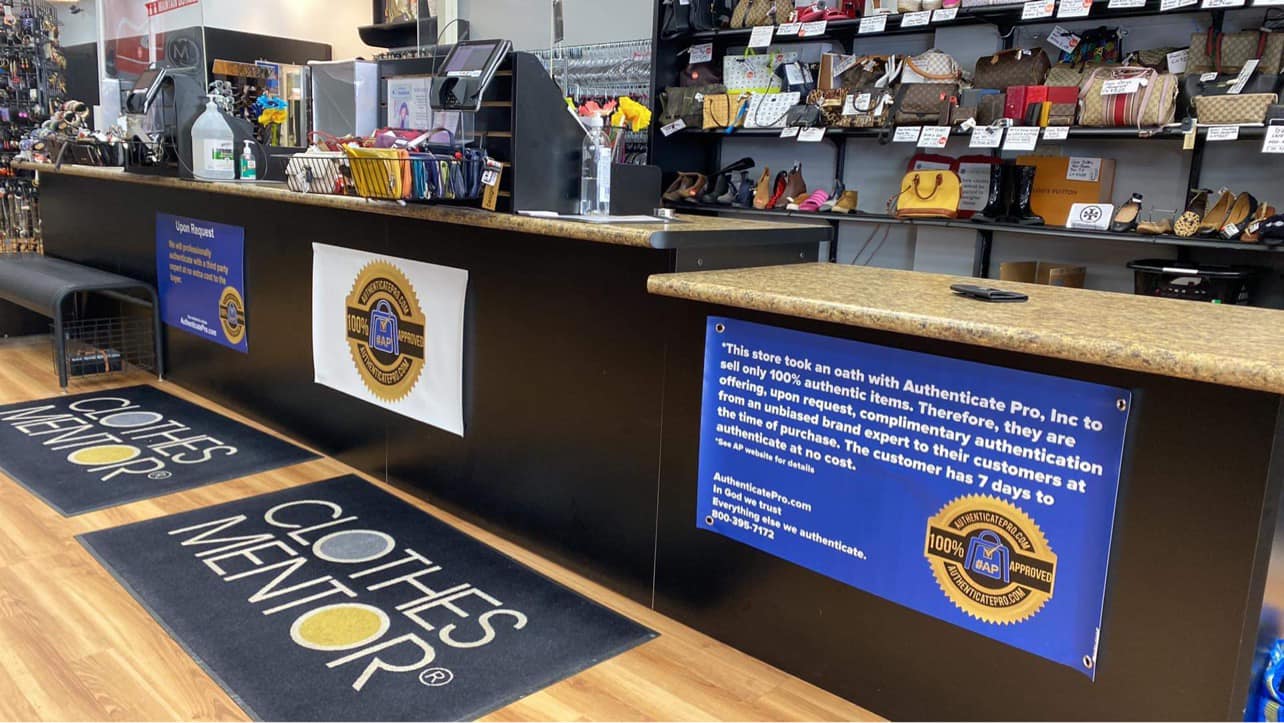
Clothes Mentor has described this benefit directly:
“We love being able to offer AP as a value add service. It gives our customers the utmost confidence when purchasing high dollar authentic brand name goods which in return has helped increase our sales.”
That is the goal. Turn confidence into conversion.
Make authentication part of the product, not an afterthought
Many businesses authenticate an item internally but fail to market the result.
That leaves money on the table.
If authentication supports the value of the item, make it visible in every customer-facing channel.
In-store
Use shelf tags or display signage such as:
- Professionally authenticated
- Authenticity report available
- Ask us about our authentication process
- Verified before sale
- Shop with confidence
The message should be clear without overpromising.
Avoid vague statements such as “We think it is authentic.” That sounds uncertain.
Use specific language that reflects your actual process.
Online listings
Include authentication in the title or first lines of the description.
For example:
Authenticated Louis Vuitton handbag | Professional authentication report available
Or:
Designer bag authentication completed before listing
Online buyers cannot inspect the item in person. They need more information before they trust the transaction.
Include:
- The authentication status
- The service used
- Whether a report is available
- The turnaround for any buyer-requested review
- Any conditions connected to a guarantee or seal
For online sellers, the Authenticate Pro membership program describes a process that can support customer authentication requests after purchase, subject to program terms and item conditions.
Social media and live selling
Use authentication as content.
Show customers that you take the process seriously:
- Explain why authentication matters.
- Share how customers can request a report.
- Feature authenticated items in live sales.
- Answer “Is this real?” with a defined process.
- Explain the difference between an opinion, a report, and a guarantee.
You do not need to reveal confidential expert methods. You do need to make your standards visible.
Speed matters when inventory is moving
Authentication only creates a pricing advantage if it fits your workflow.
A resale store cannot wait indefinitely to list a high-demand bag. A pawn shop may need a decision before completing a loan. An online thrifter may need to buy, list, or return an item quickly.
Turnaround options can help match the service to the inventory.
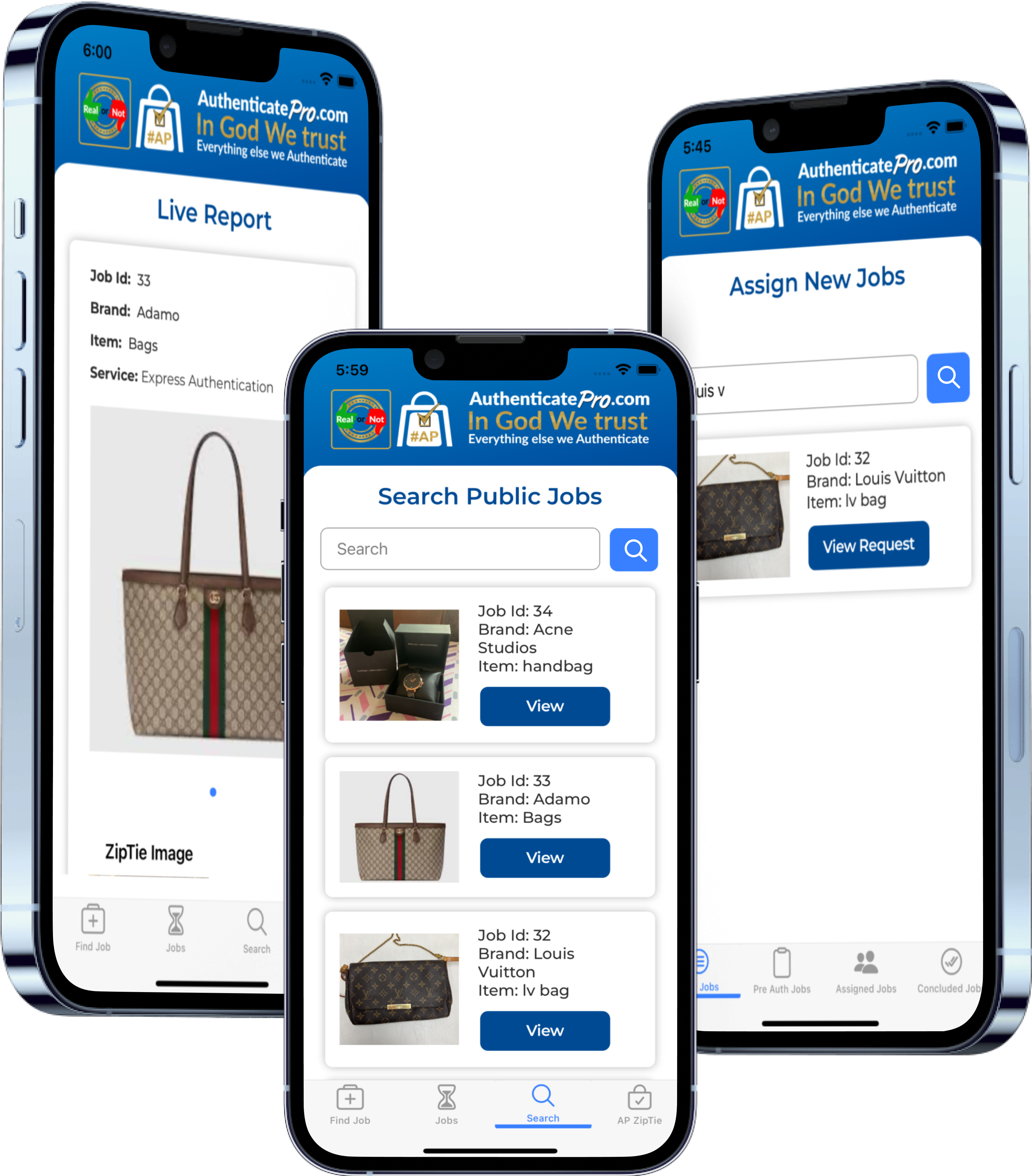
Authenticate Pro currently lists:
- Mini Check: approximately 20 minutes to 12 hours
- Quick Check: approximately 20 minutes to 12 hours
- Express Authentication: approximately 15 to 60 minutes
- Level 2 Authentication: approximately 12 to 48 hours
Availability can depend on the brand, item, image quality, and expert capacity. For current options and rates, review the Authenticate Pro pricing page.
A practical workflow looks like this:
- Receive or source the item.
- Capture clear photos and item details.
- Submit the item through the authentication platform.
- Use preliminary tools where appropriate.
- Escalate the authentication to human experts.
- Receive the conclusion and report.
- Price, list, or decline the item based on the result.
The human-expert step matters. Authenticate Pro’s approach combines technology with qualified human review, and authentications escalate to human experts to achieve approximately 99% accuracy.
That is a much stronger message than relying on a quick visual check alone.

Use ACE to explain the process
Authenticate Pro describes its model as:
Authentication · Community · Experts
That framework gives resale businesses a simple way to explain why professional authentication is more reliable than an individual guess.
Authentication
The item enters a documented process instead of receiving an informal opinion.
Community
Authentication can be supported by a network of brand specialists and experienced reviewers.
Experts
When the item requires deeper review, the process escalates to human experts. This is critical for difficult, expensive, vintage, or unusual items.
For your customers, the message is easy to understand:
Technology helps organize the process. Human experts help deliver the conclusion.
That combination supports confidence without asking customers to trust an unexplained “yes” or “no.”
How to turn authentication into pricing power
Professional authentication can support a stronger price in four practical ways.
1. Reduce the discount for uncertainty
Buyers often negotiate because they are protecting themselves from risk.
Proof of authenticity gives them less reason to demand a large discount simply because the item is difficult to verify.
2. Position the item as ready to buy
A buyer may pay more for a handbag that has already been reviewed than for one they must authenticate themselves after purchase.
You are selling the item and saving the customer time.
3. Protect high-value inventory
When the stakes are higher, a counterfeit can cost the business far more than the authentication fee.
A professional process can help prevent:
- Lost inventory value
- Chargebacks
- Refund disputes
- Reputation damage
- Wasted staff time
- Incorrect purchase decisions
4. Create a premium tier
Consider separating inventory into clear categories:
- Standard fashion items
- Professionally authenticated
- Authenticated with enhanced coverage or guarantee options
- As-is or unverified items, where appropriate
Do not imply that an “as-is” opinion carries the same protection as a guaranteed authentication. Be transparent. Clear conditions build more trust than aggressive claims.
A simple listing formula that works
Use this structure in product descriptions:
1. State what was authenticated.
Example: “This designer handbag was submitted for professional authentication.”
2. Explain the customer benefit.
Example: “The buyer can shop with greater confidence and access the available report.”
3. State the timing or request process.
Example: “Authentication options are available before purchase or within the stated post-purchase window, subject to program terms.”
4. Be clear about conditions.
Example: “Any seal, zip tie, guarantee, or buyer-requested review is subject to the applicable service requirements.”
This formula gives buyers useful information without making claims your process cannot support.
What to do when an item does not authenticate
A professional authentication program is not only a sales tool. It is also a screening tool.
If an item receives a negative conclusion or cannot be confidently authenticated:
- ❌ Do not list it as genuine.
- ❌ Do not quietly move it to another sales channel.
- ❌ Do not rely on a customer’s willingness to accept the risk.
- ✅ Document the result.
- ✅ Follow your sourcing, return, and counterfeit-handling policies.
- ✅ Protect your reputation before protecting one transaction.
Your team should also know that authentication is not the same as valuation.
A price check estimates potential value. Authentication addresses whether the item is genuine. You may need both services before setting a final price.
Measure the business impact
Track the results instead of guessing.
Compare authenticated and non-authenticated inventory across:
- Average selling price
- Days to sell
- Number of offers
- Return rate
- Customer questions
- Chargebacks
- Gross margin
- Repeat purchases
- Consignor or pawnbroker acceptance rate
A simple calculation can show whether authentication is producing value:
Additional gross profit + avoided loss + saved labor − authentication cost = authentication impact
You may find that the biggest gain is not a higher price. It may be a faster sale, fewer disputes, or the ability to confidently buy inventory that competitors avoid.
Build trust before the customer asks
The best time to explain your authentication process is before the buyer asks, “Is this real?”
Put the answer in your:
- Store signage
- Website FAQs
- Product descriptions
- Social media profiles
- Live-selling scripts
- Receipts
- Staff training
- Customer service templates
A professional authentication process gives your business more than a conclusion. It gives you a reason to charge for expertise, reduce buyer hesitation, and present luxury inventory with greater confidence.
If you sell handbags, designer goods, or other high-value items, explore Authenticate Pro to learn how professional authentication, human expert escalation, and faster virtual workflows can support your business.
Authenticate luxury items. Price with confidence. Give customers a reason to trust your store.
Leave a Reply