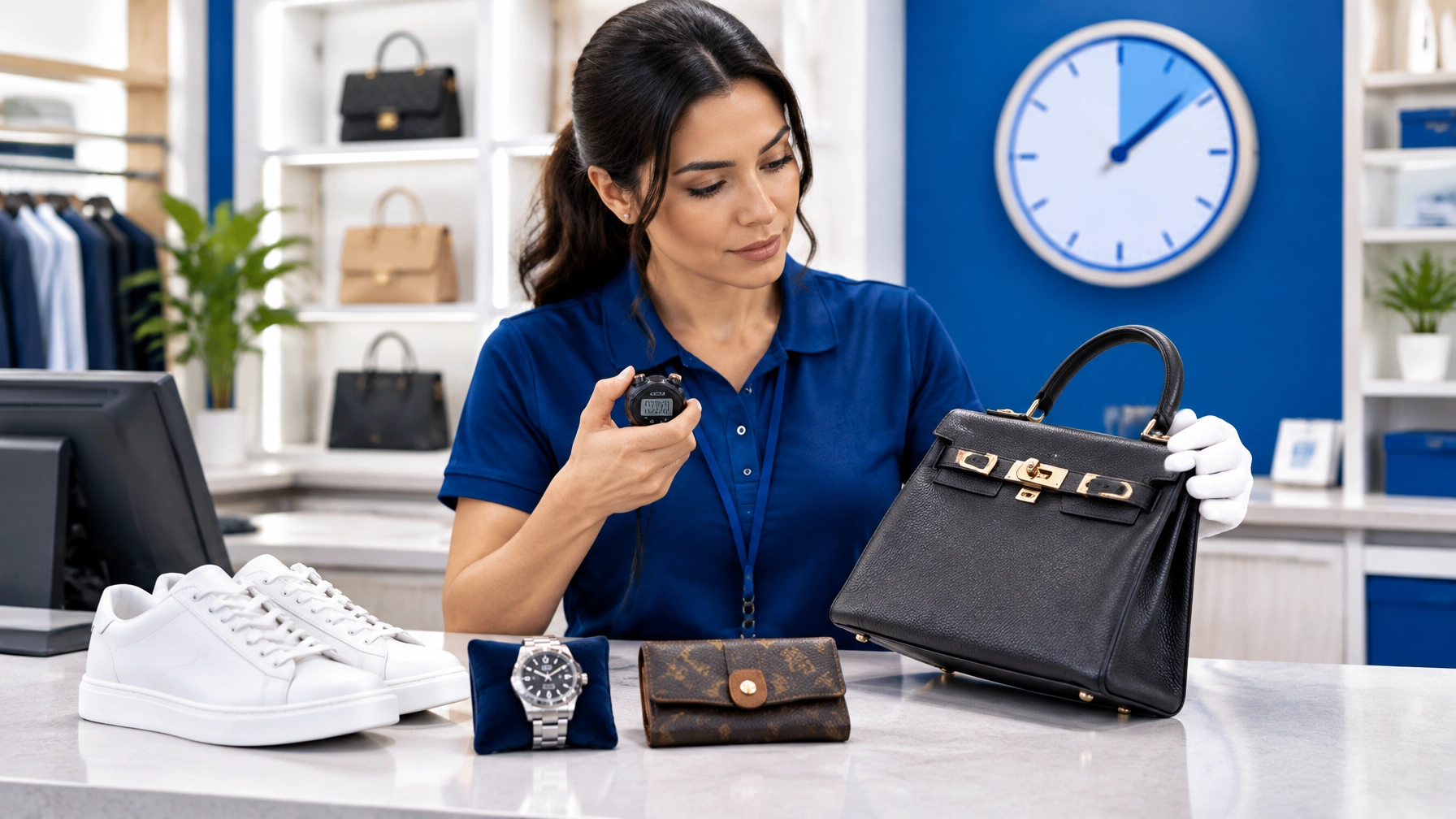
How many times a week does a customer ask, “Is this real?”
For resale stores, pawn shops, thrift stores, and online sellers, the question is more than a customer-service moment. A counterfeit can create lost revenue, returns, chargebacks, damaged trust, and reputation problems.
Your staff do not need to become luxury authentication experts overnight.
They do need a repeatable first-pass process that helps them identify risk before an item reaches the counter, inventory system, or sales floor.
The goal is simple:
- Screen quickly
- Document clearly
- Escalate consistently
- Never guess
A 60-second triage is a filter. It is not a final verdict. Questionable items should move to qualified human experts for a deeper review. Authenticate Pro’s process escalates items to human experts and reports approximately 99% accuracy based on its authentication results. Learn more about the company’s authentication process and resale store membership options.
The 60-Second Rule: Triage Before Intake
Train every buyer, retail floor employee, and front-counter team member to pause before accepting or displaying a higher-risk item.
Use the same sequence every time.
0–10 seconds: Check the story
Start with the seller and the item’s context.
Ask:
- Where was it purchased?
- Approximately when?
- Was it bought from a boutique, authorized retailer, or online marketplace?
- Is there a receipt, invoice, box, dust bag, warranty card, or other documentation?
- Why is the seller letting it go?
- What price are they expecting?
You are not interrogating the seller. You are looking for inconsistencies.
Immediate yellow flags include:
- The price is far below the normal market range.
- The seller’s story changes.
- The item is supposedly new but shows unexplained wear.
- The seller pressures staff to skip inspection.
- The seller insists that a card or receipt proves authenticity.
Documentation can be useful. It is not proof by itself. Counterfeiters can copy packaging, invoices, cards, and serial formats.
The Five-Point Quick Check
After the initial conversation, run the physical inspection. Keep it consistent across handbags, watches, jewelry, shoes, small leather goods, and accessories.

1. Overall construction
Look at the item as a whole.
Check:
- Does it hold its shape correctly?
- Are seams straight?
- Is the pattern aligned across panels?
- Are edges finished cleanly?
- Are there loose threads, excess glue, or uneven stitching?
- Does the item feel structured or unusually flimsy?
Counterfeit items often fail at the finish. The problems may be small, but they tend to appear in several places at once.
One uneven stitch does not prove an item is fake. Multiple construction problems should trigger an escalation.
2. Materials and feel
Use sight and touch.
Look for:
- Thin, plasticky, or overly smooth material
- Leather that feels inconsistent with the item’s price point
- Strong chemical or glue odor
- Fabric, lining, or trim that feels cheap
- Unusual stiffness, softness, or weight
Train staff to compare materials against known authentic examples whenever possible. A reference item is more useful than memory alone.
Avoid teaching employees that smell or texture can make the final call. Materials vary by age, model, storage, and condition. These are risk indicators, not definitive answers.
3. Hardware and finish
Hardware is one of the fastest areas to inspect.
Check:
- Weight and density
- Plating consistency
- Engraving quality
- Alignment of clasps, zippers, snaps, and feet
- Screw type and placement
- Color differences between hardware pieces
Be cautious with hardware that feels hollow, rattles, peels, or appears poorly plated.
A logo on a clasp may look close at first glance but still have incorrect spacing, depth, or shape. Encourage staff to use a loupe or close-up phone photo when needed.
4. Logos, stamps, and codes
Look at the details that should be precise.
Check:
- Logo font
- Letter spacing
- Stamp depth
- Date codes or serial markings
- “Made in” stamps
- Metal hallmarks
- Placement of internal labels
- Monogram or pattern alignment
Do not teach staff that every item must have a serial number. Codes and production methods vary by brand, model, and manufacturing period.
The better rule is:
Does this marking match the expected format and placement for this specific item?
If the employee cannot answer confidently, the item should be escalated.
5. The decision: green, yellow, or red
At the 60-second mark, staff must choose one of three outcomes.
✅ Green: Continue with normal intake
Use this only when:
- The seller’s story is reasonable.
- The item has no significant construction concerns.
- Materials and hardware appear consistent.
- Markings look appropriate.
- The item falls within your store’s approved risk level.
Record the basic details and continue your normal process.
⚠️ Yellow: Hold and escalate
Use this when:
- One significant red flag appears.
- Two or more smaller concerns appear.
- The item is high value.
- The brand or category is frequently counterfeited.
- The employee is uncertain.
Place the item in a designated review area. Do not put it on the sales floor. Do not finalize the transaction until the review is complete.
❌ Red: Stop the transaction
Use this when:
- Multiple red flags appear.
- The item has an implausible story and unusually low price.
- Markings, materials, and construction conflict.
- The seller is pressuring staff to skip authentication.
- The employee believes the item may be counterfeit.
Follow your store’s written policy. Depending on the situation, that may mean refusing the item, involving a manager, documenting the attempt, or sending the item for external authentication.
The Most Important Training Rule: Fast Triage Is Not Authentication
A frontline employee may identify risk in 60 seconds. That does not mean they can issue a final authenticity decision.
This distinction protects your staff and your business.
Train employees to say:
“This item needs an additional review before we can complete intake.”
Do not train them to say:
“This is definitely fake.”
There are too many variables. Older authentic items may have unusual markings. Repairs may change hardware. Limited editions may not match common reference photos. Counterfeits can also be sophisticated.
When an item is questionable, escalate it to a human expert. Authenticate Pro describes a workflow that combines technology with human review. Its Human Expert process is designed for higher-confidence decisions, with approximately 99% accuracy reported by the company.
The operating rule is simple:
If staff are unsure, the item is not ready for the sales floor.
Create a One-Page Counter Cheat Sheet
A short checklist will outperform a long training manual during a busy intake shift.
Place one copy at:
- The buying counter
- The front register
- The manager’s desk
- The photography station
- The online listing area
Include these five prompts:
- Story: Does the price and purchase history make sense?
- Construction: Are stitching, seams, shape, and finishing consistent?
- Materials: Does the item feel and smell consistent with the brand and model?
- Markings: Are logos, stamps, codes, and hardware properly placed and finished?
- Decision: Green, yellow, or red?
At the bottom, add the escalation rule in bold:
Two or more concerns, high-value item, or uncertainty = hold and escalate.
The cheat sheet should also include:
- Where the review tray is located
- Who the designated manager or authentication lead is
- How to photograph the item
- Where to record the seller and item details
- Which authentication service to use
- What staff should tell the customer
Make the Training Stick With Short Drills
Do not rely on a single training session. Counterfeit detection improves through repetition.
Run a five-minute daily drill
Show staff one item or photo and ask:
- What is the first thing you notice?
- Which of the five points would you check next?
- Is this green, yellow, or red?
- What would you document?
- Would you escalate?
Keep the discussion practical. The objective is not to reward the employee who sounds most confident. It is to reinforce the correct decision.
Use authentic and counterfeit training examples
Maintain a secure training collection with:
- Known authentic items
- Confirmed counterfeit examples
- Close-up photos of common red flags
- Different conditions and production eras
- Packaging and documentation examples
Label training items clearly. Never allow examples to enter active inventory by mistake.
Practice the customer conversation
Employees need language for uncomfortable situations.
Use scripts such as:
“We need to complete an additional review before we can accept this item.”
“Our policy requires expert verification for certain brands and value levels.”
“This does not mean we have reached a final decision. We are pausing the intake so the item can be reviewed properly.”
Clear language reduces arguments and prevents employees from making unsupported claims.
Set Written Escalation Rules
Your staff should not have to decide when to escalate based on mood, experience, or sales pressure.
Write the rules down.
A practical policy might require escalation when:
- The item exceeds a defined dollar value.
- The brand is on your high-risk list.
- Two or more red flags appear.
- The seller cannot provide a consistent purchase story.
- The item is missing expected details for its specific model.
- Staff disagree about the item.
- A customer requests authentication.
- The item is intended for online sale and will be represented as authentic.
Record:
- Seller name and contact information
- Brand and item type
- Model name, if known
- Serial number or date code
- Purchase story
- Photos of front, back, interior, hardware, labels, and markings
- Specific concerns
- Employee and manager names
- Final authentication result
For stores using external services, review current options and terms on the Authenticate Pro pricing page. Service levels and turnaround times can vary by item, brand, and availability.
Measure the Process, Not Just Sales
Reward staff for making safe decisions.
Track:
- Number of items triaged
- Number escalated
- Number rejected
- Number cleared after expert review
- Repeat red flags by brand or category
- Training drill accuracy
- Items removed from inventory after review
Do not penalize employees for escalating a legitimate item. If staff believe they will be criticized for slowing down a transaction, they will eventually stop raising concerns.
A strong program makes the safe choice the easy choice.
Final Takeaway
Your staff do not need to authenticate every luxury item in under 60 seconds.
They need to identify which items deserve more attention.
Teach them to:
- Ask about the story.
- Scan overall construction.
- Feel materials and hardware.
- Check logos, stamps, and codes.
- Make a documented green, yellow, or red decision.
- Escalate uncertainty to human experts.
That process protects your inventory, your customers, and your reputation.
A fast triage catches risk. A qualified human expert makes the deeper call. When those two steps work together, your store can move efficiently without treating speed as a substitute for accuracy.
For resale stores and pawn shops that want a structured authentication workflow, visit Authenticate Pro or call 800-395-7172.
Leave a Reply