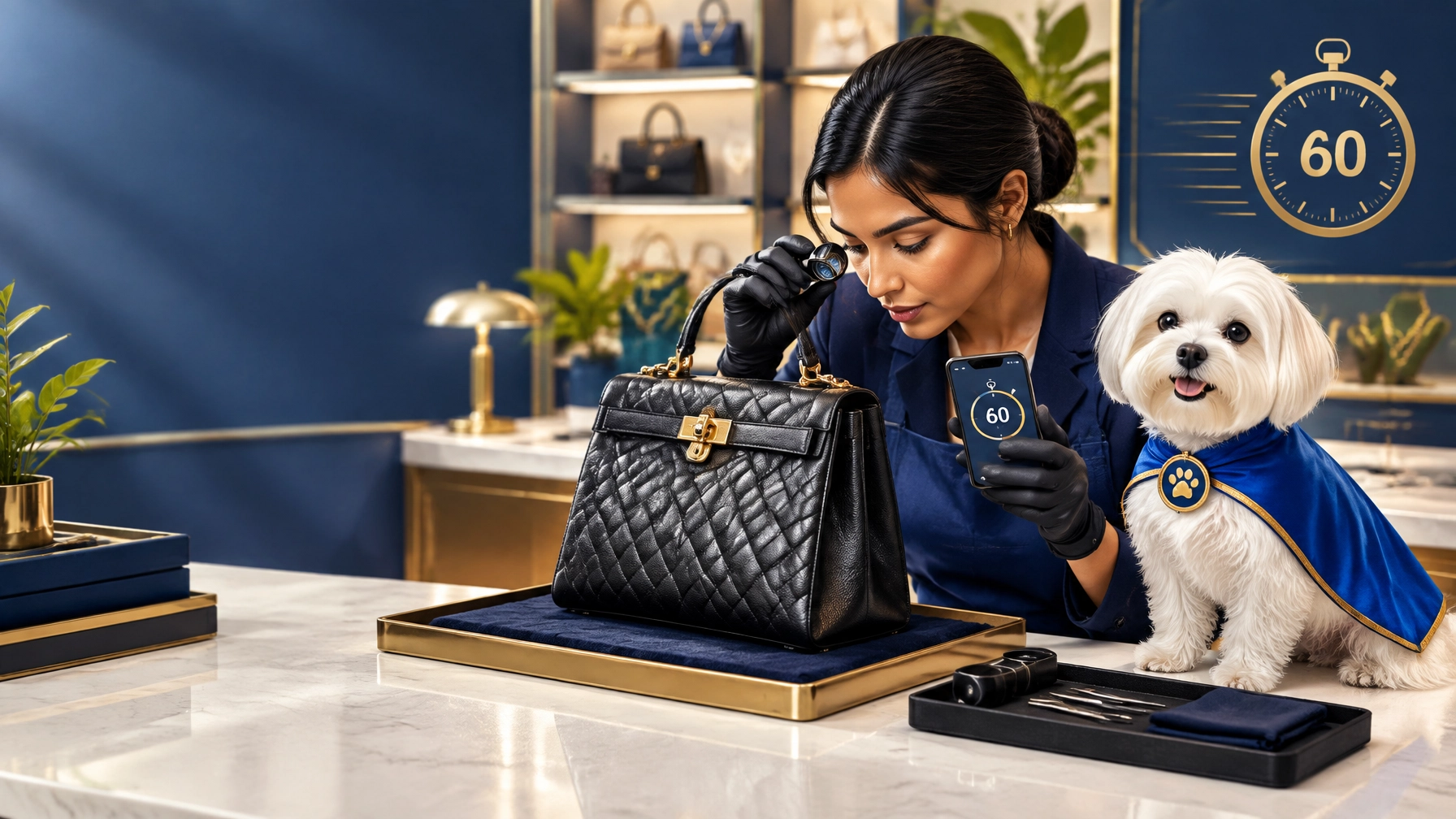
How many times a week does a customer ask, “Is this real?”
For resale stores and pawn shops, the answer affects more than one transaction. A counterfeit can lead to:
- Lost inventory value
- Refunds and chargebacks
- Damaged customer trust
- Reputation problems
- Expensive compliance and legal issues
Your staff do not need to complete a full authentication at the intake counter. They do need a consistent way to identify risk quickly.
A structured 60-second intake screening helps your team decide whether to:
- ✅ Move the item forward for professional authentication
- ⚠️ Hold the item for additional review
- ❌ Decline the item because the risk is too high
The goal is not to make every employee a luxury-brand expert. The goal is to create a repeatable first layer of counterfeit detection.
First, Set the Right Expectation
A 60-second screen is triage, not a final authentication.
Staff should never feel pressured to guarantee authenticity based only on a quick visual inspection. High-quality counterfeits can look convincing. Some authentic items may also have wear, repairs, or production variations that appear unusual.
Train your team to use this rule:
When something feels wrong, stop the transaction and escalate. Do not guess.
The quick screen should identify obvious red flags and prevent rushed purchases. A professional authentication service should handle questionable, high-value, or high-risk items before your store makes an offer or lists the item for sale.
The 60-Second Intake Screening

0–15 Seconds: Check the Seller’s Story
Start with the item’s background. Ask simple, neutral questions:
- “Where did you purchase this?”
- “When did you buy it?”
- “Do you have the receipt or original paperwork?”
- “Why are you selling or pawning it today?”
- “What did you pay for it?”
Look for inconsistencies. A vague answer is not proof of a counterfeit. Multiple inconsistencies should increase the risk level.
Seller-story red flags
- The purchase location or date keeps changing
- The seller cannot explain basic details about the item
- The seller is unusually aggressive or rushed
- The asking price is far below normal resale value
- The seller focuses only on getting cash quickly
- The item is described as “brand new” but shows unexplained wear
- The seller relies on a card or receipt while avoiding inspection of the item
Do not accuse the seller. Keep the interaction professional:
“We inspect every high-value item before making an offer. This one needs an additional review.”
That protects your staff and keeps the conversation focused on store policy.
15–40 Seconds: Inspect the Item
Use an eyes–hands–details sequence. Staff should inspect the item in the same order every time.
1. Material and overall feel
Luxury items usually have a deliberate, substantial feel. That does not mean every authentic item must be heavy or flawless. It means the materials should make sense for the brand, model, and age.
Watch for:
- Plastic-like leather or coated canvas
- Excessive shine on a material that should be matte
- A strong chemical or vinyl smell
- Hollow or unusually lightweight hardware
- Edges that appear poorly finished
- Material that feels inconsistent across the item
Avoid relying on smell or weight alone. These are screening clues, not final proof.
2. Stitching and construction
Construction is one of the fastest places to find useful red flags.
Check:
- Stitch spacing
- Seam alignment
- Loose threads
- Crooked stitching
- Visible glue
- Uneven edge paint
- Misaligned logos, monograms, or patterns
One minor flaw may be normal wear. Several construction problems in the same item are more serious.
3. Logos, fonts, and branding
Inspect the logo stamp, interior label, engraving, and printed text.
Look for:
- Misspellings
- Incorrect font shape
- Uneven spacing
- Fuzzy or bleeding print
- Shallow or sloppy embossing
- Misaligned logos
- Engravings that look rough or inconsistent
Your store should maintain side-by-side reference images for its most common brands. Start with the brands your business handles most often. Do not expect staff to memorize every variation across hundreds of brands.
4. Hardware
Zippers, clasps, chains, screws, and other hardware often provide useful clues.
Check whether the hardware:
- Feels solid and appropriately weighted
- Has an even finish
- Shows peeling or unexpected discoloration
- Includes clean, precise engravings
- Uses the correct shape and construction for the item
- Rattles or feels hollow
Hardware should be evaluated against the specific brand and model. A general rule is not enough. Brand-specific training matters.
40–60 Seconds: Check Codes, Documents, and Risk
At this stage, staff should review the item’s labels, codes, packaging, and paperwork.
Check for:
- Serial numbers or date codes, where applicable
- Correct placement and formatting
- Model details that match the item
- Receipt quality and store information
- Spelling and print quality on cards or booklets
- Packaging that fits the item’s age and model
Important: A receipt or authenticity card does not prove that the item is authentic.
Counterfeiters can reproduce packaging, cards, dust bags, and receipts. Documentation should support the physical inspection. It should never override obvious problems with the item itself.
A Simple Decision Rule for Staff
Give your employees three clear outcomes.
✅ Greenlight for professional authentication
Use this outcome when:
- The seller’s story is plausible
- The item has no major physical red flags
- Construction and materials appear consistent
- Documentation is reasonable, even if incomplete
A greenlight does not mean “authentic.” It means the item is appropriate for the next authentication step.
⚠️ Escalate for review
Escalate when:
- Two or more red flags appear
- The item is high value
- The staff member cannot explain what feels wrong
- The item is from a frequently counterfeited category
- The seller’s story conflicts with the item
- The item is rare, current-season, or difficult to compare
If the item could create a significant financial loss, do not make an offer until it receives professional authentication.
❌ Decline the item
Decline when there are multiple clear problems across different areas, such as:
- Poor stitching
- Wrong-looking hardware
- Misaligned branding
- Suspicious paperwork
- A pressured seller story
- An unrealistic price
Train staff that declining an item is not a failure. It is a successful risk-control decision.
The Top 10 Red Flags to Memorize
Create a laminated checklist for every intake station.
- Too-good-to-be-true price
- Vague or changing purchase story
- Plastic-like material or strong chemical odor
- Uneven stitching or loose threads
- Misaligned patterns or monograms
- Lightweight, rattling, or poorly finished hardware
- Misspelled logos or incorrect fonts
- Suspicious or missing codes where one should be present
- Blurry printing or typos on paperwork
- Seller relying on packaging while the item itself looks wrong
Three or more red flags should trigger an automatic hold, escalation, or decline based on your store policy.

How to Train Staff to Use the Process
Start with your top five brands
Do not begin with every luxury brand. Choose the five brands your store sees most often.
For each brand, create a one-page reference guide that includes:
- Authentic logo examples
- Common materials
- Typical hardware
- Common code locations
- Known counterfeit issues
- Acceptable wear and repairs
- Escalation instructions
Update these guides as your team encounters new examples.
Use real hands-on practice
Photos are useful. Physical handling is better.
When possible, let staff inspect known authentic items. Have them describe:
- How the material feels
- How the hardware moves
- How the stitching looks
- How the item smells
- Where the codes and labels are located
Then compare those examples with known counterfeit or questionable items.
Run timed drills
Set up weekly or monthly training drills:
- Place an item at the intake counter.
- Give the employee 60 seconds.
- Require a decision: greenlight, escalate, or decline.
- Ask the employee to name the specific red flags.
- Review the decision as a team.
The goal is not perfect accuracy in 60 seconds. The goal is consistent judgment and correct escalation.
Document every decision
Your intake record should capture:
- Date and time
- Employee name
- Seller information
- Brand and item type
- Seller’s stated purchase details
- Photos of key areas
- Red flags observed
- Final decision
- Authentication order number or report, if escalated
Good documentation helps identify patterns. It also gives management a clear record when a staff member declines an item under pressure.
When to Use Professional Authentication
Your staff’s screening process is an important first step. It is not a replacement for expert review.
Use professional authentication before buying, pawning, or listing an item when:
- The value is significant
- The item has multiple red flags
- The employee is uncertain
- The item is difficult to authenticate
- The customer requests verification
- Your store wants stronger documentation for resale
At Authenticate Pro, authentications move to human experts as part of the workflow to achieve approximately 99% accuracy. AI and pre-authentication tools can support the process, but human expertise is essential when the decision carries financial and reputational risk.
Authenticate Pro offers authentication options for resale businesses, including Mini Check, Quick Check, Express Authentication, and Level 2 Authentication. Review the current membership options or pricing to determine which workflow fits your store.
Turn Speed Into a Strength
A 60-second screen keeps your intake line moving. A documented escalation process protects your business.
The best policy is simple:
- Screen quickly
- Document clearly
- Do not guess
- Escalate high-risk items
- Use professional authentication before committing money
This approach helps resale stores and pawn shops make faster, more consistent decisions while protecting customers from counterfeit merchandise.
As one Clothes Mentor location shared about Authenticate Pro:
“It gives our customers the utmost confidence when purchasing high-dollar authentic brand name goods, which in return has helped increase our sales.”
Build the 60-second screen into your intake routine. Then give your staff the support to stop when the item deserves a closer look.

When the answer matters, do not rely on a rushed opinion. Use a clear process and authenticate luxury items with professional support before they reach your sales floor.
Leave a Reply