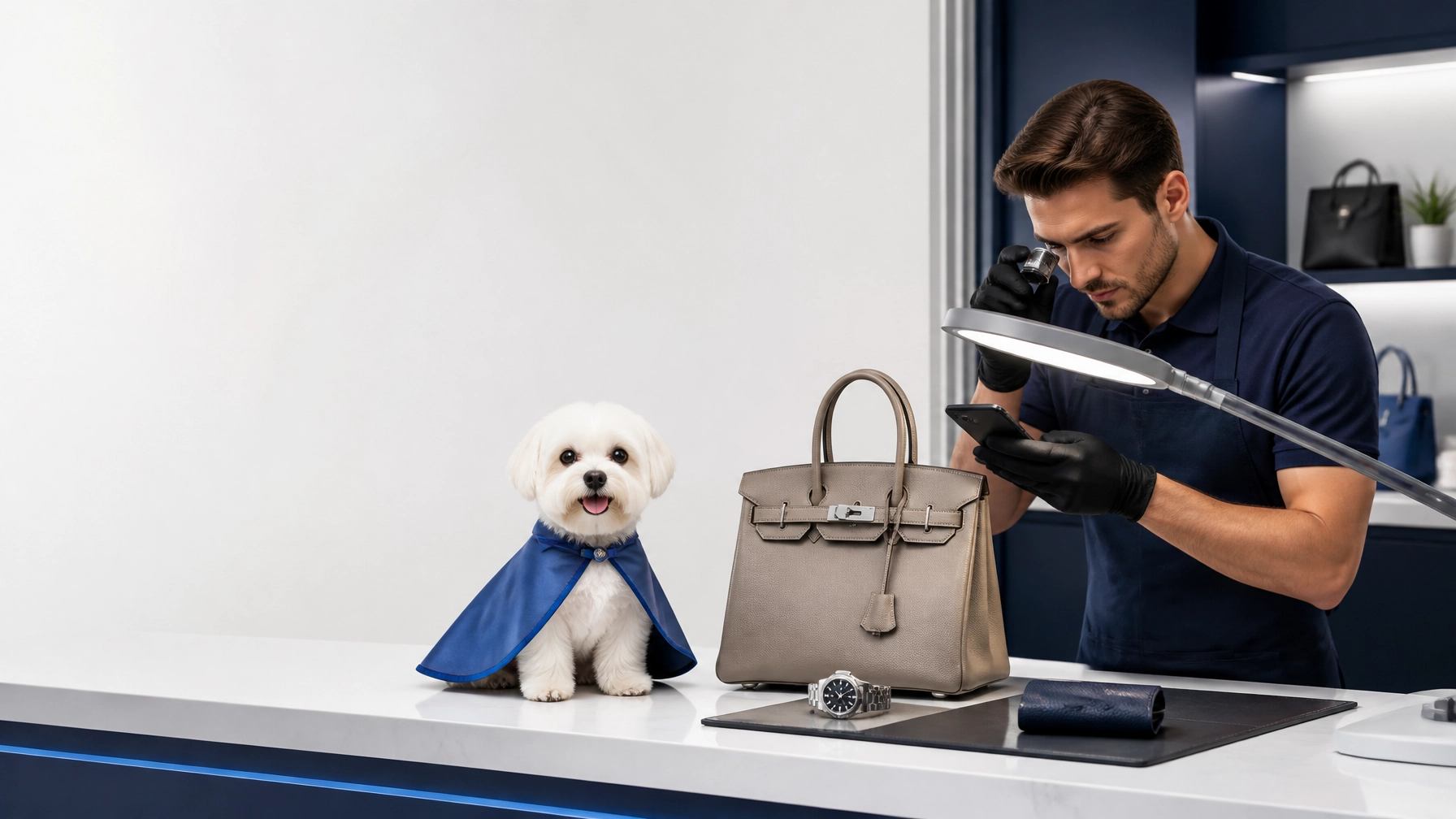
How many times a week does a customer ask, “Is this real?”
For resale stores, pawn shops, thrift shops, and online luxury sellers, the answer can affect more than one transaction. A counterfeit item can lead to:
- Lost revenue
- Costly returns
- Damaged customer trust
- Marketplace penalties
- Reputation damage
- Difficult liability questions
Your staff do not need to become full-time brand experts to improve intake decisions. They do need a consistent process.
A 60-second inspection is not a final authentication. It is a screening workflow that helps staff decide whether an item is ready for normal processing, needs professional authentication, or should be declined.
Here is the process.
The 60-Second Rule: Triage, Not Certification
Professional authenticators rely on brand-specific knowledge, detailed reference materials, physical inspection, photography, and years of experience. High-quality counterfeits can pass a quick visual check.
That means your staff should never say:
“This is definitely authentic because I looked at it for one minute.”
Instead, train them to reach one of three decisions:
- ✅ Proceed: No immediate red flags. Continue with your normal intake process.
- ⚠️ Escalate: One or more concerns require professional authentication.
- ❌ Decline or hold: Multiple red flags, inconsistent details, or an unacceptable level of risk.
A quick screening protects your team from false confidence. It also creates a repeatable process across every location and employee.

Before the Timer Starts: Set Up the Intake Station
Speed does not mean rushing in poor conditions.
Give staff a consistent inspection area with:
- Bright, neutral lighting
- A clean, uncluttered surface
- A smartphone or tablet for close-up photos
- A small magnifier or loupe
- A measuring tool when needed
- A written intake checklist
- A secure location for items awaiting review
The goal is to make the same details visible every time. Poor lighting and rushed handling can cause employees to miss flaws: or create false concerns.
Also document the item before moving forward. Capture photos of:
- Front and back
- Interior
- Logo or heat stamp
- Hardware
- Stitching
- Serial number, date code, or other identifying details
- Any existing damage
Clear records support better decisions and create an audit trail if a customer later disputes an item.
The 60-Second Counterfeit Screening Workflow
Seconds 0–10: Check the Item’s Story
Start with the source and supporting information.
Ask:
- Where did the item come from?
- When and where was it purchased?
- Is there a receipt?
- Is there a dust bag, box, certificate, or service record?
- Has the item been repaired, altered, or customized?
- Is the seller familiar with the item’s history?
Documentation is useful, but it is not proof. Counterfeiters can reproduce receipts, packaging, tags, and certificates.
Treat the story as one part of the decision: not the decision itself.
Immediate story red flags
- The seller cannot explain where the item came from.
- The claimed purchase date conflicts with the product’s design.
- The packaging does not match the item.
- The receipt contains unusual formatting, spelling, or logo errors.
- The price is far below a reasonable resale range without a clear explanation.
A missing receipt does not automatically mean an item is fake. An impressive box does not automatically mean it is real.
Seconds 10–25: Perform a Construction Scan
Now inspect the overall build quality.
Look at:
- Shape and symmetry
- Material quality
- Edge paint
- Stitching
- Pattern alignment
- Lining
- Handles and straps
- Seams and finishing
Luxury items are not always perfect. They can show wear, repairs, storage damage, and manufacturing variation. Staff should look for clusters of inconsistencies, not one isolated flaw.
Common construction red flags
- Uneven or wandering stitches
- Loose threads
- Excessive glue
- Peeling or cracking edge paint
- Warped panels
- Misaligned patterns
- Extremely stiff or plastic-feeling material
- Strong chemical or glue odor
- Poorly finished interior seams
- Hardware that feels unusually light or hollow
These details are useful for counterfeit detection, but they are not conclusive by themselves. A vintage item may have different construction from a current model. A repaired item may not look factory-new.
Seconds 25–40: Inspect Logos, Stamps, and Typography
Counterfeit production often fails at small details.
Inspect every visible logo, heat stamp, engraving, and label. Compare the details with trusted brand references and known authentic examples.
Look for:
- Incorrect letter spacing
- Inconsistent font weight
- Uneven logo proportions
- Poorly centered stamps
- Fuzzy or shallow engravings
- Incorrect placement
- Wrong capitalization
- Misspelled words
- Misaligned interior labels
Do not rely on a logo alone. Many counterfeiters can reproduce a logo convincingly. The question is whether the logo matches the item’s model, era, material, placement, and overall construction.
Train employees to avoid shortcuts such as:
- “The logo looks good, so it must be real.”
- “The serial number is present, so it must be real.”
- “The seller has the original box, so it must be real.”
Those assumptions create risk.
Seconds 40–52: Check Hardware and Identifying Codes
Move to the stress points counterfeiters often get wrong.
Inspect:
- Zippers
- Clasps
- Snaps
- Buckles
- Rivets
- Feet
- Chain links
- Watch case-backs
- Hallmarks
- Serial numbers
- Date codes
- Microchips or other identifiers, where applicable
Check the quality, location, format, and relationship of the identifying details.
A serial number can be copied. A date code can be placed on the wrong model. A hallmark can be poorly engraved. Some authentic items may not have the same identifying features as newer versions.
Your staff should know the basic patterns for the brands and categories your store handles most often. They should not be expected to memorize every brand variation.
When a code looks unusual, incomplete, or inconsistent with the item, mark it for escalation.
Seconds 52–60: Decide and Document
End every screening with a clear action.
✅ Proceed
Use this status when:
- The item’s construction is consistent.
- Details appear to match the model.
- No major red flags are present.
- The item fits your normal risk policy.
“Proceed” does not mean “certified authentic.” It means the item can move through your regular process.
⚠️ Escalate
Escalate when:
- One important detail does not match.
- The item is high value.
- Documentation is missing and the brand is high risk.
- The item is rare, vintage, altered, or heavily repaired.
- Your employee is unfamiliar with the brand or model.
- The item is a potential “superfake.”
- The item will be listed as authentic online.
The best employees are not the ones who claim certainty. They are the ones who know when to ask for help.
❌ Decline or Hold
Decline or hold the item when:
- Multiple major details are inconsistent.
- The item has obvious construction problems.
- The seller’s story changes repeatedly.
- The item appears intentionally altered.
- The risk exceeds your store’s written policy.
Follow your legal and business policies before making a final decision. For questions involving consumer protection, pawnbroker rules, contracts, or liability, consult qualified legal counsel.

When Staff Must Stop and Escalate
Visual inspection has limits.
Your staff may identify warning signs in 60 seconds. They may not be able to distinguish an authentic vintage variation from a sophisticated counterfeit. That is where professional authentication becomes essential.
A practical escalation policy should require expert review for:
- High-dollar handbags, watches, jewelry, and accessories
- Items with multiple red flags
- Unfamiliar brands or models
- Rare or discontinued pieces
- Items with conflicting documentation
- Items being sold with an authenticity guarantee
- Items that will be listed on a marketplace
- Any item an employee cannot confidently classify
At Authenticate Pro, the workflow combines technology with human review. Authentications move to human experts to support an approximately 99% accuracy conclusion, based on the company’s published authentication information. That escalation is important because AI and visual screening should support expert decision-making: not replace it.
For stores that need to authenticate luxury items online, the process can begin with clear photos and item details. Learn more through the Authenticate Pro website or review membership options for resale stores.
Train Staff With Known Examples
A checklist is useful. Practice makes it reliable.
Build a training set containing:
- Confirmed authentic items
- Confirmed counterfeit items
- Damaged authentic items
- Vintage examples
- Different production years
- Items with repairs or modifications
- High-quality counterfeit examples
Run short drills. Give each employee 60 seconds to classify an item. Then review:
- What did they notice?
- What did they miss?
- Which observations were facts?
- Which observations were assumptions?
- Should the item have been escalated?
Repeat the exercise weekly for 10–15 minutes. Counterfeit methods change. Brand designs change. Staff confidence can also become outdated.
Do not train employees to memorize a single flaw. Train them to compare the complete item against reliable references.
Reduce Counterfeit Liability With a Written Policy
Your inspection process should be supported by clear store rules.
Document:
- Which items require professional authentication
- Who can approve high-value inventory
- When an item must be held
- What photos must be captured
- How records are stored
- What employees can and cannot promise to customers
- How suspected counterfeits are handled
- How disputes and returns are reviewed
Avoid telling customers that a one-minute visual check is a guarantee. Use accurate language such as:
“This item passed our initial screening. Professional authentication is recommended before final acceptance or sale.”
For online listings, describe the authentication process clearly. If the item has not been professionally authenticated, do not imply that it has.
Authenticate Pro also offers services such as Quick Check, Express Authentication, and Level 2 Authentication. Service availability, timing, and coverage can vary, so confirm the current terms before creating a store policy.

The Bottom Line
A 60-second workflow can help your staff spot obvious warning signs, slow down risky transactions, and create consistent intake decisions.
It cannot replace professional authentication.
Train employees to:
- Check the item’s story.
- Scan construction quality.
- Inspect logos and stamps.
- Review hardware and identifying codes.
- Decide: proceed, escalate, or decline.
- Document the inspection.
The most important skill is not guessing correctly every time. It is recognizing when the item deserves a deeper review.
That protects your inventory, your customers, and your reputation.

Frequently Asked Questions
Can staff really authenticate a luxury item in 60 seconds?
No. Staff can perform a 60-second screening to identify visible warning signs. A quick screening is not the same as professional authentication.
What should a pawn shop do when an item has no receipt?
A missing receipt is not automatic proof of a counterfeit. Document the item carefully and consider the brand, value, construction, seller history, and other risk factors. High-risk items should be escalated to professional authentication.
Should every luxury item receive professional authentication?
Not necessarily. Each store should establish its own risk-based policy. High-value, unfamiliar, rare, altered, or questionable items should receive professional review before acceptance or sale.
Can AI replace a human authenticator?
AI can support image review and help organize an authentication workflow. However, difficult cases should move to human experts. Authenticate Pro’s workflow includes escalation to human experts and reports an approximately 99% accuracy conclusion.
What is the best way to authenticate luxury items online?
Start with clear, detailed photos of the item’s construction, logos, hardware, codes, and condition. Then use a professional authentication service with qualified experts and a documented process.
Leave a Reply