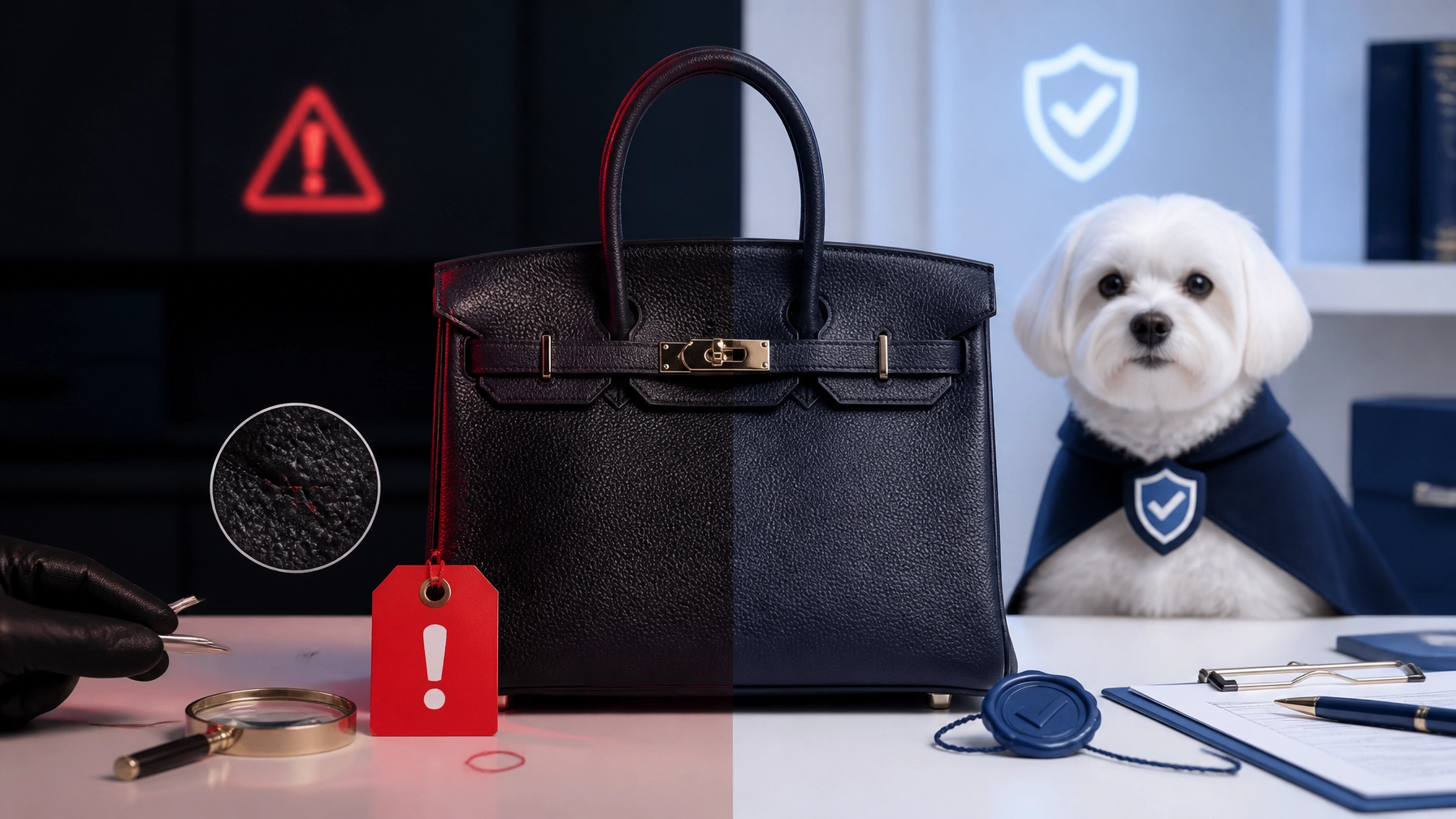
How many times a week does your customer ask, “Is this real?”
For resale stores, pawn shops, consignment businesses, and online thrifters, that question is more than a request for reassurance. It reflects a serious business risk.
One counterfeit luxury item can trigger:
- Refunds and lost revenue
- Inventory loss
- Customer complaints
- Marketplace penalties
- Brand-owner disputes
- Legal expenses
- Long-term reputation damage
The seller may not have known the item was fake. That matters. But it does not always eliminate liability.
The safest approach is simple: authenticate luxury items before selling them, especially when the price, brand, or source raises questions.

Accidental does not always mean consequence-free
Counterfeit liability depends on the facts. However, a business can face civil claims even when an employee or owner did not intentionally sell a fake.
Under federal trademark law, a brand owner may pursue claims involving counterfeit marks or trademark infringement when counterfeit goods are offered for sale. The Lanham Act allows courts to award monetary damages, profits, statutory damages, injunctions, and other remedies.
Criminal liability is different. Federal criminal counterfeiting law generally requires proof that a person intentionally trafficked in goods and knowingly used a counterfeit mark. The Department of Justice explains the criminal standard, while 18 U.S.C. § 2320 outlines the federal statute.
That distinction is important.
A genuine mistake is not the same as knowingly selling counterfeit goods. But repeated red flags, unusually low purchase prices, suspicious suppliers, prior warnings, or ignored customer complaints can make a business appear willfully blind.
Good-faith procedures matter. Documentation matters. Professional authentication matters.
The financial cost of selling counterfeit goods
The purchase price is often only the beginning of the loss.
1. Refunds and chargebacks
If a customer discovers that a handbag, watch, shoe, or accessory is counterfeit, you may need to:
- Refund the purchase price
- Pay return shipping
- Absorb payment-processing fees
- Handle a chargeback
- Cover authentication or inspection costs
- Remove related listings from multiple channels
For an online seller, the item may have already been shipped. The refund can exceed your profit from the sale.
For a pawn shop or resale store, the customer may also expect compensation for travel, inspection, or other expenses. Even when those demands are not legally required, resolving the dispute takes time and management attention.
2. Lost inventory and lost opportunity
A counterfeit item is not recoverable inventory.
Once identified, it may need to be quarantined. It cannot simply be discounted and sold as-is if it carries a counterfeit trademark. The goods may be surrendered, seized, or destroyed depending on the circumstances.
That means losing:
- Your original investment
- Expected gross margin
- Time spent processing the item
- Photography and listing costs
- Storage space
- The opportunity to sell legitimate merchandise instead
3. Legal and professional expenses
A demand letter from a brand owner can require a fast response. A lawsuit requires more.
Potential costs include:
- Attorney review
- Settlement negotiations
- Document collection
- Employee interviews
- Inventory audits
- Court costs
- Expert testimony
- Compliance changes
Federal law provides for statutory damages in certain counterfeiting cases. The amounts can range from $1,000 to $200,000 per counterfeit mark per type of goods or services, and may reach up to $2 million per mark when willfulness is found. These are statutory maximums, not automatic awards, and the facts of each case matter.
Still, the risk is too large to dismiss as “just one item.”
The reputational damage can outlast the refund
Your customers do not always separate one bad item from the business that sold it.
They may ask:
- What else in the store is fake?
- Can I trust the seller’s other listings?
- Did the business know?
- Should I warn other buyers?
- Should I post a review?
A single counterfeit sale can create a much larger trust problem. Customers buying pre-owned luxury goods are already managing uncertainty. They want confidence in the seller’s sourcing, inspection, and return policies.
Once that confidence is damaged, the consequences can spread to:
- Online reviews
- Social media discussions
- Repeat purchase rates
- Consignor relationships
- Marketplace ratings
- Brand partnerships
- Employee morale
Clothes Mentor Reno described this risk directly in a customer testimonial for Authenticate Pro:
“This service offers great peace of mind to our staff and customers due to the high production of knock-off goods that could cost the customer and our businesses thousands of dollars in lost revenue.”
Trust is not a slogan. For a resale business, it affects conversion, pricing power, and repeat business.
Why visual inspection is not enough
Counterfeit detection is getting harder.
High-quality counterfeits can include:
- Correct-looking logos
- Convincing packaging
- Replicated date codes
- Similar hardware
- Accurate colorways
- Near-identical stitching
- Reproduced receipts or dust bags
An employee may know a brand well and still miss a subtle issue. That is especially true when the store is busy, the item is unfamiliar, or the brand releases frequent variations.
Common warning signs include:
- Price far below comparable market value
- Seller unable to explain the item’s history
- Inconsistent font, spacing, or stamping
- Poor alignment
- Incorrect materials
- Hardware that feels or looks wrong
- Serial or date codes that do not match the model
- Packaging that appears genuine but does not belong with the item
These signs are useful. They are not a complete authentication process.
Professional authentication creates a stronger control
Professional authentication adds an independent review before the item reaches the customer.
At Authenticate Pro, the workflow combines advanced technology with human review. An initial assessment can help identify risk indicators, but questionable or higher-value items can be escalated to experienced human experts. That escalation is essential to achieving the company’s stated approximately 99% accuracy conclusion rate.
The process is designed to help sellers:
- Upload clear item photographs.
- Receive a preliminary assessment.
- Escalate the item to a qualified brand expert when needed.
- Review the final conclusion and report.
- Document the result before listing or selling.
This is not about replacing staff knowledge. It is about adding a consistent second layer to the intake process.
Authenticate Pro’s patented process is built to connect sellers, buyers, advanced AI systems, and human experts. The company’s authentication process is available for luxury goods across hundreds of brands, with options for different turnaround times and levels of coverage.

Authentication also helps manage returns and disputes
A documented authentication result gives your team a clearer record of what was reviewed and when.
For physical stores, an authentication report or secure item identifier can help connect:
- The item
- The transaction
- The customer receipt
- The authentication result
- The staff member who processed it
For online sellers, the process can support more transparent listings. Customers can be told that professional authentication is available, subject to the service terms and timing requirements.
Authenticate Pro also offers options involving its AP Ziptie system. Depending on the authentication level and applicable terms, the Ziptie can help with report lookup, item identification, return-fraud reduction, and optional cost-recovery coverage. The Ziptie must remain intact for applicable guarantees.
Review the current membership options and pricing details before choosing a program. Coverage, turnaround times, eligible brands, fees, and guarantee terms can vary.
What to do if you discover a counterfeit
Finding a suspected fake after the sale is stressful. Move quickly and document everything.
Immediate steps
- Stop selling the item.
- Remove related listings from every sales channel.
- Quarantine the item so it is not accidentally returned to inventory.
- Preserve purchase records, seller information, photographs, messages, and receipts.
- Review whether similar items came from the same source.
- Contact qualified legal counsel if a brand owner, customer, marketplace, or law enforcement agency becomes involved.
- Communicate with the buyer promptly according to your policies and legal advice.
Do not alter, relabel, destroy, or resell the item without understanding your obligations. The correct response can depend on the brand, jurisdiction, transaction history, and evidence available.
A practical intake policy for resale businesses
Your counterfeit-detection policy does not need to be complicated.
Start with these controls:
- Authenticate high-value and high-risk brands before purchase or listing.
- Require clear photos of logos, labels, hardware, stitching, serial details, and date codes.
- Record the source and intake date for every luxury item.
- Flag unusually low prices for review.
- Train staff on brand-specific red flags.
- Require a second review when an employee is uncertain.
- Keep authentication reports with transaction records.
- Do not allow an item to go live until the required review is complete.
- Audit repeat suppliers when multiple questionable items appear.
- Revisit procedures after every counterfeit incident.
The goal is not to guarantee that no counterfeit will ever reach your business. The goal is to create a repeatable process that reduces risk and shows responsible due diligence.
The cost of prevention is easier to manage
Professional authentication is an operating expense. A counterfeit incident is an unpredictable liability.
One authentication fee may protect more than one sale. It can protect:
- Your margin
- Your customer relationship
- Your marketplace account
- Your store’s reputation
- Your staff’s confidence
- Your future inventory pipeline
For resale stores, pawn shops, and online thrifters, the decision is straightforward:
✅ Authenticate before selling.
✅ Escalate uncertain items to human experts.
✅ Keep records.
✅ Use clear customer-facing procedures.
❌ Do not rely on price alone.
❌ Do not assume packaging proves authenticity.
❌ Do not ignore red flags because the item is profitable.
❌ Do not wait until a customer discovers the problem.
A counterfeit sold by accident can become expensive very quickly. A professional authentication workflow gives you a practical way to reduce that exposure and sell with greater confidence.
Learn more about Authenticate Pro or contact the team to discuss a program for your resale business.
Frequently asked questions
Can a business be liable for selling a counterfeit by accident?
Yes, civil liability may exist even when the seller did not know the item was counterfeit. Criminal liability generally requires additional proof of intentional trafficking and knowing use of a counterfeit mark. Consult qualified legal counsel for advice about a specific situation.
What should a pawn shop do when it suspects a counterfeit item?
Remove the item from sale, quarantine it, preserve all intake and seller records, review related inventory, and seek professional authentication. If the item has already been sold, obtain legal guidance before taking further action.
Is professional authentication worth the cost?
For high-value or high-risk luxury items, professional authentication can be less expensive than refunds, lost inventory, legal fees, and reputation damage. It also gives staff and customers a more consistent process.
Does AI replace human authentication experts?
No. AI-assisted review can help identify preliminary findings and risk indicators. Authenticate Pro escalates authentications to human experts to support an approximately 99% accuracy conclusion rate.
Leave a Reply