
How many times a week does a customer ask, “Is this real?”
If your answer is a sign that says “We don’t sell fakes,” you have a promise.
You do not yet have a protection strategy.
Resale stores and pawn shops operate in a high-risk environment. Luxury handbags, watches, jewelry, sneakers, and designer accessories can carry significant value. They can also carry significant counterfeit liability.
A disclaimer does not authenticate an item.
A policy does not authenticate an item.
A confident employee does not authenticate an item.
You need a repeatable process, professional authentication, clear documentation, and evidence showing what your business did before the item reached the sales floor.
Important: This article is general information, not legal advice. Counterfeit laws and liability standards vary by jurisdiction. Speak with qualified legal counsel about your specific business.
A “no fakes” sign is not a legal shield
A sign can communicate your intent. That matters for customer expectations and staff culture.
But it does not automatically protect your store if a counterfeit item is sold.
Under U.S. trademark law, a business may face civil claims for selling goods that bear counterfeit marks: even if the business did not manufacture the item. Lack of knowledge may not eliminate civil exposure. It may, however, affect questions such as willfulness, damages, and how your conduct is evaluated.
Criminal liability generally involves knowledge or intent. But ignoring red flags can create a serious problem. Repeatedly buying from questionable sources, accepting unrealistic prices, or continuing to sell after receiving a warning may be viewed as evidence that your business failed to act responsibly.
The International Trademark Association’s overview of counterfeiting explains the broader risks for businesses and consumers.
The practical takeaway is simple:
- “We don’t sell fakes” is a statement.
- A documented authentication program is a control.
- Only the control gives you evidence of how decisions were made.
The real risks of selling counterfeit goods
One counterfeit item can create more than a bad return.
It can lead to:
- Lost inventory and purchase costs
- Customer refunds
- Chargebacks
- Marketplace account restrictions
- Negative reviews
- Damaged relationships with consignors and sellers
- Brand-owner demand letters
- Civil litigation
- Seizure or destruction of inventory
- Investigation by law enforcement
- Loss of customer trust
Potential damages can also be substantial. In some U.S. trademark cases, statutory damages may range from $1,000 to $200,000 per counterfeit mark, with higher amounts possible when infringement is found to be willful. The actual outcome depends on the facts, the claims, and the jurisdiction.
That is why counterfeit risk should not be treated as a minor operating issue.
It is a business risk.
Why resale stores and pawn shops are especially exposed
Resale and pawn businesses often acquire inventory from sources that do not provide a complete retail paper trail.
You may buy from:
- Walk-in sellers
- Estate sales
- Consignment clients
- Local wholesalers
- Online sellers
- Liquidation channels
- Customers seeking a quick loan
- Repeat sellers with changing inventory
That variety is part of the business model. It is also why intake controls matter.
A genuine receipt helps. Original packaging helps. A seller’s story may help.
None of these automatically proves authenticity.
Sophisticated counterfeits can include:
- Correct-looking packaging
- Matching serial formats
- Replacement tags
- “Authenticity cards”
- Convincing materials
- Real receipts attached to different items
- Details copied from genuine products
The Consumer Product Safety Commission’s resale and thrift store resources also demonstrate why resale businesses need structured product-screening practices.
What a defensible authentication process looks like
A professional process does not have to be complicated.
It does have to be consistent.
1. Identify the item at intake
Create a record before the item is moved into inventory.
Capture:
- Seller or consignor information
- Date of intake
- Item category
- Brand and model, when known
- Serial number or date code, when present
- Purchase or loan amount
- Seller-provided provenance
- Photos of the item from multiple angles
For pawn shops, connect the item to the existing transaction record and required identification documentation.
For resale stores, connect the item to the seller, consignment agreement, or purchase record.
2. Separate screening from final approval
Your employee’s first review should identify obvious red flags.
Examples include:
- Price far below reasonable market value
- Poor stitching or hardware
- Incorrect fonts or logos
- Unusual odor or materials
- Inconsistent date codes
- Mismatched serial information
- Missing or suspicious brand details
- Seller pressure to skip review
- A story that does not match the item
This first review is useful.
It should not be the only review for high-risk or high-value inventory.
3. Escalate to professional authentication
When the item presents meaningful value or risk, send it to a qualified third-party service or brand-specific expert.
At Authenticate Pro, the workflow can use technology and preliminary review to organize the request. Authentications then move to human experts for the final expert review, helping achieve approximately 99% accuracy based on the company’s reported results.

That escalation matters.
AI-assisted screening can help identify patterns. Human experts evaluate the item, the images, and the relevant brand details before a conclusion is made.
For additional information, see Authenticate Pro’s authentication membership program.

4. Document the conclusion
A verbal “looks good” is difficult to defend later.
Keep a record of:
- Authentication request date
- Item photos
- Authentication provider
- Reviewer or expert information, when available
- Service level used
- Final conclusion
- Report or job number
- Any limitations or conditions
- Employee who approved the item for sale
If a question arises weeks or months later, you should be able to retrieve the file quickly.
Documentation is the difference between a claim and a process
Good documentation helps answer the questions that matter:
- Who sold us the item?
- When did we acquire it?
- What did we inspect?
- Who reviewed it?
- What information did we rely on?
- What was the final conclusion?
- When did the item enter inventory?
- Which customer purchased it?
This information helps with more than counterfeit claims.
It can also reduce internal confusion, prevent duplicate work, improve training, and support customer service.
Use a consistent file structure. Keep records tied to the item’s inventory number. Restrict editing access. Back up digital reports. Establish a retention period with your attorney and insurance professional.

A tamper-evident identifier adds another layer
For higher-value items, a tamper-evident identifier can connect the physical product to its authentication record.
Authenticate Pro’s AP Ziptie system is designed to connect an item with a unique number and a report that can be looked up in the platform. The tie can also help reduce return fraud and show whether the item was altered after authentication.
The control only works if your staff follows the process.
That means:
- Attach the identifier before listing or displaying the item
- Record the unique number
- Photograph the identifier with the item
- Connect it to the report and inventory record
- Explain any buyer verification period clearly
- Document removal, damage, or tampering
Do not treat a number by itself as proof of authenticity. The report and the underlying authentication process are what give the identifier meaning.
What to do when an item is disputed
A customer complaint should trigger a procedure: not an argument.
If a customer or brand owner raises a counterfeit concern:
- Remove the item from sale immediately.
- Preserve the item and all packaging.
- Freeze related listings and transfers.
- Review the intake and authentication records.
- Confirm whether any identifier was removed or altered.
- Contact the authentication provider if a second review is appropriate.
- Address the customer promptly and professionally.
- Consult legal counsel before responding to a formal demand letter.
Do not delete listings.
Do not rewrite old records.
Do not blame the customer or seller without reviewing the evidence.
A fast, documented response can prevent a difficult situation from becoming a larger one.
Turn authentication into customer confidence
Professional authentication is not only a defensive expense.
It can help you sell with more confidence.
Customers want to know:
- Is this item authentic?
- Can I verify the conclusion?
- What happens if I have a concern?
- Does the store stand behind its process?
A clear answer can separate your business from sellers that rely on vague claims.
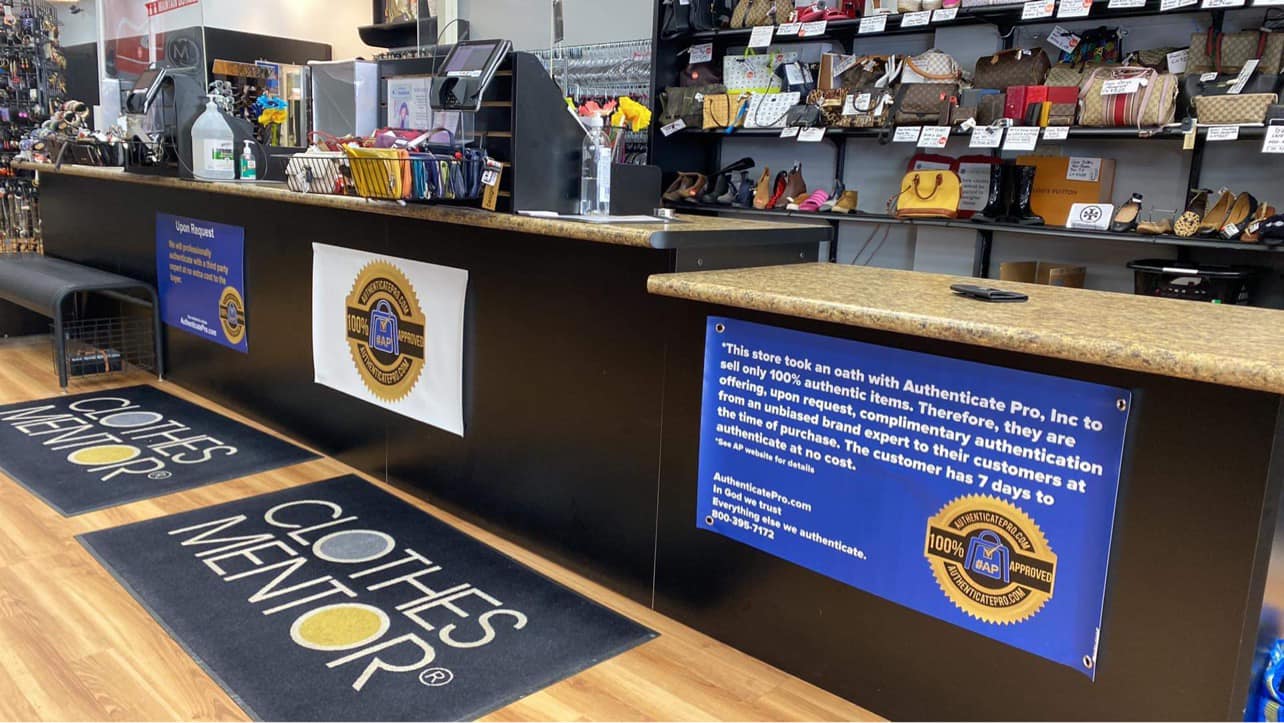
Clothes Mentor Reno described Authenticate Pro as a service that gave its staff and customers “peace of mind” and helped support sales of high-value branded goods. That is the right goal: not empty reassurance, but visible proof that your store has a system.
Build the strategy before you need it
A sign saying “We don’t sell fakes” may be worth displaying.
It should never be the entire plan.
A stronger counterfeit-risk program includes:
- Written intake standards
- Staff training
- High-risk brand and category rules
- Seller and supplier records
- Professional authentication
- Human expert escalation
- Item-level documentation
- Tamper-evident controls where appropriate
- A dispute-response procedure
- Legal and insurance review
The objective is not to claim that counterfeit risk can be reduced to zero.
The objective is to show that your business takes reasonable, repeatable steps to identify risk before selling an item.
That is better for your customers.
Better for your staff.
Better for your reputation.
And far better than trying to explain an empty promise after a counterfeit has already changed hands.
Need a more reliable process?
Authenticate Pro helps resale stores and pawn shops authenticate luxury items through a structured service that connects sellers and buyers with professional reviewers. Authentication requests move to human experts for the final review, with results reported at approximately 99% accuracy based on recent company results.
Learn more about the Authenticate Pro pricing options, review the membership program, or contact Authenticate Pro to discuss a process that fits your store.
A conversation is a low-pressure place to start.
Your sign can make a promise.
Your process should provide the proof.
Leave a Reply