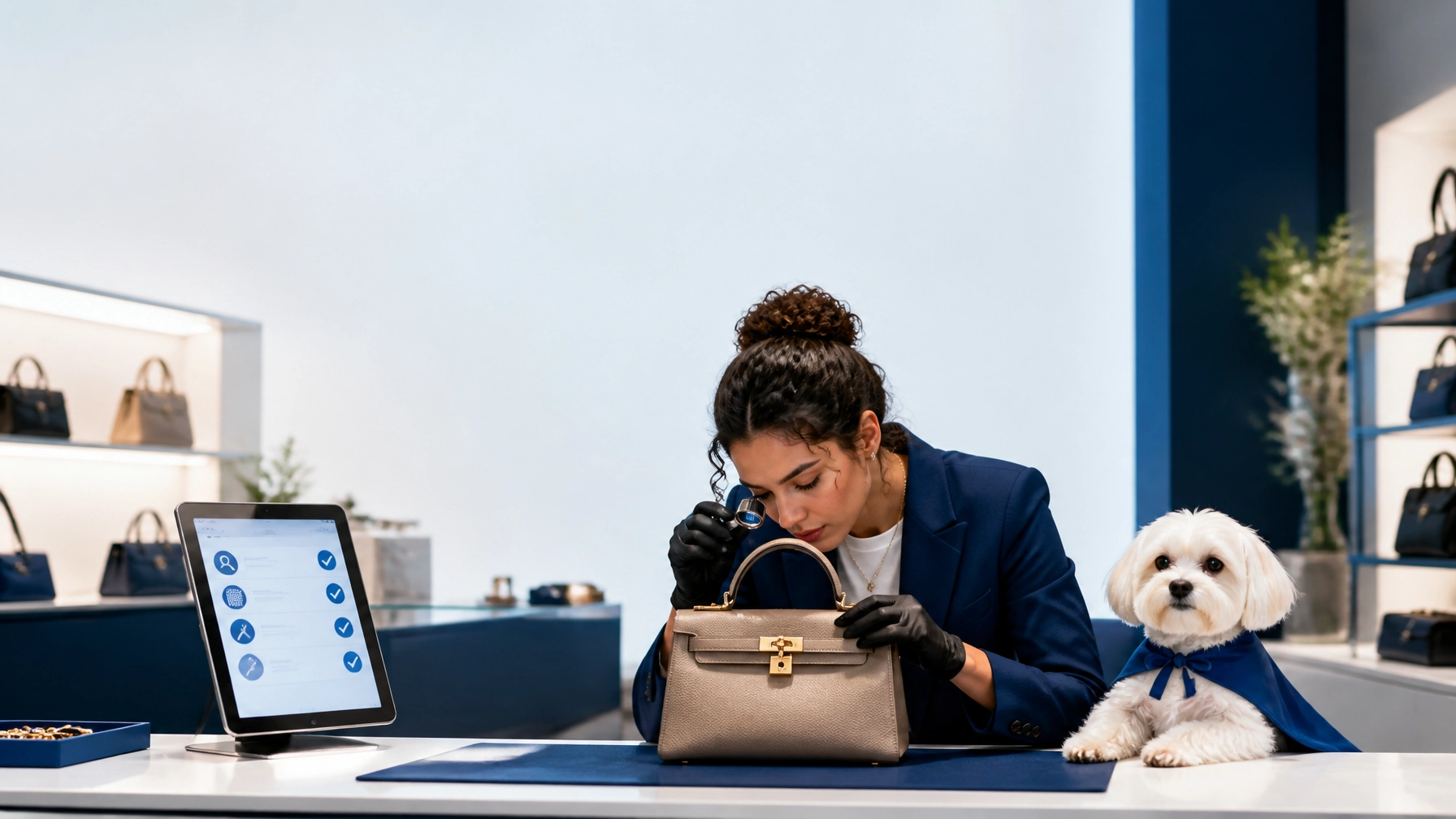
How many times a week does a customer ask, “Is this real?”
Your staff do not need to become expert authenticators overnight. They do need a consistent way to identify obvious red flags, protect your store, and know when to escalate an item for professional authentication.
The goal is not to make a definitive authenticity decision in one minute.
The goal is fast, repeatable counterfeit detection.
That distinction matters. A 60-second inspection can catch poor construction, incorrect markings, suspicious pricing, and other warning signs. It cannot reliably clear every high-value handbag, sneaker, or luxury item: especially modern superfakes.
Here is the training system resale stores, pawnshops, thrift shops, and online sellers can use.

Start With the Right Rule: Triage, Not Certification
Train staff to use this language:
- “Consistent with brand standards”
- “Not consistent with brand standards”
- “Requires escalation”
Avoid teaching employees to make absolute claims such as “This is definitely authentic” based only on a quick inspection.
Why?
Because counterfeiters have improved. Some fakes now copy:
- Materials
- Stitching patterns
- Packaging
- Serial numbers
- Date codes
- Receipts and authenticity cards
A quick inspection is a screening tool. It is not a replacement for a luxury authentication service.
The USPTO’s counterfeit goods guidance also emphasizes practical warning signs such as price, seller source, packaging, and product quality.
The 60-Second Luxury Item Inspection
Give every employee the same workflow. Consistency is more valuable than memorizing hundreds of brand-specific details.

0–10 Seconds: Check the Price and Provenance
Start before touching the item.
Ask:
- Where did you purchase it?
- How long have you owned it?
- Do you have a receipt, invoice, or original documentation?
- Has the item been repaired, altered, or restored?
- Why are you selling it today?
Then compare the price to realistic resale values.
A low price does not automatically mean counterfeit. People need quick cash. Items may have damage. Sellers may not know what they own.
But a price far below market value should increase the risk level.
Red flags at this stage
- Vague or changing ownership story
- No provenance for an unusually expensive item
- Seller refuses reasonable questions
- Price is dramatically below comparable resale listings
- Documentation appears generic, damaged, or mismatched
Do not let a receipt settle the question. Counterfeiters can reproduce paperwork.
10–25 Seconds: Assess the Overall Feel
Now handle the item.
Pay attention to:
- Weight
- Balance
- Material quality
- Flexibility
- Smell
- General finish
Luxury goods should feel deliberate and well-made. Hardware should not feel hollow or unusually light. Leather should not feel like thin plastic. A strong chemical odor can be a warning sign, although smell alone is never conclusive.
For sneaker authentication, check the overall shape and structure:
- Does the shoe hold its shape correctly?
- Do both shoes match in proportion?
- Does the sole feel consistent with the model?
- Are the materials and panels positioned correctly?
For handbag authentication, look at:
- Silhouette
- Handle shape
- Edge finishing
- Lining
- Structure
- Hardware weight
One minor difference is not enough to reject an item. Look for clusters of problems.
25–40 Seconds: Inspect Construction
Construction quality is one of the fastest ways to identify an obvious counterfeit.
Check:
- Stitching
- Seam alignment
- Pattern alignment
- Edge paint or glazing
- Symmetry
- Interior finishing
Authentic items can show wear, repairs, and manufacturing variation. A used bag will not look new. A vintage item may use older materials or different markings.
The question is not, “Does it look perfect?”
The question is, “Does the construction make sense for this brand, model, era, and condition?”
Common construction red flags
- Uneven stitch length
- Loose threads
- Crooked seams
- Misaligned monograms or quilting
- Excess glue
- Rough edge finishing
- Interior details that look rushed
- Hardware attached unevenly
Inspect hidden areas when possible. Counterfeiters often spend more time on visible surfaces than on interior pockets, underside seams, or attachment points.
40–52 Seconds: Check High-Value Details
The final inspection should focus on details that are difficult to reproduce correctly.
Logos and typography
Look for:
- Incorrect font shape
- Wrong letter spacing
- Poor centering
- Spelling errors
- Uneven embossing
- Logo placement that conflicts with seams or pattern alignment
Never rely on a single logo detail. Brands change fonts, stamps, and placements over time.
Hardware and engravings
Check:
- Weight
- Finish
- Plating quality
- Engraving clarity
- Screw type
- Zipper construction
- Lock and clasp movement
Cheap hardware often feels thin, sounds tinny, or shows inconsistent finishing. Again, use these observations as risk indicators: not as an instant verdict.
Serial numbers and date codes
Teach employees to confirm whether markings are:
- Present where expected
- Correctly formatted for the item’s era
- Cleanly stamped
- Consistent with the brand and model
A serial number is not proof of authenticity. Counterfeiters can copy real numbers or use numbers that look plausible.
For older items, the absence or presence of a particular code may be normal. Brand and era knowledge matter.
52–60 Seconds: Make the Risk Decision
At the end of the inspection, staff should assign one of three outcomes.
Low risk
The item’s:
- Story is plausible
- Price is reasonable
- Materials feel consistent
- Construction looks appropriate
- Markings appear credible
Action: Continue with your normal intake process. For high-value goods, still consider professional review.
Medium risk
There are one or two concerns, but no decisive issue.
Action: Hold the item. Request more information or detailed photos. Do not list it until the item passes your store’s review process.
High risk
There are multiple red flags, or the item is high value and difficult to authenticate.
Action: Decline the item or escalate it for professional authentication before purchase or resale.
High-risk categories often include:
- Designer handbags
- Limited-edition sneakers
- Luxury watches
- Rare streetwear
- High-value jewelry
- Items with unusual provenance
Use the Same Escalation Policy for Every Employee
A staff member should never be pressured to approve an item because:
- The customer is a regular
- The item appears profitable
- The store needs inventory
- The item “looks close enough”
- Another employee previously accepted it
Create written rules such as:
- Items above a set dollar value require external review
- All high-risk brands require professional authentication
- Any item with multiple red flags is held or declined
- No employee may override an escalation requirement
- No item is advertised as authentic until the review is complete
Authenticate Pro provides luxury authentication services for categories including handbags, sneakers, and other resale goods. The workflow uses AI-supported tools, but authentications move to human experts to achieve approximately 99% accuracy.
That human escalation is especially important for superfakes. A sophisticated counterfeit may pass a fast visual check. It needs a deeper review by an approved expert familiar with the relevant brand and category.
Train With Real Items, Not Just Slides
A strong staff program should include hands-on practice.
Build a training set with:
- Known authentic items
- Confirmed counterfeits
- Worn and damaged authentic items
- Different production eras
- Items with repairs
- Items with missing packaging
- Commonly faked models
Let employees handle each piece.
Have them compare:
- Weight
- Texture
- Smell
- Stitching
- Hardware
- Interior finishing
- Logo placement
Then run timed exercises.
Give each employee 60 seconds to inspect an item and record:
- Their risk level
- The red flags they observed
- The evidence they still need
- Whether escalation is required
Debrief every exercise. The lesson is not just whether the employee was right. It is whether they followed the process.

Give Staff a One-Page Checklist
Put the checklist at the intake counter and in your online seller workflow.
Fast counterfeit detection checklist
- Price and provenance are plausible
- Materials feel consistent with the brand and item
- No strong chemical or plastic odor
- Stitching is even and secure
- Seams and patterns align appropriately
- Hardware feels solid and correctly finished
- Logos and typography appear consistent
- Codes and markings fit the model and era
- Packaging and accessories are not mismatched
- No unresolved red flags remain
- High-risk items are escalated
A checklist prevents rushed decisions and makes training measurable.
Give Employees a Customer-Facing Script
Customers may feel offended when you ask questions or hold an item for review. Keep the explanation professional:
“We use the same review process for every luxury item. This quick inspection helps us identify obvious concerns. Because this item is high value, we may send it to a professional authenticator before we purchase or list it.”
If an item is rejected:
“We are unable to accept this item under our current authentication policy. We cannot confirm that it meets our standards.”
Do not accuse the customer of knowingly selling a fake unless you have verified facts and a clear internal policy for handling suspected counterfeits.
Refresh Training Every Month
Counterfeit detection is not a one-time lesson.
Schedule short monthly refreshers covering:
- New counterfeit trends
- Brand changes
- Commonly submitted models
- Recent staff mistakes
- Updated escalation rules
- New examples from professional reviews
Track your results:
- Number of items screened
- Number escalated
- Number rejected
- Number later confirmed counterfeit
- Brands and categories creating the most risk
This data will show where your team needs more training.
Build Trust With a Documented Authentication Process
Customers want confidence. Your employees need clarity. Your business needs protection.
The best process combines:
- Fast staff triage
- Clear documentation
- Consistent escalation
- Human expert review
- Transparent customer communication
Authenticate Pro’s Patented ACE Standards framework reinforces the principle behind a trustworthy authentication workflow:
Authentication · Community · Experts
Use your 60-second inspection to identify risk. Use professional authentication when the stakes are higher. That is how resale stores, pawnshops, and online thrifters can authenticate luxury items without making employees responsible for decisions beyond their training.
Ready to formalize your process? Review Authenticate Pro membership options or see current pricing.

Leave a Reply