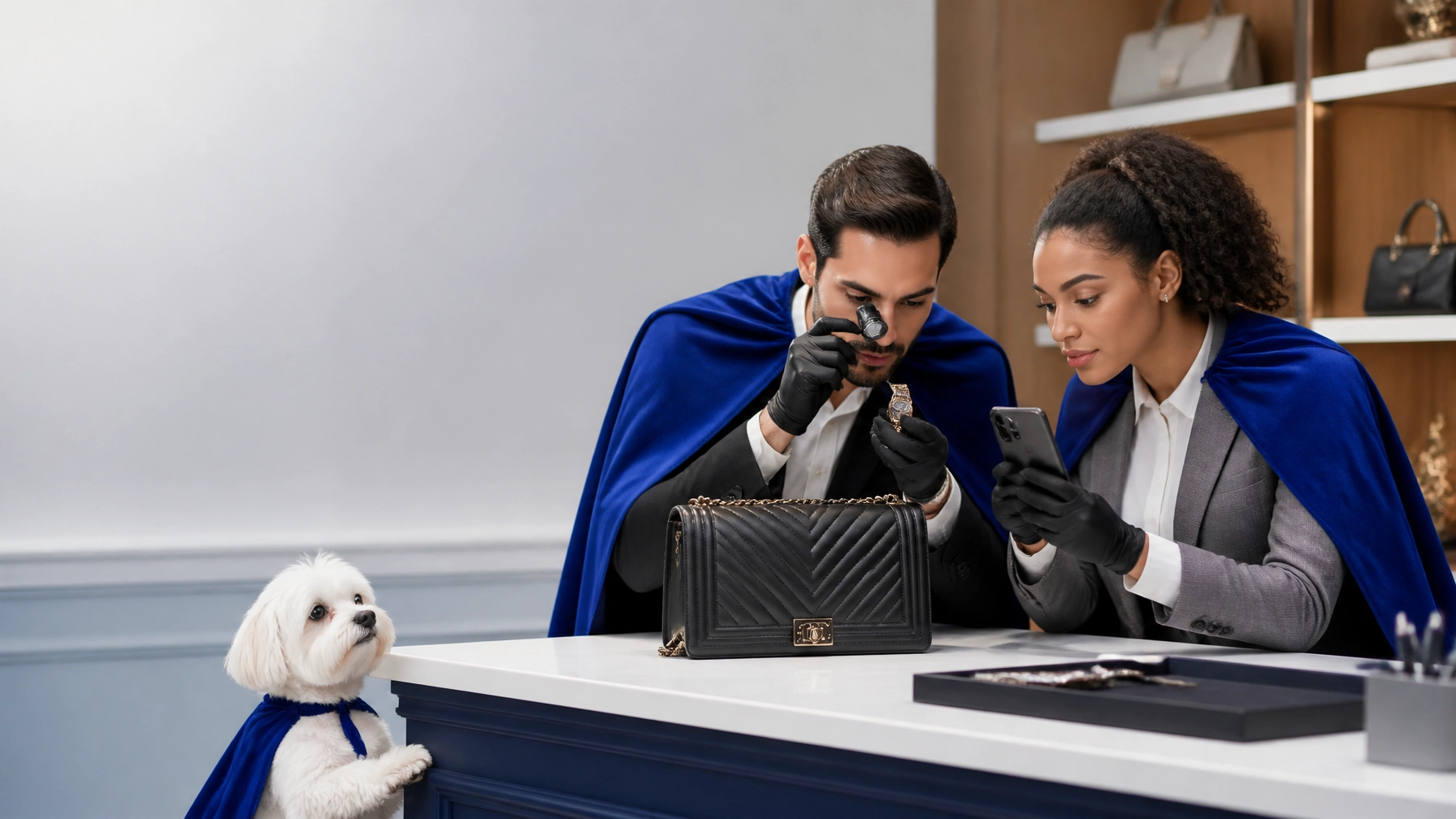
How many times a week does a customer ask, “Is this real?”
For resale stores, pawn shops, online thrifters, and TikTok sellers, the answer can affect more than one sale. A counterfeit item can lead to:
- Lost revenue
- Refunds and chargebacks
- Damaged customer trust
- Negative reviews
- Brand and marketplace complaints
- Staff uncertainty at the buying counter
Your team does not need to become a full-time authentication department overnight. They need a repeatable 60-second triage process.
The goal is simple:
✅ Identify obvious red flags
✅ Separate lower-risk items from higher-risk items
✅ Escalate uncertain or high-value items to a qualified human expert
❌ Do not treat a quick visual scan as a final authentication
Authenticate Pro’s process combines advanced technology with human expertise. Authentications move to human experts for review, helping achieve approximately 99% accuracy based on the company’s reported authentication results.
Here is how to train your staff to make the first decision quickly and consistently.
Start With the Right Expectation
The 60-second check is not designed to prove that an item is authentic.
It is designed to answer:
Should we proceed, pause, escalate, or reject?
That distinction matters. Skilled counterfeiters can copy packaging, serial formats, stitching, and even receipts. A confident-looking item can still require expert review.
Teach your staff this rule:
When the risk is high or the answer is unclear, escalate.
This protects your business and gives employees a clear next step instead of forcing them to guess.
The 60-Second Fake Check
Divide the inspection into four 15-second stages.
0–15 Seconds: Check the Price and the Story
Begin with the transaction, not the item.
Ask:
- Is the price far below the normal resale range?
- Does the seller have a clear explanation for the item?
- Where was it purchased?
- When was it purchased?
- Is proof of purchase available?
- Is the seller rushing the transaction?
- Do the details change during the conversation?
A low price does not automatically mean counterfeit. People need quick cash. They may not know the item’s value. They may be clearing out a closet.
But an unusually low price combined with an evasive story is a meaningful warning sign.
For online listings, review:
- Seller history
- Account age
- Feedback
- Previous listings
- Stock or reused photos
- Generic descriptions
- Claims that do not match the images
Train staff to record the concern without accusing the seller. Use neutral language:
“This item needs an additional review before we can finalize the transaction.”
15–30 Seconds: Scan Craftsmanship and Materials
Now inspect the physical item.
Look at the areas counterfeiters often rush:
- Stitching
- Seams
- Pattern alignment
- Edges
- Hardware
- Zippers
- Buttons
- Glazing
- Handles
- Interior finishing
- Weight and structure
Watch for:
- Uneven or inconsistent stitching
- Loose threads
- Misaligned patterns
- Flimsy hardware
- Poorly finished edges
- Cheap-feeling materials
- Excessive glue
- Unexpected lightness or stiffness
Do not teach employees to rely on one detail. A single loose thread does not prove an item is fake. Authentic items can show wear, repairs, or manufacturing variation.
Instead, teach them to look for multiple inconsistencies.
The best training tool is a side-by-side comparison. Keep known authentic examples, approved reference photos, or brand-specific guides available at the buying station.

30–45 Seconds: Inspect Branding, Labels, and Codes
Counterfeit items often reveal themselves in small details.
Have staff check:
- Logo shape and spacing
- Font and lettering
- Misspellings
- Label placement
- Date codes or serial formats
- Engraving quality
- Tag construction
- Packaging and dust bags
- Included cards or booklets
The question is not simply, “Does it have a serial number?”
The better question is:
Is the serial number, code, or label consistent with this brand, model, material, and production period?
A serial number alone is not proof of authenticity. Counterfeiters frequently copy legitimate numbers and reuse them across multiple items.
Online staff should also inspect the listing images carefully. Ask for clear photos of:
- Front and back
- Interior
- Logo
- Hardware
- Stitching
- Date code or serial area
- Base or sole
- Packaging
- Any flaws or repairs
If the seller refuses reasonable close-up photos, uses only stock images, or crops every identifying detail, pause the listing.
45–60 Seconds: Make the Risk Decision
At the end of the minute, staff should place the item into one of three categories.
✅ Proceed
Use this category only when:
- The price is reasonable
- The seller’s information is consistent
- Craftsmanship looks correct
- Branding appears consistent
- No major red flags are present
Proceeding does not always mean skipping authentication. For expensive luxury goods, your policy may still require an expert review.
⚠️ Escalate
Escalate when:
- One major red flag appears
- Several smaller concerns appear
- The item is high value
- The category is commonly counterfeited
- Staff members disagree
- The seller pressures the employee
- The item will be advertised as authenticated
High-risk categories often include:
- Designer handbags
- Luxury watches
- Jewelry
- Sneakers
- Streetwear
- Limited-edition collectibles
- High-value accessories
This is where a professional authentication workflow matters. Authenticate Pro allows sellers to upload clear item photos for review. The process uses pre-authentication, expert review, and final conclusions. Authentications move to human experts to support approximately 99% accuracy.
❌ Reject or Hold
Hold or reject the item when:
- The item has several serious inconsistencies
- The seller cannot provide basic information
- The item appears materially different from known authentic examples
- The seller refuses required photos or documentation
- Your internal policy identifies the item as unacceptable risk
Document the reason. Do not rely on memory.
Build a Simple Staff Checklist
Place a short checklist at the counter, in your buying software, or beside the photography station.
60-Second Checklist
1. Price and story
- Price is within a reasonable range
- Seller’s story is clear and consistent
- Purchase information is available when appropriate
2. Craftsmanship
- Stitching and seams look consistent
- Materials and weight feel correct
- Hardware and finishing show no obvious concerns
3. Branding
- Logo, font, and spacing look correct
- Labels and codes are in expected locations
- Packaging and accessories are consistent
4. Decision
- Proceed
- Escalate to manager or expert
- Hold or reject
- Photograph and document concerns
Keep the checklist short. If it takes several minutes to read, employees will stop using it during busy periods.
Train With Realistic Drills
One long training session is not enough.
Use short, repeated practice:
- Show one authentic item and one counterfeit example
- Give staff 60 seconds to identify concerns
- Ask what they noticed first
- Have them explain the decision
- Discuss which findings require expert escalation
Run these exercises weekly for five minutes. Rotate the category:
- Week one: handbags
- Week two: sneakers
- Week three: watches
- Week four: jewelry
- Week five: online listing photos
Focus on reasoning, not just the final answer. An employee who says “fake” without explaining why has not learned a reliable process.
Train Online Sellers Differently
TikTok sellers, online thrifters, and marketplace teams may not have the item in front of them during the buying decision.
Their 60-second review should focus on:
- Photo quality
- Seller history
- Price compared with market value
- Description consistency
- Close-ups of logos and codes
- Reused or stolen images
- Missing angles
- Pressure to buy immediately
Ask sellers for additional images before publishing or purchasing. A professional photography process also helps. Use consistent angles for every item so staff can compare products more efficiently.

Create a Clear Escalation Policy
Your staff should never wonder who to contact when something feels wrong.
Write down:
- Which categories require review
- What dollar amount triggers escalation
- Who gives the final internal approval
- Which photos are required
- How concerns are documented
- When an outside authentication service must be used
- What happens if an item is found to be counterfeit
Make “pause and escalate” an approved action. Employees should not feel punished for being cautious.
For stores using Authenticate Pro, options include Mini Check, Quick Check, Express Authentication, and Level 2 Authentication, depending on the item and the level of review needed. Review the current membership options and pricing before building them into your store policy.
Protect the Customer After the Sale
Authentication is also a customer-service tool.
Authenticate Pro’s resale-store program can help businesses provide authentication support after a purchase. The company’s program includes options such as an AP Ziptie, report lookup, and customer authentication processes, depending on the service and store arrangement.
This gives customers an additional layer of confidence when purchasing expensive items.
As one Clothes Mentor location explained:
“It gives our customers the utmost confidence when purchasing high-dollar authentic brand name goods which in return has helped increase our sales.”
That confidence matters. Customers remember how your store handled uncertainty.
The Fastest Staff Training Plan
Use this four-week rollout:
Week 1: Teach the process
Introduce the four 15-second stages. Make sure every employee understands the difference between triage and final authentication.
Week 2: Practice with examples
Use authentic and counterfeit examples. Run 60-second drills.
Week 3: Add role-specific training
Train buyers on physical inspection. Train online teams on photos, seller history, and listing details.
Week 4: Measure and improve
Track:
- Items escalated
- Items rejected
- Counterfeits identified
- Near-misses
- Average review time
- Staff confidence
- Customer questions
Update the checklist as new counterfeit patterns appear.
Make the 60-Second Check Part of Your Culture
Your staff does not need perfect instincts. They need a dependable system.
Teach them to:
- Check the price and story.
- Scan craftsmanship and materials.
- Inspect branding and codes.
- Make a clear risk decision.
- Escalate uncertainty to human experts.
A one-minute screen can reduce careless purchases. A documented escalation process can protect your reputation. Professional authentication can give your staff and customers the confidence that a quick visual check cannot provide on its own.
For more information, visit Authenticate Pro or contact the team at 800-395-7172 to discuss authentication support for your resale business.

Leave a Reply