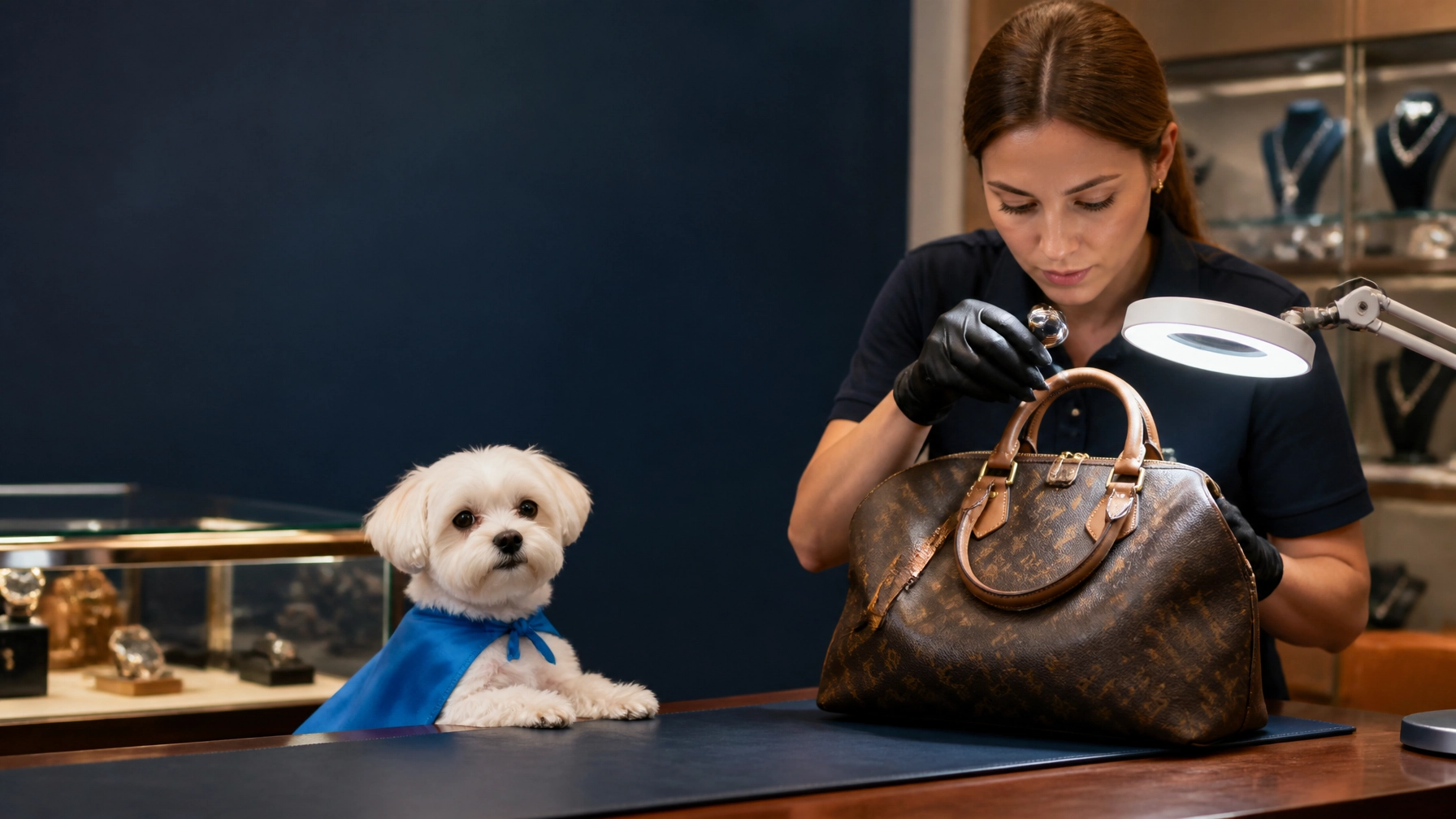
A Louis Vuitton handbag can represent serious value for a pawn shop.
It can also represent serious risk.
How many times a week does a customer ask, “Is this real?” When the answer affects a loan, purchase price, resale listing, or your store’s reputation, a quick glance is not enough.
Counterfeits are better than they used to be. Some reproduce date codes, heat stamps, hardware, and packaging. No single detail proves authenticity. The safest approach is a repeatable inspection process that combines physical examination, model research, documentation, and expert review.
This guide gives your team a practical starting point.
Important: This is an educational checklist, not a final authentication determination. For high-value, unusual, or questionable items, use a professional authentication service before you put money at risk.
Start with the big picture
Before checking a date code or logo font, take 30–60 seconds to assess the bag as a whole.
Look for:
- Balanced proportions
- Clean, even seams
- Structured construction
- Consistent panel alignment
- Smooth edge finishing
- Quality materials
- Hardware with appropriate weight
Does the bag feel solid and intentional? Or does it feel flimsy, overly plastic, uneven, or poorly finished?
A Louis Vuitton bag should not look perfect simply because it is authentic. Used bags can show wear, stains, repairs, fading, and patina. The question is whether the construction and aging make sense for the model and claimed history.

1. Inspect the monogram or Damier pattern
Louis Vuitton’s canvas patterns are carefully placed. They are not random decorations.
On many classic Monogram styles:
- The pattern appears balanced across major panels.
- The LV initials and floral motifs follow a predictable layout.
- The front pattern is usually positioned intentionally around seams and hardware.
- The canvas may appear upside down on certain sections because of how the material is cut and wrapped.
That last point matters. An upside-down pattern is not automatically a counterfeit indicator. It depends on the model and construction.
The better question is:
Does the pattern placement match authentic examples of this exact style?
Check the bag against trusted references for the model, size, canvas, and production era. A counterfeit may use a generally familiar print but place the flowers, squares, or initials incorrectly.
2. Check the canvas, leather, and edge glazing
Classic Louis Vuitton bags often combine coated canvas with natural vachetta leather.
Coated canvas
Authentic coated canvas should feel structured and durable. It should not feel like thin plastic or soft vinyl. The surface may have texture and should retain the expected shape for the model.
Vachetta leather
Untreated vachetta commonly starts pale and gradually develops a honey or caramel patina. Natural aging is not always perfectly uniform. It can vary based on handling, sunlight, moisture, and use.
Be cautious when:
- A supposedly old bag has completely fresh-looking leather.
- The leather is darkened in a perfectly even way.
- The trim feels stiff or plastic-like.
- The leather has a strong chemical or dye smell.
- The edge glazing is lumpy, bubbling, cracked, or inconsistent.
Repairs can complicate this inspection. A genuine bag may have replacement handles, refinished leather, or restored glazing. Those issues affect condition and value, but they do not automatically make the bag counterfeit. Document them separately.
3. Examine the stitching
Stitching is one of the most useful construction checks.
Look for:
- Even stitch spacing
- Straight stitch lines
- Secure thread ends
- Consistent thread color
- Clean reinforcement at stress points
- No loose threads or bunching
On many classic brown Louis Vuitton pieces, stitching has a mustard or yellow tone. The exact appearance can vary by model, material, and age, so do not judge color alone.
The key is consistency. Counterfeit bags often show irregular stitch length, crooked lines, weak reinforcement, or thread that looks too bright, too dull, or synthetic.
Inspect handles, tabs, side laces, corners, pockets, and zipper bases. These areas receive stress and often reveal shortcuts.
4. Evaluate the hardware
Hardware should feel appropriate for the item’s size, age, and model.
Check:
- Weight
- Finish
- Color
- Movement
- Engraving quality
- Signs of wear
Genuine hardware is typically substantial and smoothly finished. It should not feel hollow, flimsy, sharp, or excessively lightweight.
Engravings should be crisp and evenly spaced. Look closely at zipper pulls, locks, rings, snaps, feet, and decorative plaques. Shallow, fuzzy, crooked, or poorly centered lettering deserves further review.
Hardware can show wear on an authentic vintage bag. Tarnishing or loss of plating is not an automatic fail. The concern is whether the finish, construction, and aging are consistent with the item.
5. Review the heat stamp and logo font
The interior heat stamp is important, but it is not conclusive.
Inspect:
- Letter shape
- Spacing
- Depth of the stamp
- Alignment
- ® symbol placement
- “Made in” wording
- Location within the bag
Louis Vuitton lettering has distinctive proportions. For example, authentic examples generally show clean, thin lettering, very round O shapes, and tightly spaced letters in “VUITTON.”
Fakers can copy a familiar logo, so do not stop at “the font looks right.” Compare the stamp with known examples from the same model and era. A correct-looking stamp on a bag with wrong materials or sloppy stitching is still a problem.
6. Understand date codes and microchips
This is where many pawn shop inspections go wrong.
Louis Vuitton phased out visible date codes around 2021 and moved to embedded RFID or NFC-style identification systems in newer items. That means:
- A pre-2021 bag may have a stamped date code.
- A newer bag may not have a visible date code.
- The absence of a date code does not automatically mean the item is fake.
- A date code does not prove authenticity.
Older date codes can indicate a claimed factory and production period. They must make sense for the model. A code that conflicts with the bag’s design, country stamp, or claimed age is a red flag.
Counterfeiters regularly copy real date codes. Treat the code as one piece of evidence, not a final answer.
For additional background, Real Authentication’s Louis Vuitton date code guide explains why a verified code is not, by itself, an official authenticity determination.
7. Confirm the interior and model configuration
The inside of the bag must match the specific model.
Check:
- Lining material
- Lining color
- Pocket layout
- Interior stamp placement
- Leather tabs
- Zipper construction
- Included pouch, lock, or keys
- Hardware color
Fakes often combine details from different models. A Neverfull may have the wrong lining. A Speedy may have the wrong lock or interior layout. A Pochette may use hardware from another style.
Ask a simple question:
Did Louis Vuitton actually produce this exact combination of model, size, print, lining, and hardware?
Search for the style using reliable references. A receipt, box, dust bag, or authenticity card is supporting evidence only. Packaging can be faked, replaced, or mismatched.
8. Consider the smell and tactile feel
Use this as a supporting check, not a verdict.
A genuine coated-canvas and leather item may have a faint canvas or leather scent. A strong chemical, glue, or plastic odor can indicate poor materials or recent treatment.
Also feel:
- The canvas surface
- The stiffness of the structure
- The softness and grain of the leather
- The smoothness of the zipper
- The weight of the hardware
Your team should handle authentic items regularly. Familiarity improves speed, but it does not replace a documented process.

Build a pawn shop authentication workflow
A checklist protects your store from rushed decisions and inconsistent training.
For every Louis Vuitton intake:
- Photograph the entire item.
- Capture close-ups of the pattern, stitching, hardware, heat stamp, date code area, lining, and damage.
- Record the model, size, colorway, condition, and seller’s stated history.
- Compare the configuration with reliable model references.
- Require a second review for high-value pieces.
- Escalate uncertain items before finalizing the loan or purchase.
- Save the inspection notes with the transaction record.
Use a simple decision structure:
- ✅ Consistent details: Continue with valuation and documentation.
- ⚠️ One unexplained concern: Hold for second review.
- ❌ Multiple conflicting details: Decline or submit for professional authentication.
Do not let a low price create urgency. A bargain is not a bargain if the item becomes a counterfeit loss, a customer dispute, or a reputation problem.
When to escalate to human experts
Internal knowledge is valuable. It is not unlimited.
Escalate when:
- The item is high value.
- The model is unusual or vintage.
- The bag has been repaired or customized.
- The date code and claimed age do not align.
- The seller’s story changes.
- Several details feel “almost right” but not right.
- Your team cannot confirm the exact configuration.
- The offer would create meaningful financial exposure.
Authenticate Pro’s patented process combines advanced AI screening with human expertise. Items can move from pre-authentication to human experts for review, with authentications escalating to qualified experts to achieve approximately 99% accuracy based on the company’s reported results.
That escalation matters. AI can help organize images and identify potential red flags. Human experts evaluate the item in context and make the final conclusion.
For resale stores and pawn shops, the workflow is designed around speed and documentation. Visit the Authenticate Pro Membership page to review reseller options, or see current service choices on the pricing page.

The bottom line
When Louis Vuitton walks into your pawn shop, do not rely on one stamp, one code, or one confident seller.
Check the full picture:
- Pattern alignment
- Material quality
- Natural aging
- Stitching
- Hardware
- Heat stamp
- Date code or chip-era logic
- Interior configuration
- Model plausibility
- Seller documentation
Then escalate when the risk justifies it.

A consistent process gives your staff a clear next step, helps protect your margin, and gives customers more confidence in the merchandise you sell.
For more information about Authenticate Pro’s authentication workflow, visit AuthenticatePro.app or call 800-395-7172.
Leave a Reply